Main Points
- Seven phases take a team from unclear goals to a steady delivery rhythm.
- Phases 1 to 4 need written outputs before the first sprint starts.
- Build the delivery pipeline early, because it decides whether short cycles are safe.
- Inspect and adapt every sprint with one improvement experiment.
Most teams do not need a new methodology, they need a clear order of steps. This framework has seven phases that take a team from unclear goals to a steady delivery rhythm. It borrows from Scrum and Kanban and leaves out the parts that rarely matter for a team of a few dozen people. If you want guidance fitting it to your organization, agile software consulting can run the first phases with you.
The phases overlap in practice, and the last two repeat for as long as the product lives.
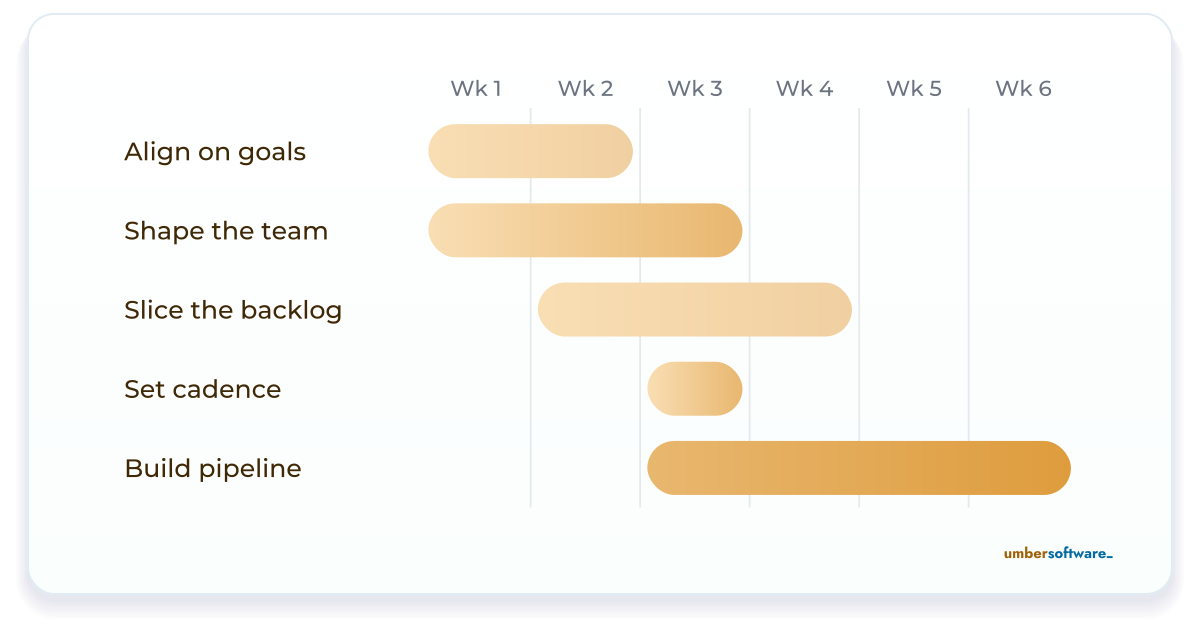
The Framework at a Glance
| Phase | Timing | Owner | Output |
|---|---|---|---|
| Phase 1: Align on Goals and Constraints | Weeks 1 to 2 | Product owner, sponsor | A one-page product goal, constraints and success measures |
| Phase 2: Shape the Team and Roles | Weeks 1 to 3 | Sponsor, engineering lead | A cross-functional team with a named product owner |
| Phase 3: Build and Slice the Backlog | Weeks 2 to 4 | Product owner, team | A ranked backlog with the top 15 to 20 items ready |
| Phase 4: Set Cadence and Working Agreements | Week 3 | Whole team | Sprint length, meeting schedule, definition of done |
| Phase 5: Build the Delivery Pipeline | Weeks 3 to 6 | Developers, DevOps | Automated build, tests and deployment |
| Phase 6: Run Sprints and Show Real Software | Ongoing, every sprint | Whole team, stakeholders | A working increment and feedback every sprint |
| Phase 7: Inspect, Measure and Adapt | Ongoing, every sprint | Whole team | One improvement experiment per sprint |
The Seven Phases, Step by Step
Phase 1: Align on Goals and Constraints
Before any sprint, agree on why the product exists, who it serves and what limits you face: budget, date, compliance and team size. Write a product goal in one or two sentences and three to five measures of success, such as activation rate or support tickets per user. Skipping this phase is the most common reason teams drift into feature factories.
Key steps:
- List the users and the problem you solve for them.
- State fixed constraints separately from preferences.
- Choose success measures you can read from data.
- Get the sponsor to sign off in writing.
Phase 2: Shape the Team and Roles
Form a team of five to nine people who can design, build, test and release without waiting on others. Name a product owner with real decision authority and a facilitator, often called the scrum master, who removes obstacles. A team split across handoffs cannot deliver in short cycles, so remove those handoffs if you can.
Key steps:
- Check that all needed skills sit in the team.
- Name one product owner and make their availability explicit.
- Agree on working hours overlap for distributed members.
- Write down decision rights: who decides scope, design and release.
Phase 3: Build and Slice the Backlog
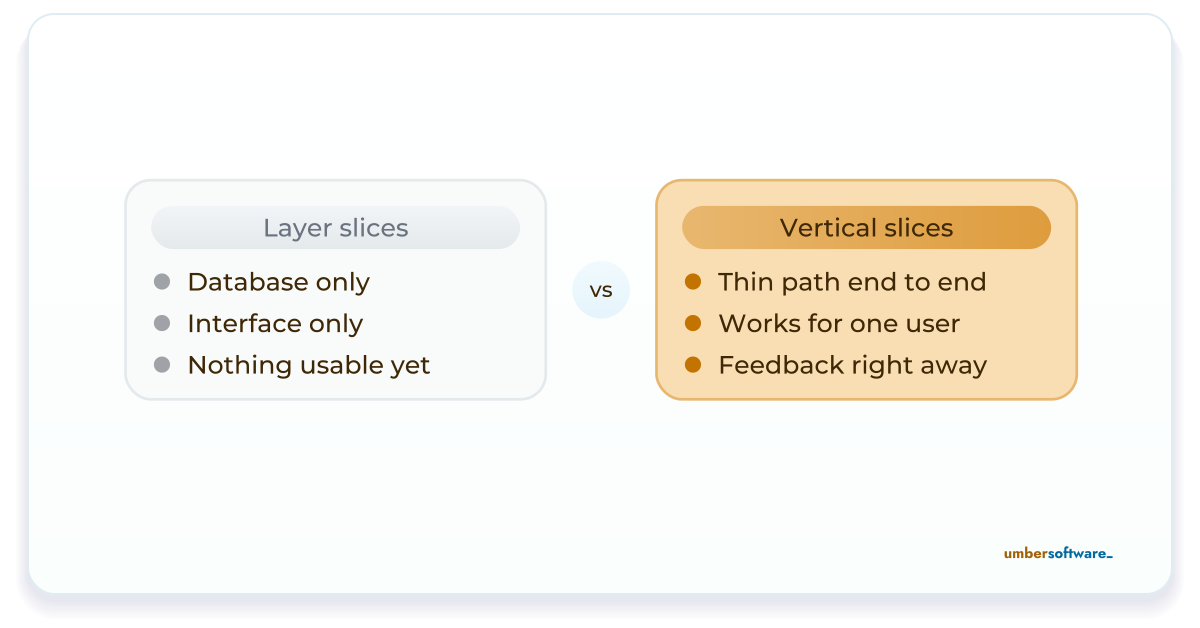
Turn goals into stories small enough to finish in two to four days. Slice by user value, not by technical layer, so every story ships something a person can use. Rank by value and risk, and keep only the next two sprints in detail. A huge detailed backlog is a liability that goes stale.
Key steps:
- Write each story with a user, a need and acceptance criteria.
- Split anything bigger than a few days.
- Rank by value, risk and dependency.
- Review the top items together before planning.
Phase 4: Set Cadence and Working Agreements
Choose a sprint length, usually two weeks, and a rhythm for planning, daily sync, review and retrospective. Keep meetings short and purposeful. Write a definition of done that includes testing and review, plus working agreements for handling blocked work and urgent requests. Kanban teams replace sprints with work-in-progress limits and a regular cadence for review.
Key steps:
- Pick a sprint length and keep it fixed for at least a quarter.
- Time-box each meeting and publish the agenda.
- Write the definition of done and post it on the board.
- Agree how urgent work interrupts the sprint, if at all.
Phase 5: Build the Delivery Pipeline
Short cycles only work if releasing is cheap and safe. Automate builds and tests on every commit, set up a staging environment and make deployment one step. Add code review rules and quality gates. This is the phase teams most often postpone, and it determines whether agile actually delivers speed.
Key steps:
- Set up continuous integration on the main repository.
- Add automated unit and API tests for new code.
- Create a staging environment that mirrors production.
- Automate deployment and rehearse a rollback.
Phase 6: Run Sprints and Show Real Software
Plan the sprint around a goal, build and test continuously and end with a review where stakeholders use the software. Collect feedback and feed it into the backlog. Do not demo slides. The review is the main control point for the product, because it is when real users or their proxies tell you what is wrong.
Key steps:
- Define one sprint goal in a single sentence.
- Track progress on a visible board.
- Demo working software, not screenshots.
- Capture feedback as backlog items right away.
Phase 7: Inspect, Measure and Adapt
End each sprint with a retrospective and a short look at cycle time, throughput and escaped defects. Choose one improvement to try and write down the owner and the expected effect. Adaptation is the part of agile that most organizations drop first, and it is where long-term gains come from.
Key steps:
- Review the numbers before discussing opinions.
- Pick one change, not five.
- Assign an owner and a date.
- Check the result at the next retrospective.
What the First 30 Days Look Like
A framework on paper means little until you see it on a calendar. Here is a realistic first month for a team of seven that has never worked in short cycles.
Week 1: Decide and Write Down
The sponsor, the product owner and the engineering lead meet twice. They produce the one-page product goal, the constraints and the success measures. They also name the team members and agree who decides what. Nothing is built yet, and that is intended.
Week 2: Slice and Rank
The product owner and two developers turn the goal into a first backlog of 20 to 30 stories. Anything bigger than a few days gets split. The team reviews the top ten, asks questions and rewrites unclear criteria. A first version of the definition of done appears on the wall or the wiki.
Week 3: Set Up the Rhythm
The team picks a sprint length, schedules the meetings and sets up its board. A developer starts the continuous integration pipeline, even if it only runs a build and a handful of tests. Everyone agrees how blocked work and urgent requests will be handled.
Week 4: Run the First Sprint
Sprint one starts with a small, safe goal, and the team expects it to be messy. The review at the end shows whatever works, even if it is small. The retrospective picks one improvement. By the end of month one you have a team with a rhythm, a backlog worth trusting and the first real feedback from users.
Expect the first two sprints to deliver less than the team hopes, since planning and estimation take time to calibrate. Resist the urge to add pressure. Velocity and cycle time stabilize after three or four sprints, and forecasts become useful after that.
Who Does What in the Framework
Role confusion causes more friction than any process gap. These responsibilities hold in most teams.
| Role | Owns | Does not own |
|---|---|---|
| Product owner | Backlog order, acceptance, trade-offs on scope | How the team builds the work |
| Developers and testers | Estimates, design, quality of the increment | Priorities and deadlines set without them |
| Facilitator | Meeting flow, removing obstacles, coaching the team | Managing individual performance |
| Sponsor | Funding, constraints, removing organizational blockers | Day-to-day decisions about stories |
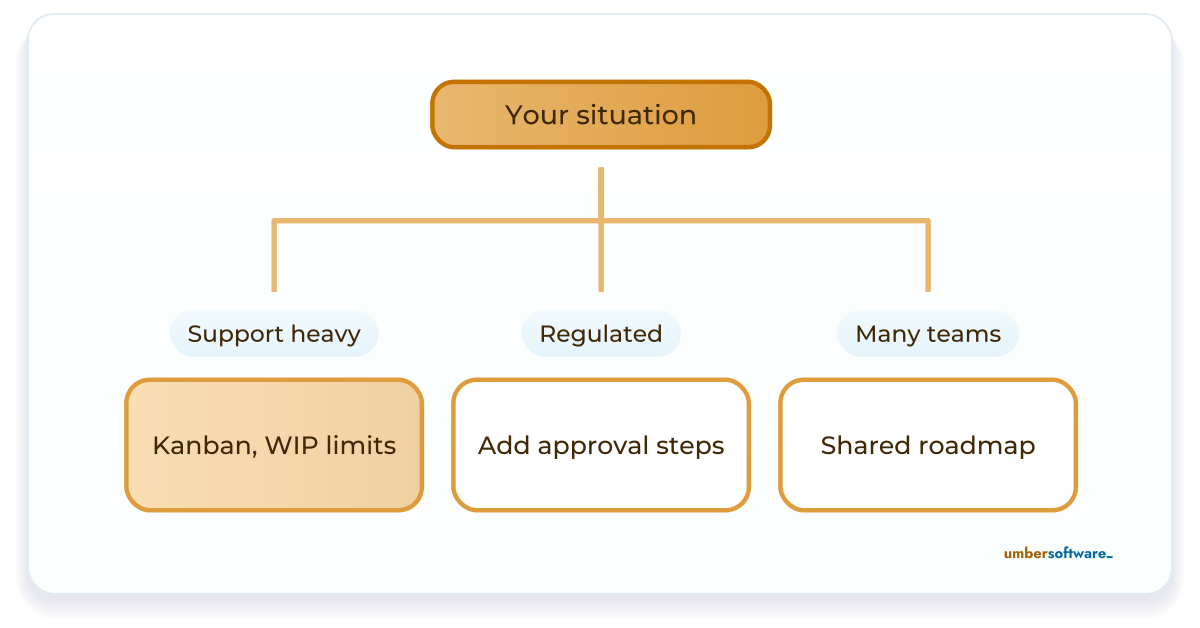
Adapting the Framework to Your Situation
The phases hold for most teams, but the details shift with size and context.
| Situation | What to change |
|---|---|
| One small team | Merge phases 2 and 4 and keep one sprint cadence |
| Several teams on one product | Add a shared roadmap and a short cross-team sync, and keep teams loosely coupled |
| Regulated product | Add traceability and approval steps to the definition of done, and automate evidence capture |
| Unpredictable support-heavy work | Use Kanban with work-in-progress limits instead of fixed sprints |
| Distributed team across time zones | Use written handoffs, shorter live meetings and a larger overlap window for planning |
Pick the tracker that makes this easy, and keep the setup simple. My comparison of agile software development tools shows which products handle sprints, Kanban or both. To know whether the framework works, track the numbers in my guide to agile software development metrics. If your leadership is still unsure about adopting it, the agile software development pros and cons article gives a balanced view.
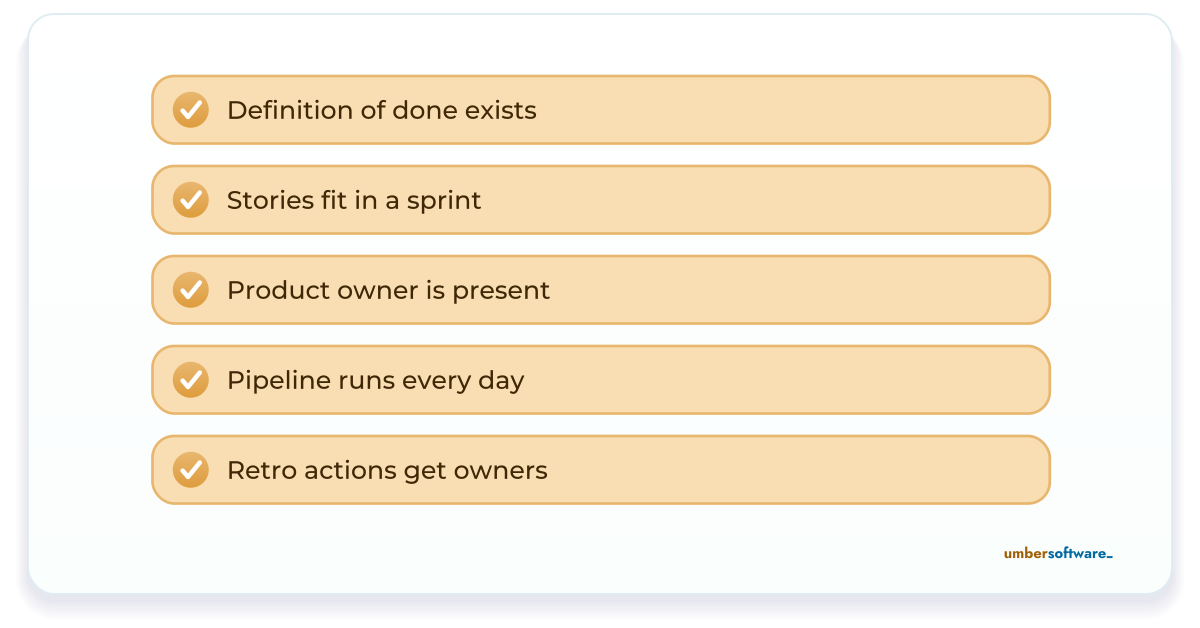
Mistakes That Derail the Framework
- Naming a product owner who has no authority to decide.
- Starting sprints before the delivery pipeline can release safely.
- Letting the backlog grow into hundreds of detailed items nobody reads.
- Treating the retrospective as optional when deadlines tighten.
- Changing sprint length every few weeks, which destroys any ability to forecast.
Each one is easy to avoid when you spot it early. Review the list during the first retrospective and again after a quarter, because the same habits creep back. A useful test is to ask each team member to name the one thing that would make next sprint better. If the answers keep pointing at the same bottleneck, such as slow reviews or unclear stories, that bottleneck belongs at the top of your improvement list, ahead of any new ceremony or tool. Build the review into the calendar and give it an owner, and the framework will keep working as the team and product change.
Sources
Questions About the Agile Software Development Framework
What Is an Agile Software Development Framework?
It is a structured set of roles, events and practices for delivering software in short cycles. Scrum, Kanban and XP are well-known examples, and many teams combine elements of them into their own model.
Which Agile Framework Should I Choose?
Pick based on how your work arrives. Scrum suits product teams with planned increments, Kanban suits support or operations work with constant incoming requests, and hybrids fit teams that need both. Start simple and adjust.
How Long Does It Take to Implement an Agile Framework?
Setting up goals, team, backlog and cadence takes about three to four weeks. Building the delivery pipeline may take a few more. Real improvement shows over several sprints.
How Long Should a Sprint Be?
Two weeks works for most teams. One week suits fast-moving work with tiny stories, and four weeks is the upper limit of the Scrum Guide. Keep the length fixed for at least a quarter so metrics stay comparable.
Do I Need a Scrum Master?
You need someone to facilitate and remove obstacles. In small teams a senior developer can do it part-time, while larger programs benefit from a dedicated person. The role matters more than the title.
Can a Framework Work Without Test Automation?
Only for a short time. Frequent releases need fast, repeatable checks. Without automation, regression testing grows with every sprint and eventually consumes the team's time.
How Do I Scale an Agile Framework?
Keep teams small and independent, align them on a shared roadmap and cadence and manage dependencies explicitly. Add scaling frameworks only when simple coordination stops working.
Please note: this guide is general information and not legal, financial or tax advice. Numbers and examples are typical-project estimates; confirm current details with your providers and advisers.
Did this article help you?
Thanks, noted.
Whitney Sorensen
Whitney leads the Umber editorial team and works with the consultants to turn real client projects into practical guides on software selection, custom development, integration and legacy modernization. Before joining Umber, she spent years writing and editing for engineering and IT teams. She has since reviewed architecture audits, system selections and modernization plans from client projects across industries from manufacturing to healthcare. She works remotely from the USA.