Main Points
- Preparation beats persuasion: usage data and a ranked list of priorities do most of the work.
- Every promise that matters has to be in the contract, in the same precise language as the price.
- One lead negotiator and a short review round with IT, finance, security and legal prevent costly surprises.
- A contract register keeps you ready for the next renewal.
Best practice in contract work means habits that hold up when the vendor pushes back, the deadline is close and three people in your company want different things. These seven come from software deals I have supported, from small subscriptions to multi-year platform agreements. If you would like support on a live negotiation, software contract negotiation consulting is built around the same habits.
For quick wins on a specific term, my list of software contract negotiation tips is a better starting point. This article is about the process around those tips, so that they get used when it counts.
The Seven Practices at a Glance
| Practice | Good sign | Warning sign |
|---|---|---|
| 1. Prepare with evidence | Usage data and alternatives on the table | You rely on the vendor's numbers |
| 2. Rank your priorities | A written list with trade-offs agreed | Every term is "important" |
| 3. Name one lead | A single voice to the vendor | Three people email the sales rep |
| 4. Write every promise down | Commitments sit in the order form | "Sales said it would be included" |
| 5. Run a short review round | IT, finance, security and legal each sign off | One person reads the whole document |
| 6. Plan the exit at signing | Export, transition and notice terms agreed | "We will think about leaving later" |
| 7. Keep a register | Dates and owners are reviewed quarterly | A renewal appears as a surprise invoice |
Notice how little of this is about clever tactics. Most of it is organization, and organization is what vendors count on you not having.
1. Prepare With Evidence Before Anyone Talks Price
A vendor's first proposal is built on their view of your usage, your budget and your alternatives. Replace those assumptions with your own facts. Collect twelve months of usage, the current contract terms, the real number of active users and quotes or estimates from at least one other supplier.
Include internal facts too. If a major reorganization will cut headcount next year, or a project will double your volume, decide how much of it to share and when. Surprising yourself at renewal is expensive. Surprising the vendor with a plan you have already modeled is useful.
When the category is new to you, ask peers what they pay. Industry contacts, user groups and independent advisers often have better benchmarks than any list price, and a realistic range keeps you from anchoring on the vendor's first offer.
2. Rank Your Priorities and Decide What You Will Trade
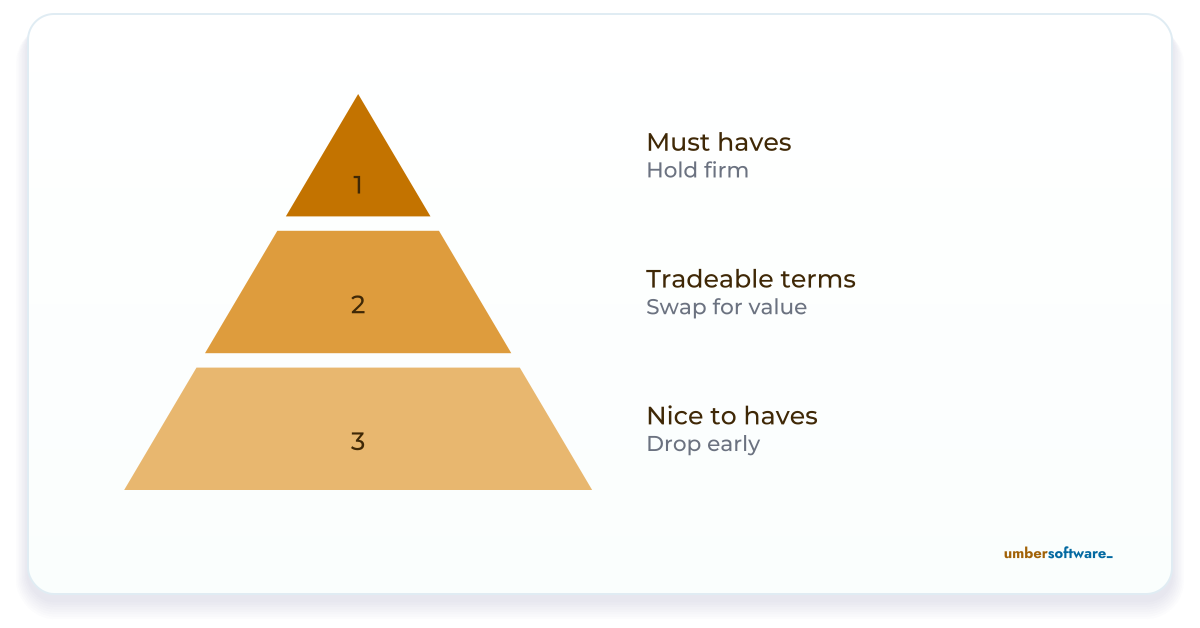
Negotiations stall when every term feels equally important. Before the first meeting, write down ten terms and put them in order. Decide which three you must win, which three you want and which four you will give away.
The list also protects you from your own team. The business owner may insist on a feature bundle, security may ask for a specific audit right and finance may want a lower price. Agree on the ranking before you speak to the vendor, so that you are not negotiating with them and with each other at the same time.
3. Name One Lead and One Channel
Sales teams are skilled at finding the person in your company who wants the product most and building the deal around them. When several of your colleagues speak to the vendor, you lose control of the message and of the timeline.
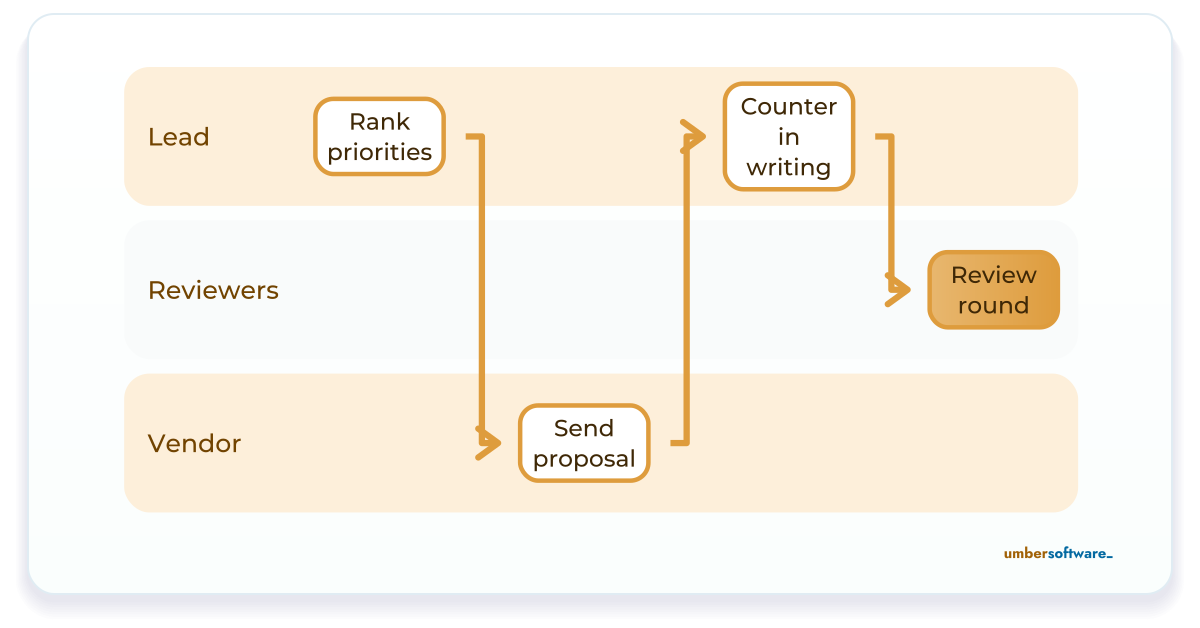
Appoint one lead, and ask the vendor to route all commercial discussion through that person. Technical contacts can still talk to the vendor's engineers about scope, but pricing and terms go through one door. Share a short written summary of the position with everyone who might be contacted.
4. Write Every Promise Into the Contract
Many contracts include an entire-agreement clause. It states that the signed document replaces everything said before. A feature a sales rep promised in a demo, a price hold for a future module or a free month of support may be worth nothing unless it appears in the text.
Go through your notes from every call and email. For each commitment that matters, check where it appears in the order form or the contract. Use exact wording: the product, the quantity, the date and the price. If the vendor says a roadmap item is coming, ask for a remedy if it is late, such as a credit or a termination right. A roadmap is a plan, not a promise.
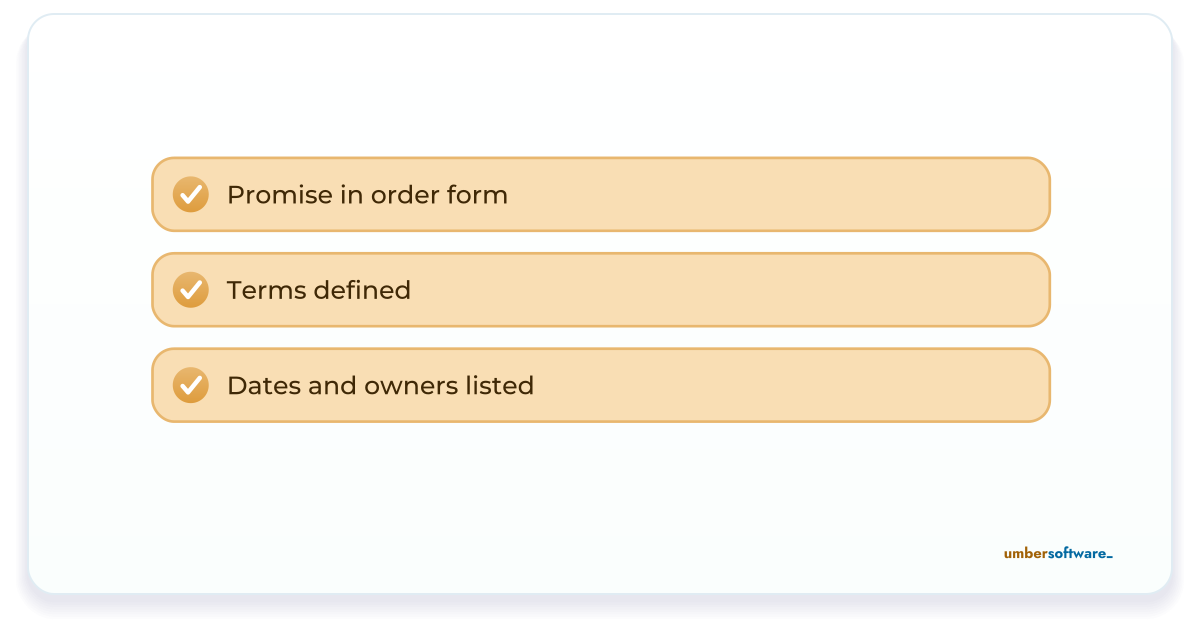
Do the same for definitions. Terms such as 'user', 'site', 'transaction' or 'affiliate' decide what you pay for. A vague definition is a future invoice.
5. Run a Short, Structured Review Round
Contracts fail at the edges between departments. IT checks the technical terms, finance checks the price and payment schedule, security checks data handling and legal checks liability and termination. When these checks happen in different weeks, the vendor can claim that earlier agreements make later ones impossible.
Hold one review meeting about a week before the deadline. Give each reviewer a section and a list of questions. Collect the issues into one document and send them to the vendor together. A single list of requests carries more weight than five emails and shows that your company is organized.
Have counsel review the final text. This article is general guidance, not legal advice, and clauses on liability, indemnity and data protection deserve a lawyer's attention.
6. Plan the Exit While You Still Have Leverage
Your leverage is greatest before signing. After signing, switching costs rise and the vendor knows it. Use the negotiation to agree what leaving would look like: how you export data, in which format, how long the vendor keeps it, what help they provide and at which price.
Ask for a transition period at the current rate, so that you are not forced to renew at a higher price because a migration takes longer than expected. Check what happens to custom configurations, integrations and any intellectual property you paid for.
A vendor that expects to keep you will agree to most of this without a fight. Resistance is information in itself. It tells you how locked in you would be.
7. Keep a Register and Review It Every Quarter
The work does not end at signature. Keep a register of every software contract: the vendor, the owner, the term, the notice date, the price, the cap and any special terms. Review it every quarter and assign the next renewal to a named person.
The register also supports your next negotiation. Past discounts, missed targets and support issues are evidence. A vendor who knows you keep records behaves differently from one who expects you to forget.
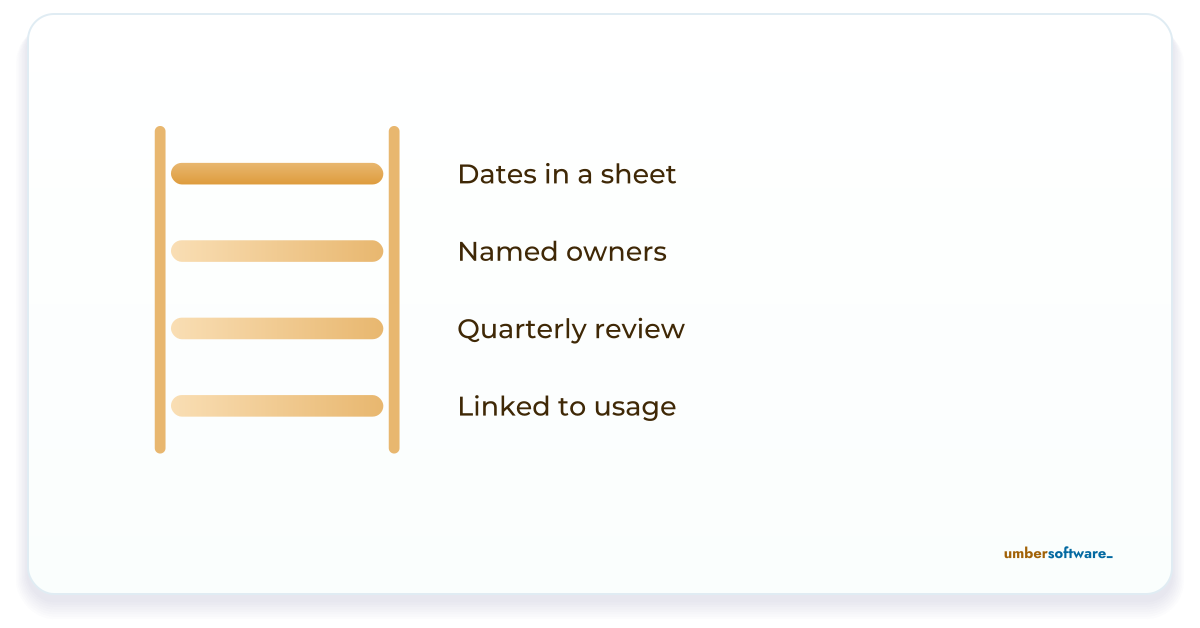
Link the register to your licence management. Seats that nobody uses and subscriptions that overlap are the cheapest savings available, and you only find them if someone checks.
A Realistic Timeline for a Mid-Sized Renewal
Teams often ask how much time all this takes. For a renewal of a mid-sized platform, the work is spread over about four months, and most of it is small tasks rather than meetings. The table shows the rhythm I use with clients.
| When | What happens | Who is involved |
|---|---|---|
| 120 days out | Usage export, current terms, first alternative quotes | Lead negotiator, IT |
| 90 days out | Priorities ranked, walk-away position written, vendor told the renewal is under review | Lead, finance, business owner |
| 60 days out | First proposal received, gaps listed, counter sent | Lead |
| 30 days out | Review round with IT, finance, security and legal | All reviewers |
| Final week | Written promises checked against the order form, signature, register updated | Lead, legal |
Shift every row earlier for a critical system or a vendor with a long notice window. The point is not the exact dates but the order: evidence first, positions second, text last.
When Practice and Reality Disagree
Real negotiations are messier than a list. The vendor may change the sales contact halfway through. A discount may expire on the last day of the quarter. A critical project may need the software before the legal review has finished.
In those cases, keep the principle and shrink the process. If time is short, hold the review round in one afternoon. If the deal has to close, agree a short extension of the current contract to buy time rather than sign terms you have not read. A vendor who will not extend by a few weeks usually has a quarter-end target, which is useful to know.
If you want to check a contract against a fixed list under time pressure, the software contract negotiation checklist gives you eleven points to confirm before you sign.
Picking Your First Step
You do not have to introduce all seven practices at once. Pick the one that would have prevented your last bad surprise.
- Surprise renewal increase: practices one and seven.
- Promised features that never arrived: practice four.
- Conflicting messages to the vendor: practices two and three.
- Difficult exit from a past vendor: practice six.
Once the habit is in place for one contract, apply it to the next. Over a year, the register and the checklist build a position that no single negotiation can.
Questions About Software Contract Negotiation Best Practices
What Are the Core Best Practices for Negotiating a Software Contract?
Prepare with usage data, set priorities before you talk, negotiate the full package, document every agreement in the contract, involve the right reviewers, protect your exit and keep a record for the next renewal. Together they cover preparation, the deal itself and the years after signing.
Who Should Lead a Software Negotiation?
One named person, usually from procurement, IT or finance, who owns the timeline and speaks for your company. Others advise on their area. Several voices talking to the vendor at once weakens your position and invites a split.
How Long Before Renewal Should I Start?
Start at least ninety days before the notice deadline, and earlier for large or critical systems. The notice deadline is the date that matters, because it is often weeks ahead of the expiry date.
What Should I Do If the Vendor Will Not Change the Standard Terms?
Ask which terms are truly fixed and which are policy. Move to what they can change: price, term length, support, seat flexibility or services. If a fixed term creates a risk you cannot accept, escalate to a senior contact or look at alternatives.
Are Verbal Promises from Sales Reps Binding?
Treat them as worthless until they appear in the contract or an order form. Entire-agreement clauses often cancel everything said outside the document. Write each promise into the text, with the same precision as the price.
How Do I Keep Track of Contracts After Signing?
Keep one register with the vendor, the term, the notice date, the price, the cap and the owner. Review it every quarter. Most missed deadlines happen because the person who signed the deal left or moved teams.
Is It Worth Hiring Outside Help?
For large renewals, unfamiliar categories or dominant vendors, usually yes. A consultant brings benchmark prices, a clear list of terms to push for and negotiating time. For small deals your own checklist is normally enough.
Please note: this guide is general information and not legal, financial or tax advice. Numbers and examples are typical-project estimates; confirm current details with your providers and advisers.
Did this article help you?
Thanks, noted.
Whitney Sorensen
Whitney leads the Umber editorial team and works with the consultants to turn real client projects into practical guides on software selection, custom development, integration and legacy modernization. Before joining Umber, she spent years writing and editing for engineering and IT teams. She has since reviewed architecture audits, system selections and modernization plans from client projects across industries from manufacturing to healthcare. She works remotely from the USA.