Main Points
- Your usage data and your timeline are the two strongest sources of leverage.
- Negotiate the whole package: caps, metrics, exit rights and service levels often beat a small discount.
- Cap renewal increases in writing and name every line item the cap covers.
- Get counsel to review the final text; this is general advice, not legal advice.
Software contracts are rarely read twice, yet they decide your costs for years. A tool that looked cheap at signing can become one of the largest lines in your budget after two renewals. The tips below come from renewals and new deals I have worked on, and they are the ones that changed the outcome most often. If you want support on a specific deal, software contract negotiation consulting brings benchmark data and a negotiator to the table.
Each tip has a short explanation, a do and an avoid. Use them in order if you have time, or pick the two that fit your deal today. For a gate-by-gate version, my software contract negotiation checklist turns the same ideas into checks.
Eight Tips and When Each One Matters
| Tip | Where it helps most | Best moment to use it |
|---|---|---|
| 1. Know your real usage | Seat counts and tiers | Three months before renewal |
| 2. Start early, keep an alternative | Overall leverage | Six months before renewal |
| 3. Negotiate the package | Total cost of ownership | First proposal |
| 4. Cap renewal increases | Years two and three | Before signature |
| 5. Match the metric to growth | Cost as you scale | Pricing discussion |
| 6. Protect data and exit | Switching cost | Legal review |
| 7. Read the service levels | Critical systems | Legal and IT review |
| 8. Bring the right people | Hidden risks | One week before deadline |
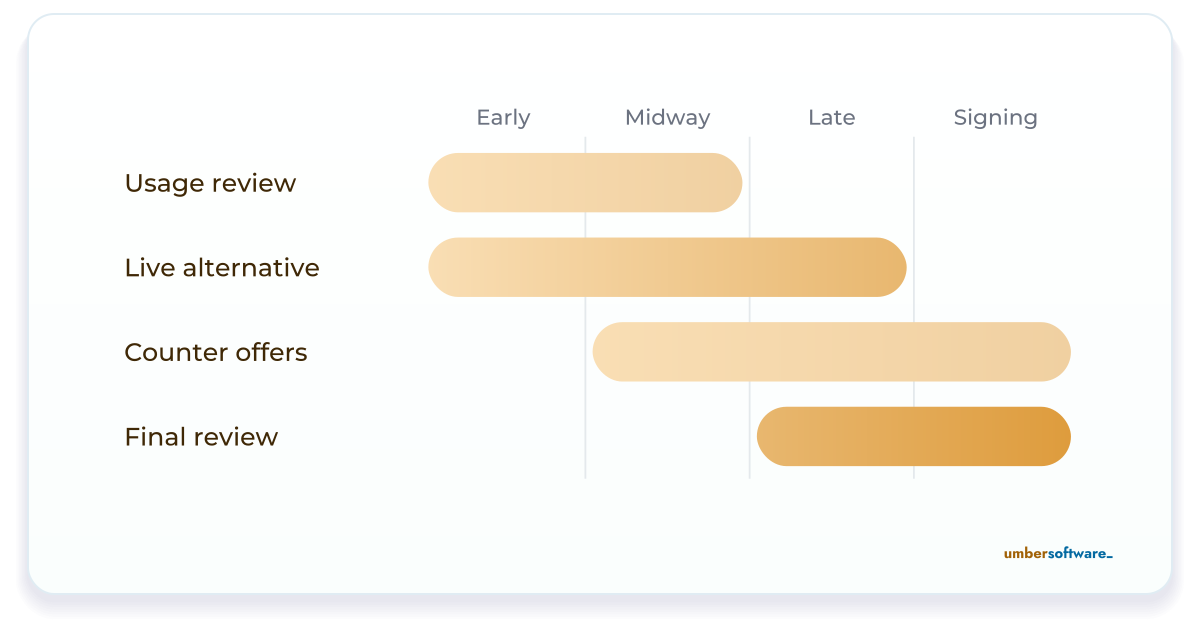
The first two tips build your position. Tips three to five shape the commercial terms, and six to eight protect you when things go wrong.
Know Your Real Usage Before the First Call
Vendors arrive with your usage numbers already in a spreadsheet. You should arrive with better ones. Pull seat counts, login activity, API calls, storage and active sites from the last twelve months, and compare them with what your current contract says you own.
On one renewal I worked on, a team believed it needed 400 seats. Login data showed 290 people had opened the tool in the previous quarter. That single export changed the conversation, because the vendor had to defend the other 110 seats instead of the other way around.
- Do: Export usage data per tier, per module and per site before you talk to sales.
- Avoid: Accept the vendor's count of 'active users' without checking how they define it.
Start Early and Keep a Real Alternative Alive
The best leverage in a software negotiation is time. A renewal opened ninety days out gives you room to run a proper comparison. One opened two weeks before expiry gives the vendor the leverage, and they know it.
An alternative does not have to be a tool you plan to switch to. It has to be credible: a shortlist with a rough price and a migration estimate. Sales teams can tell the difference between a bluff and a quote you have in your inbox.
- Do: Put the renewal date, the notice deadline and a decision date on the calendar six months ahead.
- Avoid: Tell the vendor you have no time to look at other options.
Negotiate the Whole Package, Not Only the Price
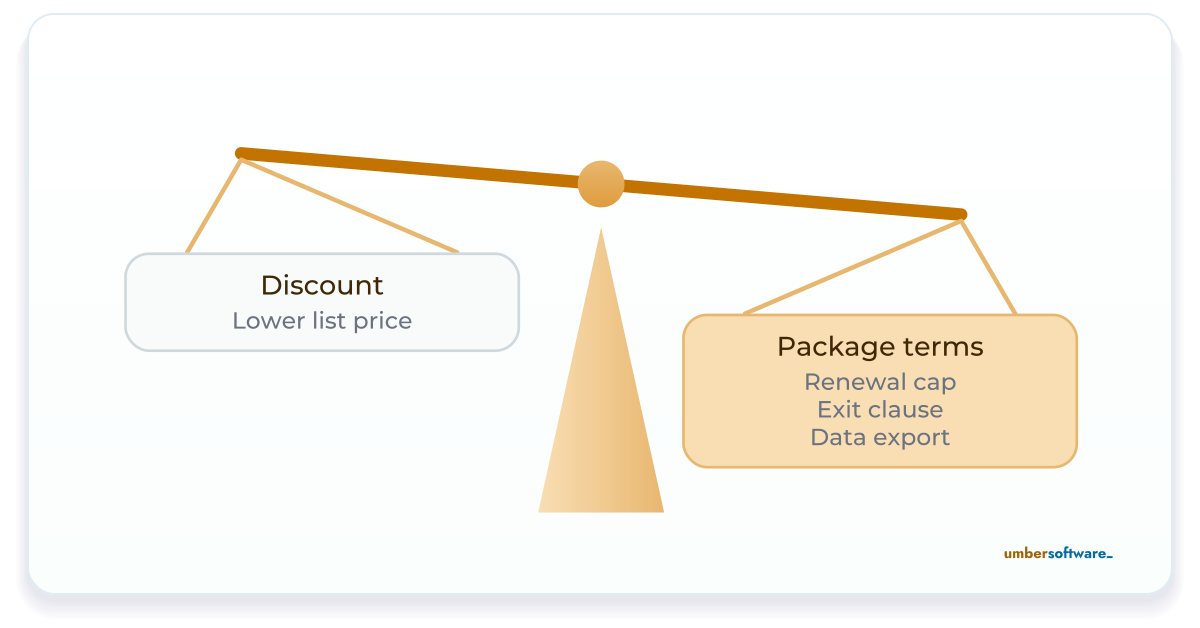
Price is the term everyone argues about, and it is often not the most valuable one. Payment timing, renewal caps, support levels, data export rights, service credits and the right to reduce seats at renewal can be worth more than a headline discount over three years.
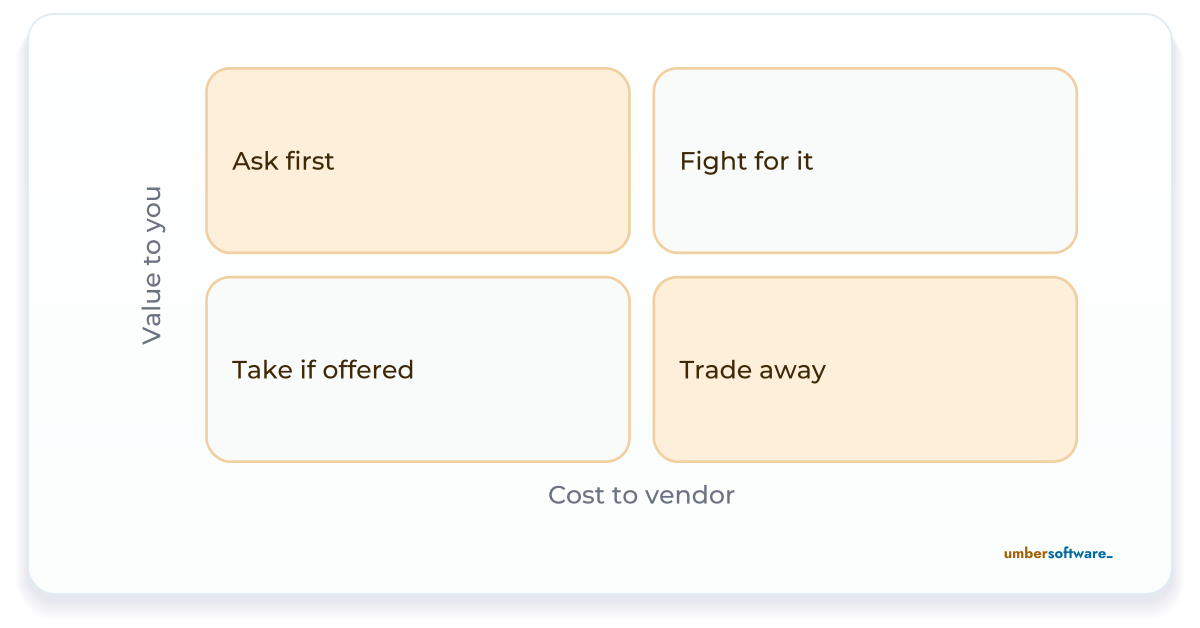
A vendor that will not move on price often has room elsewhere. Ask for a longer price lock, a lower uplift cap, free implementation hours or a named support contact. Trade the things that cost them little and matter to you.
- Do: List ten terms that matter to you and rank them before the first meeting.
- Avoid: Spend three rounds on a two percent discount and sign the rest as drafted.
Cap Renewal Increases in Writing
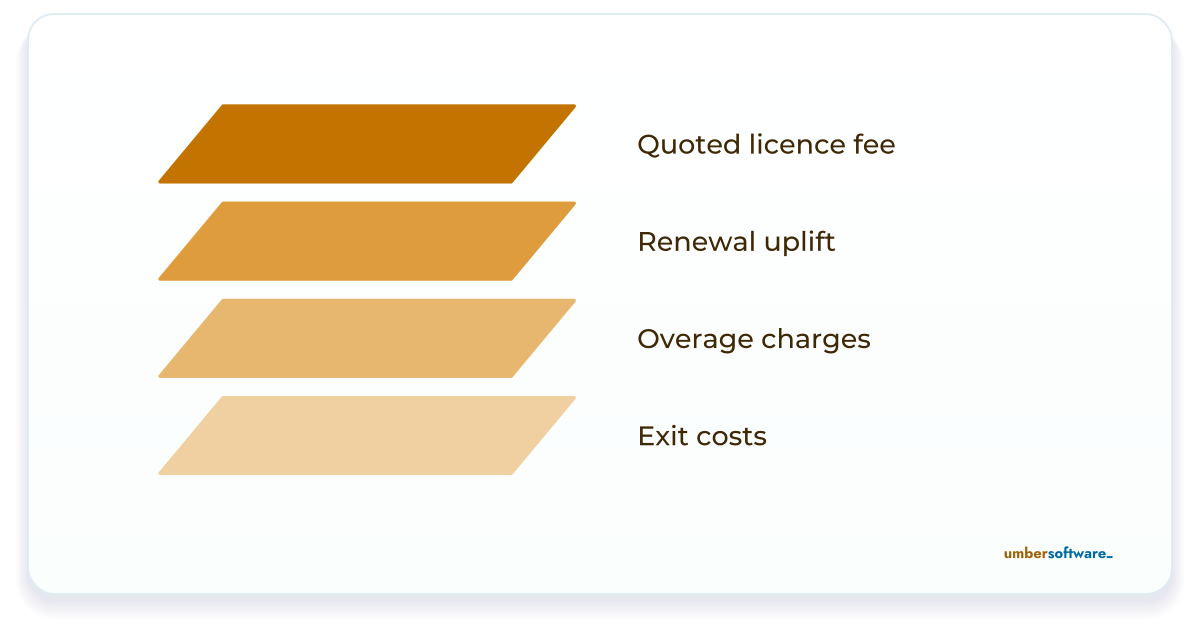
Many subscription contracts allow the vendor to raise prices at every renewal, often with a notice window that is easy to miss. A low first-year price followed by a steep uplift is a common pattern, and it only shows up in year two.
Ask for a fixed percentage cap or a price lock for the full term, and check what happens to add-ons and overage rates, which are often missing from the cap. If the vendor refuses a cap, ask for the uplift formula and a longer notice period.
- Do: Write the cap as a number and name every line item it covers.
- Avoid: Accept 'current list price' as the renewal price.
Match the Licence Metric to How You Grow
The metric you pay on decides how your bill behaves for years. Named users suit a stable team. Usage-based pricing suits spiky workloads. Per-site, per-device or per-revenue metrics can look cheap today and punish you when you grow or reorganize.
Run your own growth plan through each option before you agree. If a metric makes cost rise faster than the value you get, propose a different one or a tiered price with a ceiling.
- Do: Model cost at your current size and at twice your size under each metric.
- Avoid: Pick the metric that gives the lowest price for today's headcount only.
Protect Your Data and Your Exit
Leaving a vendor should be possible without a legal fight. Check that you can export all of your data in a usable format, how long the vendor keeps it after termination and what they charge for help. Also look at what happens to integrations and custom work you paid for.
Ask for an exit clause that includes a transition period at the current price. It costs the vendor little if they expect to keep you, and it changes how they behave at renewal.
- Do: Ask for a full data export in an open format, with a test export before you sign.
- Avoid: Assume your data is portable because the sales deck says so.
Read the Service Levels, Not Only the Uptime Number
A 99.9 percent uptime promise sounds precise. The details decide its value: how downtime is measured, which parts of the service count, how fast support must respond and what you receive when the vendor misses the target.
Service credits are often small and need a claim within a short window. If the software is critical to your operations, ask for stronger remedies such as a termination right after repeated misses.
- Do: Check the measurement window, the exclusions and the claim process.
- Avoid: Treat a service credit of a few percent as real protection for a critical system.
Bring the Right People and Get a Second Review
A software contract touches IT, finance, security, legal and the business owner who will use it. Each sees different risks. When only one of them reads the document, the others find out after signing.
I suggest a short review meeting a week before the deadline with all four. Have counsel review the final text. Nothing here replaces legal advice, and clauses on liability, indemnity and data protection need a lawyer's eyes.
- Do: Assign one lead negotiator and give each reviewer a specific section to check.
- Avoid: Sign at quarter end because the vendor says the discount expires.
Where These Tips Pull Against Each Other
Good tips conflict at times. A long term earns a larger discount, yet it locks you in while your needs change. A tight seat count saves money today and leaves you buying extra seats at list price when the team grows. A vendor who gives way on price may harden on the exit clause, because both cost them money in different ways.
My own rule is to rank your terms before you start, then decide which ones you will trade. Flexibility to reduce seats usually beats an extra few points of discount. Data export rights usually beat a lower uplift cap if the product sits at the heart of your operations.
The same trade-offs appear in pricing decisions on the vendor side, which is why my overview of software contract negotiation best practices looks at the habits of negotiators who stay calm when talks get long.
What to Do When the Deal Is Small
Not every purchase deserves a three-week negotiation. For a tool under a few thousand dollars a year, you rarely get custom terms, and the cost of the time spent adds up quickly. Concentrate on three things: monthly or annual billing with a short notice period, a way to export your data and an honest check of whether you need the paid tier.
Check who can buy software in your company, too. A team that signs up with a company card can accept terms that bind the whole business. A simple policy that routes every new subscription through one person catches most surprises. The larger the commitment, the more of the earlier tips apply.
Small tools can still hide traps. Auto-renewals at a higher rate, add-on charges once you cross a free limit and seat minimums that appear on the second invoice are common. Put the dates in a shared calendar on the day you sign.
How to Choose Which Tips to Use First
Start with the tips that protect your largest exposure.
- Spend above six figures a year: tips one, two and three, with benchmarks if you can get them.
- Multi-year commitment: tips four and five, so that years two and three stay predictable.
- Sensitive data or regulated work: tip six first, with legal review.
- Systems that stop the business when down: tip seven, then tip eight.
Whatever you choose, write down your walk-away position before you start. Knowing the point where you will leave keeps the conversation calm.
Questions About Software Contract Negotiation Tips
What Is the Biggest Mistake in Software Contract Negotiation?
Starting too late. When the renewal date is close, you have no time to compare alternatives and the vendor knows it. Opening the conversation three to six months early gives you room to use every other tip in this list.
Can Small Companies Negotiate with Big Software Vendors?
Yes, within limits. You may not get custom clauses, but discounts, payment terms, price caps, seat flexibility and support levels are often open. Multi-year commitments and clear usage data help a smaller buyer a lot.
Is a Multi-Year Deal Better than Annual Billing?
It can be, if it comes with a price lock and the right to reduce seats. A longer term with automatic uplifts and no flexibility is worse than one-year renewals. Compare total cost and exit options, not only the annual rate.
How Much Discount Can I Expect?
There is no standard number. It depends on deal size, timing, competition and how much the vendor wants to keep you. A better question is which total terms you can improve, since price is only one of them.
Should I Negotiate Through a Reseller?
Resellers can offer lower prices or bundled services, but terms and support may differ from buying direct. Ask for the vendor's terms in writing and check who is responsible for support and for incidents.
Do I Need a Lawyer for a Software Contract?
For anything business-critical or handling sensitive data, yes. A lawyer reviews liability, indemnity, data protection and termination terms. This article gives general negotiation advice and is not legal advice.
When Should I Bring in a Consultant?
When the contract is large, the vendor is dominant or your team has little experience. A consultant brings benchmark data, a clear list of terms to ask for and negotiating time, which tends to pay for itself on larger renewals.
Please note: this guide is general information and not legal, financial or tax advice. Numbers and examples are typical-project estimates; confirm current details with your providers and advisers.
Did this article help you?
Thanks, noted.
Whitney Sorensen
Whitney leads the Umber editorial team and works with the consultants to turn real client projects into practical guides on software selection, custom development, integration and legacy modernization. Before joining Umber, she spent years writing and editing for engineering and IT teams. She has since reviewed architecture audits, system selections and modernization plans from client projects across industries from manufacturing to healthcare. She works remotely from the USA.