Main Points
- Start with a baseline of four delivery numbers before you buy or change anything.
- Build the release pipeline before the test suite, so every later improvement ships the same way.
- Rank technical debt by how often code changes and breaks, then reserve 15 to 20 percent of each sprint for it.
- End each two-month phase with a pass or fail check, and reset the plan after month twelve.
Most engineering roadmaps fail for the same reason: they list everything a team could improve and rank nothing. A year is long enough to fix real problems and short enough that the first quarter decides whether anybody believes in the plan. I have used the sequence below with product teams of 8 to 40 developers, and the order matters more than the exact content of each phase.
If you want an outside view while you work through it, software engineering consulting usually starts with the same baseline described in phase one. Everything here you can copy and adapt on your own.
The 12-Month Plan at a Glance
The plan has six phases of two months each. Each phase ends with a check you can pass or fail, so you know before moving on whether the work paid off.
| Months | Phase | Main outcome | Exit check |
|---|---|---|---|
| 1 to 2 | Baseline and quick wins | Delivery numbers and the top five bottlenecks | You can state lead time and failure rate for the last 90 days |
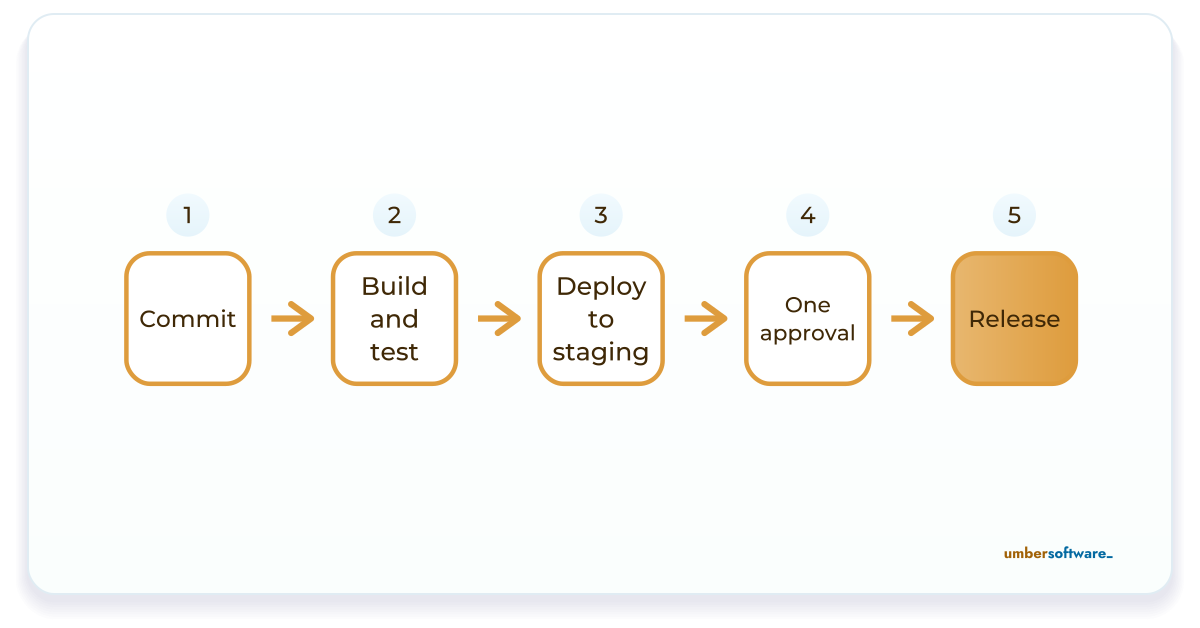
| 3 to 4 | Build and release pipeline | Every change builds, tests and deploys the same way | A release needs no manual steps beyond one approval |
| 5 to 6 | Quality and testing | Automated tests guard the riskiest code paths | Escaped defects drop for two sprints in a row |
| 7 to 8 | Technical debt and structure | A funded debt plan and the first structural fixes | One hot-spot module is measurably easier to change |
| 9 to 10 | Observability and operations | Monitoring, alerts and an incident routine | Mean time to recover falls against the baseline |
| 11 to 12 | Scale and review | Practices spread to every team and the plan is reset | A written plan for year two based on measured results |
Teams that already have a pipeline can compress phases two and three. Teams with no tests at all should stretch phase three to three months and shorten phase five. The sequence stays the same.
Months 1 and 2: Measure Before You Change Anything
The first mistake is starting with tools. A team buys a new CI service, then discovers six weeks later that builds were never the bottleneck. Spend the first two months collecting facts instead.
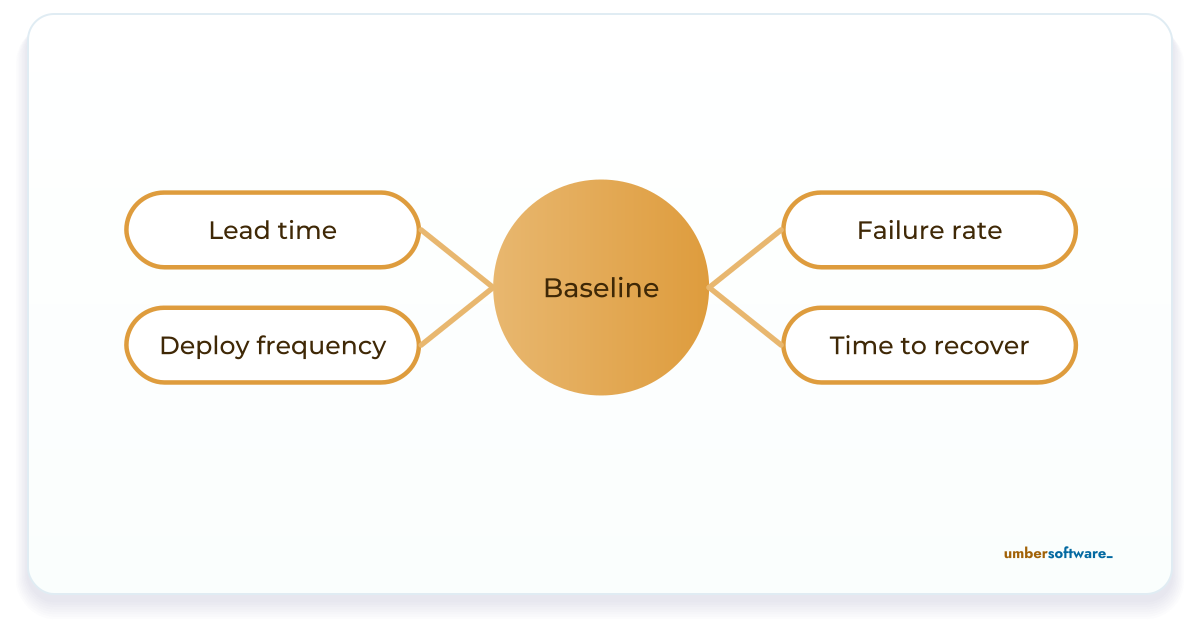
Pull four numbers from your Git host, your ticket system and your incident log: lead time from commit to production, deployment frequency, the share of deployments that need a rollback or hotfix, and the time to recover from a failed deployment. These are the delivery measures the DORA research program uses, and they give you a baseline in a shared language. My article on software engineering metrics explains how to collect each one without building a dashboard first.
Then interview five developers and one person from support or operations. Ask the same three questions: what slows you down most, what do you avoid touching, and what broke last month? Patterns show up quickly. In one client project the same fragile billing module came up in four of six interviews, and it became the first debt item on the plan.
Finish the phase with a ranked list of the top five bottlenecks, each with a rough cost in developer days per month. Quick wins belong here too: a flaky test that fails every fifth build, a manual step nobody remembers adding, a repository with no code owners. Fix two or three of them so the team sees movement early.
Months 3 and 4: Make Every Release Boring
A good pipeline does one thing: it makes every change travel the same road. Build, run the fast tests, scan, package, deploy to a test environment, wait for an approval, deploy to production. Humans make decisions at the approval point and nowhere else.
Start with the main product only. Write the pipeline as code in the same repository, keep builds under ten minutes by running tests in parallel and cache dependencies from day one. Add a rollback path before you add features to the pipeline, because a deploy you cannot undo is a deploy people delay. The comparison in my ranking of software engineering tools helps when you are choosing between hosted CI services and self-run runners.
Branching rules matter as much as tools here. Short-lived branches that merge within two days make releases small, and small releases fail less often. If your team keeps long-lived feature branches, plan a gradual move: feature flags let unfinished work sit in main without reaching users.
The exit check is blunt. Pick a Tuesday afternoon, ship a trivial change and count the human steps. If the answer is more than one approval, the phase is not done.
Months 5 and 6: Put Tests Where the Risk Is
Chasing a coverage percentage is the most common way to waste this phase. A suite with 85% coverage and no checks on payment or permission logic protects you less than a small suite aimed at the five code paths that cost you money when they break.
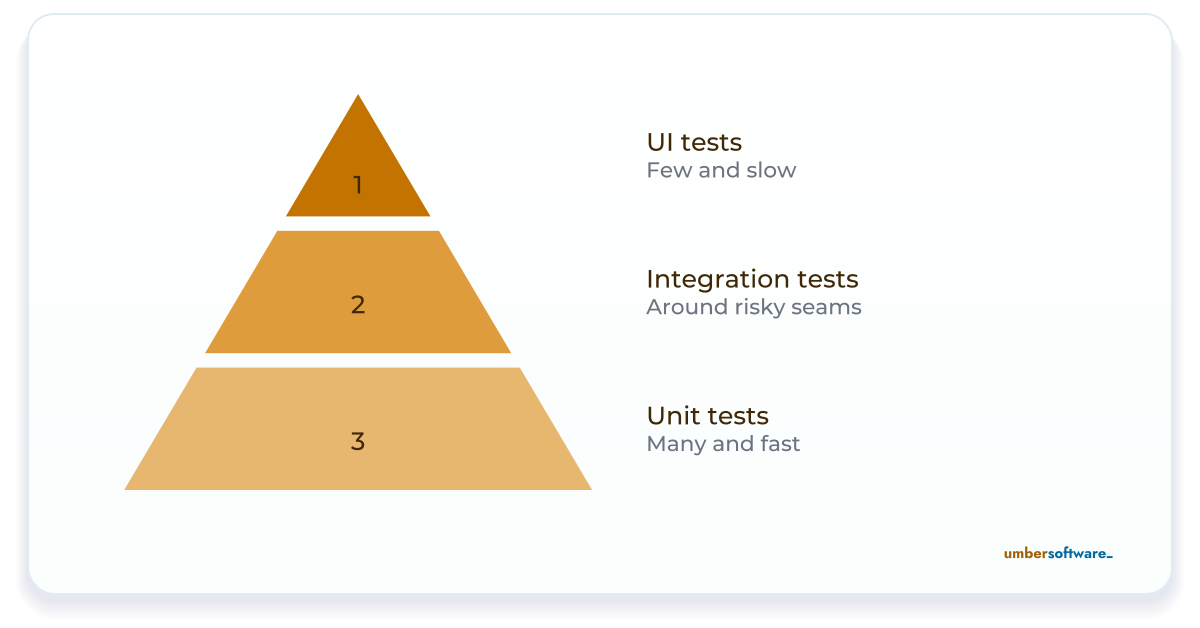
Use your incident log from phase one to choose them. For each of the top paths, write an automated test at the lowest level that still proves the behavior: unit tests for pure logic, integration tests for database and API contracts, a handful of end-to-end tests for the journeys customers pay for. Keep the end-to-end set small, because those tests are slow and flaky when they multiply.
Treat flaky tests as incidents. A test that fails at random teaches developers to ignore red builds, which wipes out the value of every other test. Quarantine it within a day, fix it within a week or delete it.
Agree on a review checklist at the same time. Four items are enough: does the change have a test, does it touch a risky path, is it small enough to read in twenty minutes, and is rollback clear. Longer lists get skipped. The common software engineering challenges page shows why review rules slip when teams are under deadline pressure.
Months 7 and 8: Pay Down the Debt That Costs You Money
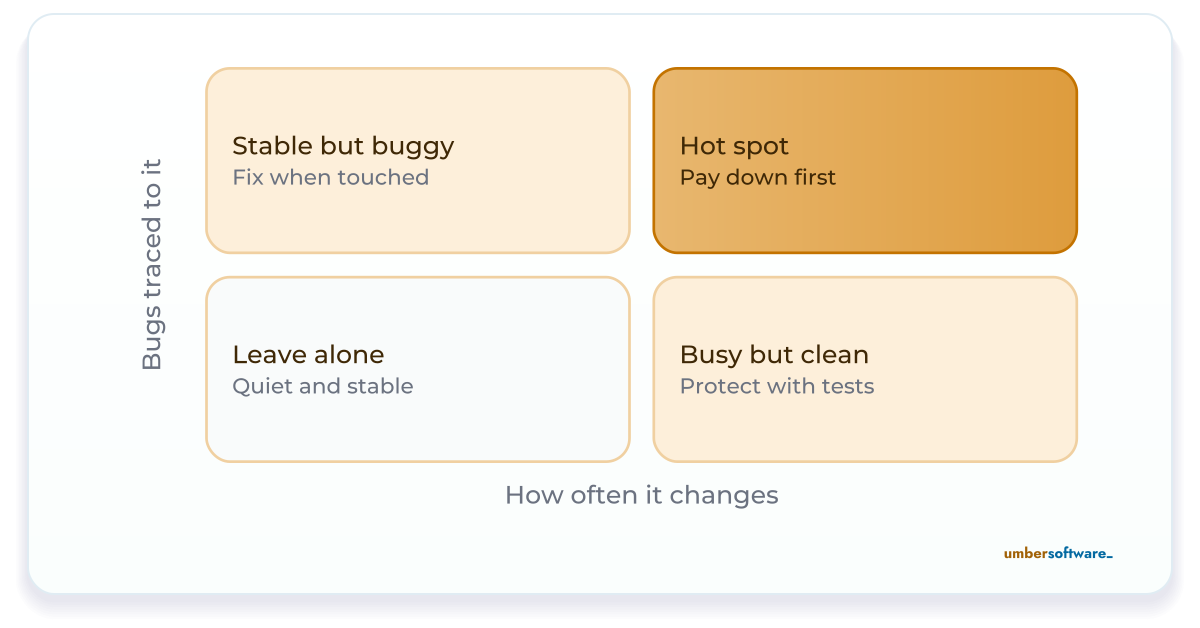
Technical debt is not a moral failing and it is not all equal. Some of it costs you every week, and some of it sits in code nobody changes. Rank debt by how often the code changes and how often it breaks. A messy module touched every sprint belongs at the top. An ugly module untouched for two years can wait indefinitely.
| Debt type | Typical sign | First move |
|---|---|---|
| Hot-spot code | Same files change in most pull requests and cause most bugs | Add tests, then split the file along clear responsibilities |
| Outdated dependencies | Security alerts pile up and upgrades keep slipping | Schedule one upgrade slot per sprint and automate update pull requests |
| Coupled modules | A small change needs edits in five places | Introduce one interface at the seam and move callers over gradually |
| Missing documentation | New developers need weeks to ship a first change | Write a one-page map of the system and a setup script that works |
Reserve a fixed share of each sprint for debt, 15 to 20 percent works for most teams, and protect it. Debt work that only happens when there is slack never happens. If the structure itself is the problem, an architecture review tells you whether a few fixes will do or a bigger change is justified.
Months 9 and 10: Know When Something Breaks Before Customers Do
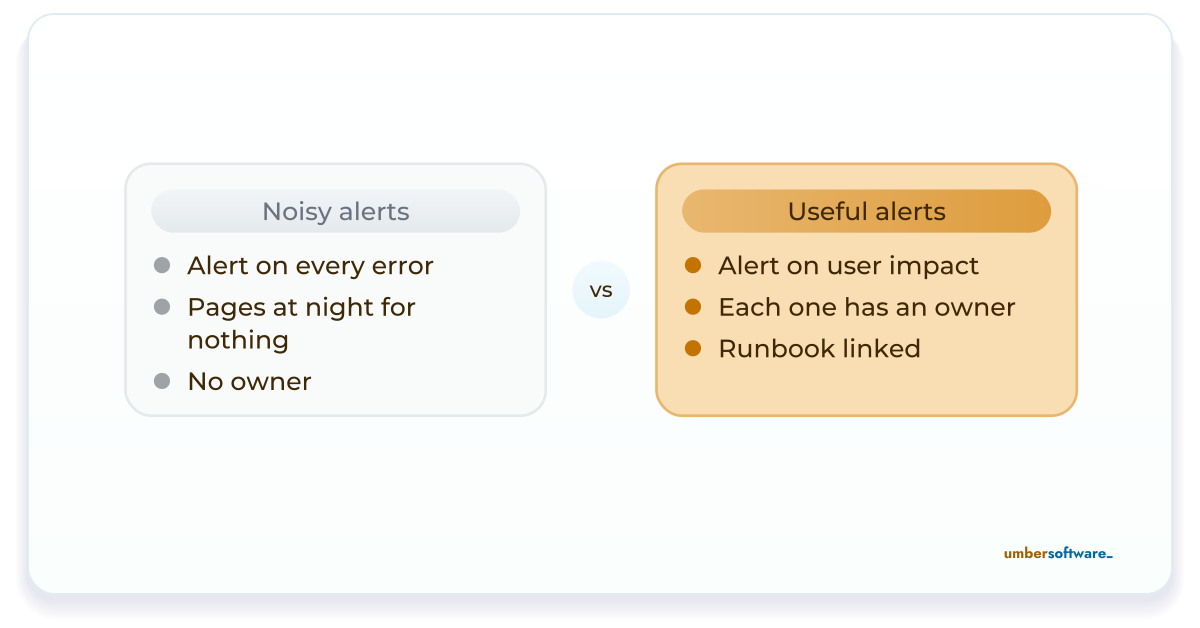
By now releases are small and tested, which makes the remaining failures easier to see. This phase makes them visible quickly. Add structured logging, a small set of service-level indicators such as error rate and response time, and alerts that page a person only when customers are affected.
Alert fatigue kills this phase more often than missing tools. Start with three to five alerts that matter and add one only when an incident shows a gap. Write a one-page incident routine: who leads, where people talk, how you decide to roll back, and who writes the short review within three days. Reviews focus on what the system allowed, not on who made the change.
Track mean time to recover against the baseline from phase one. A drop of even 30 percent is a clear win to show leadership, because it turns into fewer escalations and calmer on-call weeks.
Months 11 and 12: Spread What Worked and Reset the Plan
The last phase is about the rest of the organization. Take the pipeline template, the review checklist and the incident routine from the first team and offer them to the next two. Pair a developer from the pilot team with each new team for a sprint. Practices travel with people, not with documents.
Then repeat the baseline from phase one. Compare the four delivery numbers with the first quarter, and write a one-page summary: what changed, what it cost, what did not work. Use it to set the year-two plan. The engineering KPIs that leaders watch most closely are good candidates for the targets you present.
How to Adjust the Plan to Your Team
The sequence holds for most teams, but your starting point changes the length of each phase. Check where you stand against these four questions before you copy the schedule:
- Can you release without a manual checklist today? If yes, shorten phase two to a month.
- Do you have automated tests on your most expensive code paths? If no, move testing up and start it in month three.
- Does one system cause most incidents? If yes, bring the debt work for that system forward.
- Do you have a single person who can lead the plan for 20 percent of their time? If no, name one before you start.
Teams with fewer than five developers can merge phases into three of four months each. Teams above 40 should run the plan per product area and share one pipeline template. If you want a second opinion on the order of your first three phases, a short call with an engineering consultant usually settles it.
Questions About Your Software Engineering Roadmap
How Long Should a Software Engineering Roadmap Be?
Twelve months is a good planning horizon. It is long enough to finish structural work and short enough that the first assumptions still hold. Plan the next two months in detail, the following four in outline and leave the remainder loose. Review the whole plan every quarter and adjust it based on measured results.
What Should Be the First Item on an Engineering Roadmap?
A baseline. Record lead time, deployment frequency, failure rate and recovery time for the last 90 days. Without those numbers you cannot tell whether later changes help. The baseline also shows where the biggest bottleneck is, which often differs from what the team expects.
Do Small Teams Need a Roadmap?
Yes, a lighter one. A team of four can fit the same sequence into three or four phases and skip formal reviews. The order still applies: measure first, automate delivery, protect risky code, then pay down debt. Skipping the order usually means fixing the same problem twice.
How Much Time Should We Spend on Technical Debt?
Reserve 15 to 20 percent of each sprint as a starting point and adjust it by results. If hot-spot code still slows every release after two quarters, raise the share temporarily. Protect the time on the board as real work, because debt that is only handled when there is slack never gets handled.
How Do We Get Leadership to Fund an Engineering Roadmap?
Show cost in their language. Convert the top bottlenecks into developer days per month and then into money. Show the delivery baseline, the expected change for each phase and the exit check that proves it. Leaders usually back plans with small first steps and clear tests of success.
Should We Hire or Use Consultants for the Roadmap?
It depends on whether you have a person with time and experience to lead it. A consultant helps most with the baseline and the first pipeline, where outside patterns save weeks. Your own team should own the plan afterwards. If nobody has 20 percent of their time free, the plan will stall either way.
What If the Roadmap Falls Behind Schedule?
Cut scope, not the exit checks. Drop the least valuable item in the current phase and keep the pass or fail test. A phase that finishes late with its check passed is fine. A phase that finishes on time with the check failed means you will meet the same problem again later.
Please note: this guide is general information and not legal, financial or tax advice. Numbers and examples are typical-project estimates; confirm current details with your providers and advisers.
Did this article help you?
Thanks, noted.
Whitney Sorensen
Whitney leads the Umber editorial team and works with the consultants to turn real client projects into practical guides on software selection, custom development, integration and legacy modernization. Before joining Umber, she spent years writing and editing for engineering and IT teams. She has since reviewed architecture audits, system selections and modernization plans from client projects across industries from manufacturing to healthcare. She works remotely from the USA.