Main Points
- Score every application on business value and technical health before you pick a treatment.
- Use a menu of six treatments, because most estates need several, not one big rewrite.
- Rebuild only when the platform is end of life and nobody can change the logic safely.
- Set a gate after each step so a weak plan stops early and cheaply.
Teams argue about modernization in slogans: rewrite it, lift it to the cloud, wrap it in APIs. Slogans do not scale across thirty applications. A framework does, because it gives every application the same questions and puts the answers side by side. It is the same model I use in software modernization consulting engagements, trimmed to what you can run yourself.
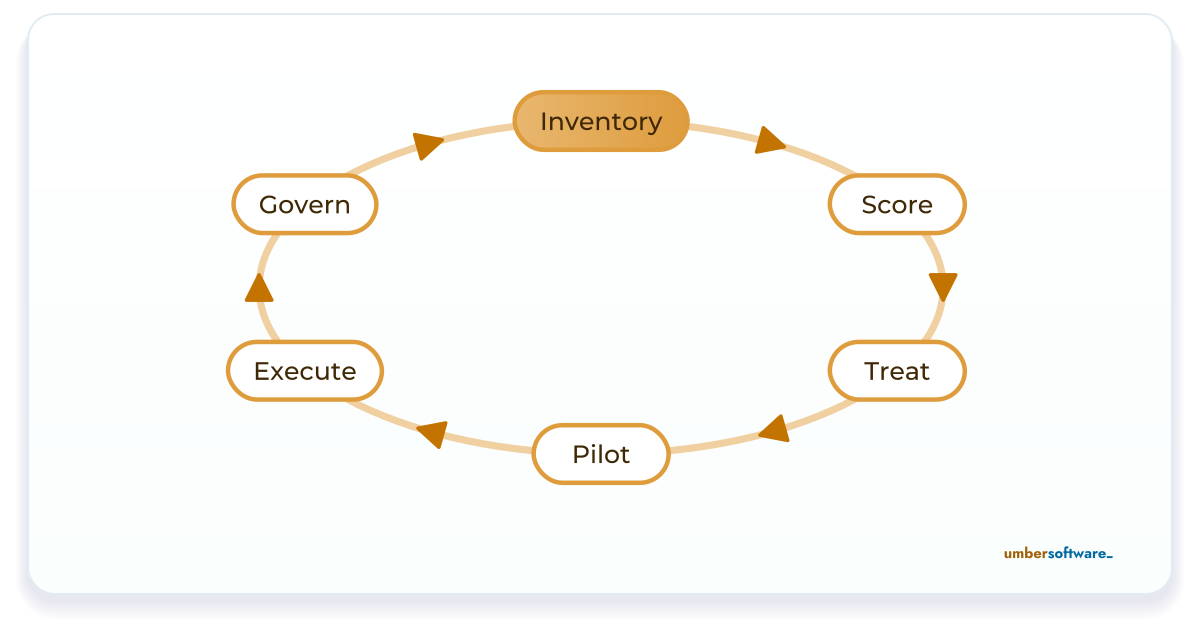
The model has six steps. Each step has an input, an output and a gate. I explain them in order, then show a scoring table and a worked example.
The Six Steps in One Table
| Step | What you do | Output | Gate |
|---|---|---|---|
| 1. Inventory | List applications, owners, stacks, users and run costs | One portfolio sheet | Every application has a named owner |
| 2. Score | Rate business value and technical health, 1 to 5 each | Scored portfolio | Owners agree with their scores |
| 3. Assign a treatment | Map each application to retain, rehost, replatform, refactor, rearchitect or replace | Decision per application | Each decision has a reason on paper |
| 4. Prove it | Run a small pilot on the highest-value candidate | Pilot result against baseline | Pilot meets its exit criteria |
| 5. Execute in slices | Migrate in small releases with side-by-side running | Modules live, legacy shrinking | Health numbers improve |
| 6. Govern | Review quarterly, retire old systems, update scores | Living portfolio | Retirement dates are met |
Step 1: Inventory What You Actually Run
You cannot score what you cannot see. Build one sheet with a row per application and a handful of columns: business owner, technical owner, language and framework, hosting, number of users, yearly run cost, last major release and the systems it talks to. Accept imperfect data. A rough number from the owner beats a perfect number you wait six weeks for.
In my experience, finance knows about licenses and hosting invoices that engineering has forgotten, and engineering knows about internal tools that never reached an asset register. Ask both. The gap between the two lists is often your first finding.
Step 2: Score Value and Health
Two scores place every application on a grid. Business value measures how much the company depends on it: revenue touched, users, regulatory weight and how hard it is to replace. Technical health measures how safe and fast it is to change: age of the platform, test coverage, vendor support, security patch status and how many people understand the code.
Use a 1 to 5 scale with written definitions, so that two assessors give the same score. A 1 in technical health, for example, means the platform is out of vendor support and nobody on staff can deploy it alone. A 5 means automated tests, regular releases and several people who can change it.
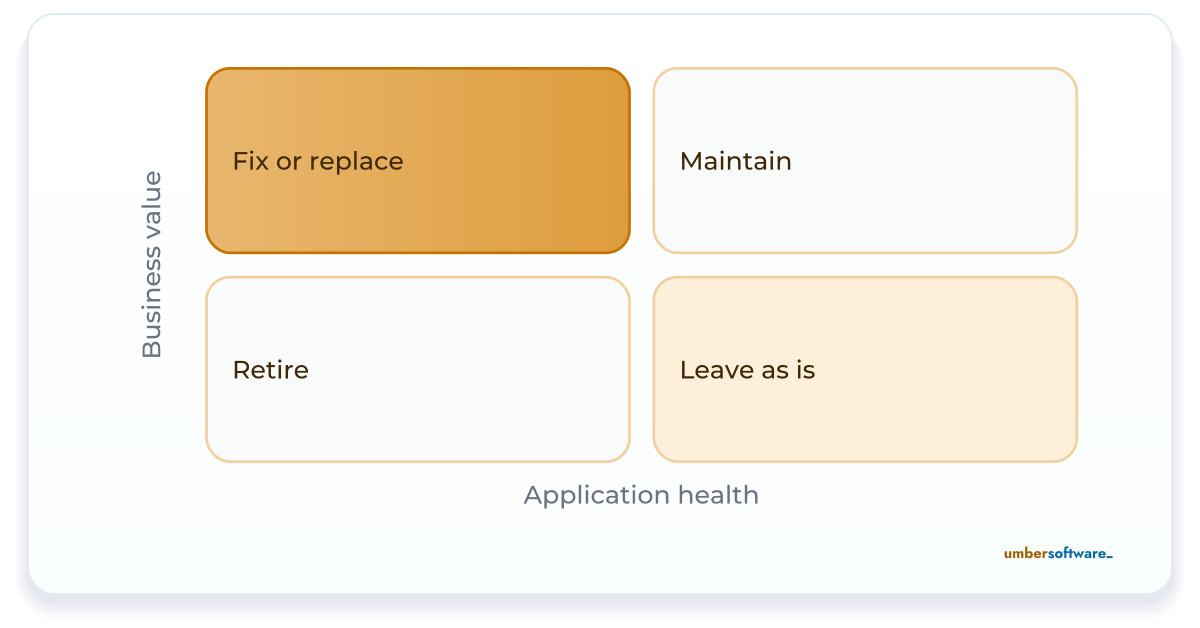
| Quadrant | Value | Health | Typical direction |
|---|---|---|---|
| Invest | High | High | Keep and extend, refactor in place |
| Modernize first | High | Low | Refactor, rearchitect or rebuild, in priority order |
| Maintain | Low | High | Retain with minimal spend |
| Retire or replace | Low | Low | Replace with a product or switch off |
Step 3: Pick a Treatment From the Menu
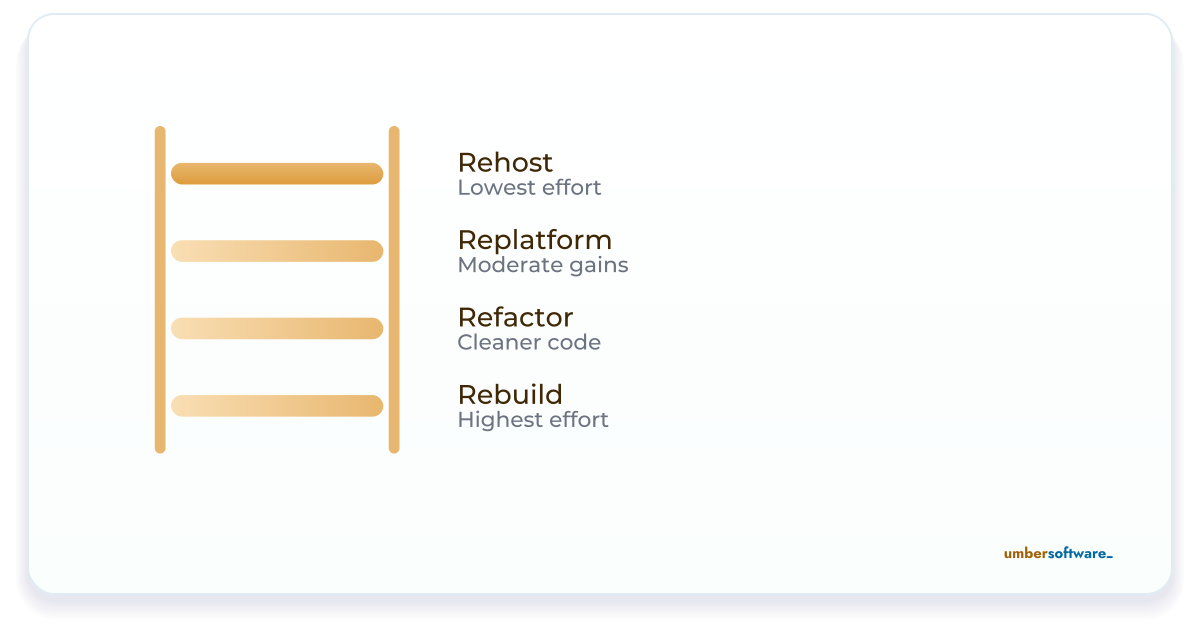
Once an application has its scores, choose a treatment. Treat the list as a menu with prices, not a ladder to climb. The cheapest option that solves the stated problem usually wins. Use the table to match the problem to the treatment.
| Treatment | What changes | Choose it when | Main risk |
|---|---|---|---|
| Retain | Nothing | Value is low and the system is stable | Slow decay of skills and support |
| Rehost | Where it runs | Hardware is the problem, code is fine | Moves the same weaknesses to a new place |
| Replatform | Runtime, database or middleware | An old platform blocks support or security patches | Hidden compatibility gaps |
| Refactor | Code structure, not behavior | Logic is sound but releases are slow | No tests means no safety net |
| Rearchitect | Boundaries and data flows | The structure blocks scale or team autonomy | Over-splitting into too many services |
| Replace or rebuild | The whole system | A product covers the need, or the platform is dead | Lost behavior nobody wrote down |
Write one paragraph per decision: the problem, the treatment, the expected gain and the main risk. When the decision involves where the application sits in a bigger plan, link it to your software modernization strategy, so that each choice traces back to a business goal.
A Worked Example: Five Applications, Five Decisions
Take a mid-sized manufacturer with five applications. These are composite numbers from the kind of portfolio I see, not a single client. The point is how the scores lead to decisions.
| Application | Value | Health | Decision | Reason |
|---|---|---|---|---|
| Order management | 5 | 2 | Refactor, then rearchitect | Core revenue path, sound rules, tangled code |
| Shop-floor scheduling | 4 | 1 | Replace with a product | Platform out of support, standard need |
| Customer portal | 4 | 4 | Retain and extend | Healthy and recent |
| Reporting server | 2 | 3 | Rehost | Hardware ageing, code adequate |
| Quality-audit tool | 1 | 1 | Retire | Two users, covered by another system |
Notice what the framework prevented. Without scores, the team had planned to rebuild the customer portal, the most visible system, because it was the most embarrassing to demo. The scores showed it was healthy, and the money went to order management, where the pain was.
Cost and benefit rise together along the menu, but not evenly. Rehosting is cheap and fast and gives you little beyond new hardware. Refactoring costs more and changes how fast you can ship. Rebuilding costs the most and carries the highest chance of a surprise. When you present decisions to finance, show the expected gain next to each cost, and add the main risk in one line. Sponsors accept a risky choice more easily when the risk is on the page from the start.
Also record what you will not do. A line such as "the reporting server stays on its current code base until the vendor drops support" prevents the same debate from returning every budget season. In the portfolios I review, a short "not now" list is often the most useful page, because it protects the team from scope drift while the first applications move.
Step 4: Prove the Treatment on a Small Pilot
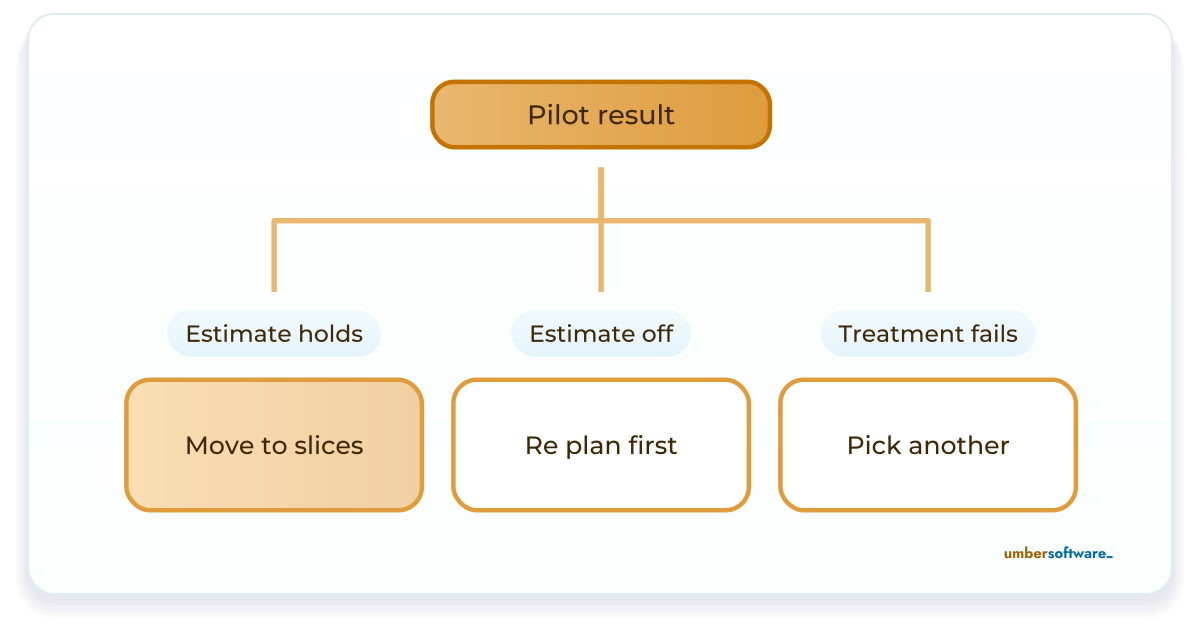
Before you commit the full budget, run a pilot on one module of the highest-value application. Write the exit criteria before you start: for example, the pilot module serves real traffic, error rate stays within the legacy baseline, and a change that used to take weeks ships in days. If the pilot misses its criteria, adjust the treatment, not the criteria.
Pilots also expose the cost of your assumptions. Teams almost always find that tests, data mapping or access rules take longer than planned. Better to learn that on a slice than on the whole system. The pilot feeds directly into the schedule in my software modernization roadmap, where the same slice becomes the first milestone.
Steps 5 and 6: Execute in Slices, Then Govern
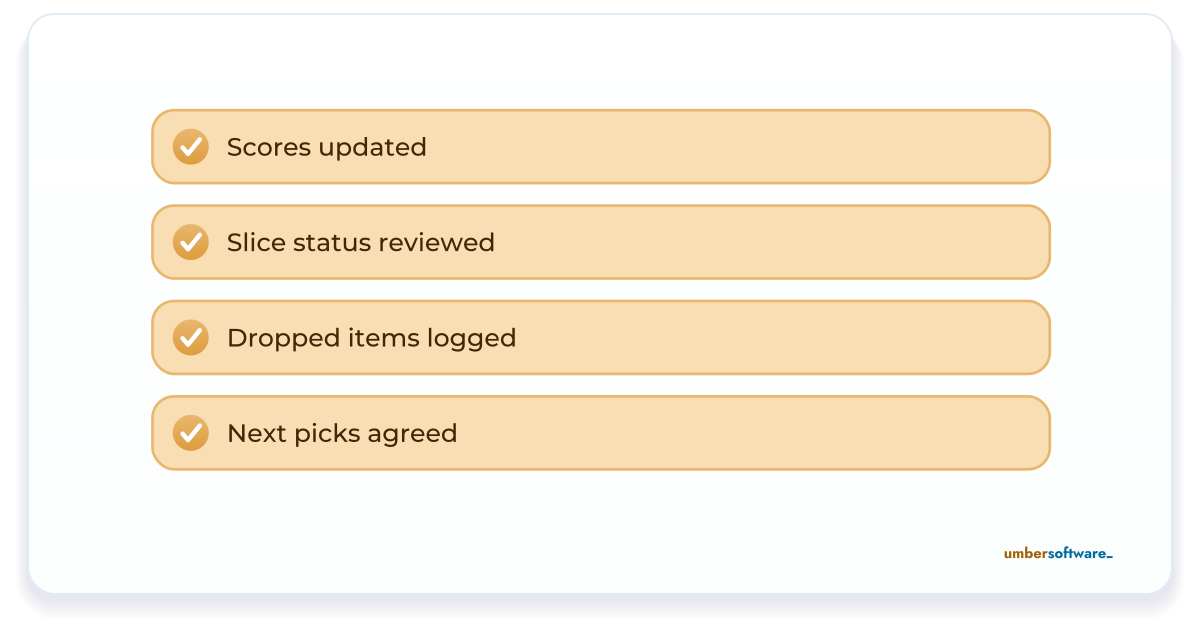
Execution follows one loop: build the next slice, send a small share of traffic to it, raise the share, retire the old code. Keep each slice shippable within one to two months. The framework adds one rule on top: after every slice, update the scores. An application whose health moved from 2 to 4 may no longer need the planned rearchitecture, and that is money you keep.
Governance is a quarterly review, not a committee. One hour, the portfolio sheet on screen, three questions: what moved, what is late and what should be added or dropped. Set retirement dates for every replaced system and track them as strictly as launch dates. Systems you forget to switch off keep costing money and keep creating risk.
Where the Framework Breaks Down
Frameworks fail in predictable ways. The scores become political: owners inflate value to protect budget. Counter it with written definitions and a second reviewer from outside the team. The inventory goes stale: assign someone to update it each quarter. The treatment menu turns into a ladder, and every application drifts toward rebuild because it feels thorough. Ask what the cheapest treatment is that solves the stated problem, and start there.
The last failure is skipping the pilot. I have seen teams spend a quarter on scoring and then launch a full migration with no proof. The scoring is cheap compared with the migration, which is exactly why you test the migration approach before you scale it.
Picking Your First Step
You do not need all six steps on day one. If you have under five applications, combine steps 1 to 3 into a single workshop. If you have dozens, run the light version of steps 1 and 2 for all of them and go deep on the top ten. Four questions help you choose a starting point:
- Which application would hurt the business most if it failed next month?
- Which one blocks the most change requests today?
- Which platform loses vendor support first?
- Which one has an owner who will answer questions quickly?
If one application answers three of the four, begin there. For a second opinion on scores or treatments, a short call is usually enough.
Questions About the Modernization Framework
What Is a Software Modernization Framework?
It is a repeatable model for deciding what to do with each part of a legacy system and in which order. A good one has an assessment step, a scoring method, a menu of treatments such as rehost or rebuild, and gates that tell you when to continue or stop. It turns a vague wish to modernize into a list of decisions you can defend.
What Are the Main Modernization Approaches?
The common menu has six options: retain, rehost, replatform, refactor, rearchitect and replace. Rebuild from scratch sits at the far end. They differ in cost, risk and the amount of benefit you get, and most real programs use several of them across different modules.
How Do I Choose Between Refactoring and Rebuilding?
Refactor when the domain logic is sound and the pain comes from structure, such as tangled code or slow releases. Rebuild when the platform itself is end of life, the logic is poorly understood and nobody can change it safely. If you cannot write tests around the code, rebuilding is often cheaper than refactoring blind.
How Many Applications Should I Assess First?
Assess your whole portfolio at a light level, then go deep on the five to ten that cost the most or block the most change. A light pass needs a few data points per application, such as owner, age, tech stack, users and annual run cost. A deep pass is a few days per application.
Can I Use This Framework for a Small System?
Yes, with fewer steps. For a single small application, the scoring can be a one-hour workshop and the decision can be a page. Keep the gates, because skipping them is how a small rewrite turns into a year-long one.
How Does Modernization Relate to Cloud Migration?
Moving to the cloud is one possible outcome, not the framework itself. A rehost into a cloud environment changes where the system runs but not how it is built. Many teams get more value from refactoring the parts that slow delivery than from moving everything to a new hosting platform.
Who Should Own the Framework in My Company?
Give it to one accountable person, usually a head of engineering or an enterprise architect, with a business sponsor for budget decisions. Shared ownership by committee slows every gate. External consultants can run the assessment, but your team should own the scoring rules and the final calls.
Please note: this guide is general information and not legal, financial or tax advice. Numbers and examples are typical-project estimates; confirm current details with your providers and advisers.
Did this article help you?
Thanks, noted.
Whitney Sorensen
Whitney leads the Umber editorial team and works with the consultants to turn real client projects into practical guides on software selection, custom development, integration and legacy modernization. Before joining Umber, she spent years writing and editing for engineering and IT teams. She has since reviewed architecture audits, system selections and modernization plans from client projects across industries from manufacturing to healthcare. She works remotely from the USA.