Main Points
- Build the strategy in five layers: outcomes, capabilities, portfolio, architecture rules and governance.
- Rank initiatives with one formula so that debates start from numbers, not rank or volume.
- Keep the output to a few pages, because short strategies get followed.
- Revisit the framework yearly and the plan built from it every quarter.
A software strategy framework is useful when you have more requests than budget, which is every company I have worked with. It gives you a fixed way to decide, so that decisions made in March still make sense in September. It is the structure I use in software strategy consulting, stripped to what a leadership team can apply in a few workshops.
The framework has five layers, one formula and a set of guardrails. I explain each, then run a worked example with real arithmetic, so you can copy the method with your own numbers.
The Five Layers and What Each One Produces
Work from the top down. Each layer constrains the one below it, so a decision at the bottom can always be traced to a goal at the top.
| Layer | What it answers | Output | Owner |
|---|---|---|---|
| 1. Outcomes | What must software help the business achieve in the next 12 to 36 months? | Three to five measurable outcomes | Business sponsor |
| 2. Capabilities | Which abilities must the business be good at to reach them? | Capability map with current and target strength | Head of engineering |
| 3. Portfolio | Which systems and initiatives support each capability? | Ranked list of initiatives | Portfolio lead |
| 4. Architecture rules | Which technical principles keep the estate coherent? | Five to ten written rules | Chief architect |
| 5. Governance | How are decisions made, funded and reviewed? | Cadence, gates and kill criteria | Steering group |
Layer 1: Outcomes You Can Measure
Start with the business, not with technology. An outcome sounds like "cut order errors by a third" or "open a second sales channel by next year". If it can be met by buying a product and not changing the business, it is probably a task. Limit yourself to five outcomes. When I see eleven, the strategy is a wish list.
For each outcome, record today's number, the target and the date. These become the scoreboard for every later decision. Several of the patterns I describe in my software strategy examples start from exactly this step, such as consolidating tools to cut run cost or funding teams against an outcome.
Layer 2: Capabilities and the Gaps Between Them
A capability is something the company must be able to do, such as quote accurately, forecast demand, onboard a customer or ship a release safely. Draw them as a simple map and rate each one for current and target strength, from 1 to 5. The gaps are where software money should go.
This layer protects you from tool-first thinking. If the gap is in forecasting, the answer may be better data and a person who owns it, and a new platform may not help at all. Many of the failed projects I review picked a product before anyone wrote down the capability it was meant to improve.
A worked capability map for a distributor might list six capabilities: quote accurately, forecast demand, fulfill orders, onboard customers, ship releases safely and report to finance. Rate each one for today and for the target. If order fulfillment sits at 2 and must reach 4, and release safety sits at 3 and needs 3, the money goes to fulfillment. The map also shows capabilities where you are already strong enough, which tells you where to stop spending.
Keep the ratings honest by asking for one piece of evidence per score: a number, an incident or a customer complaint. "Forecasting is weak" becomes "forecast error was above 30 percent on the last three large orders". Evidence makes the later confidence values in the formula easier to set, because you already know which claims have data behind them and which are guesses.
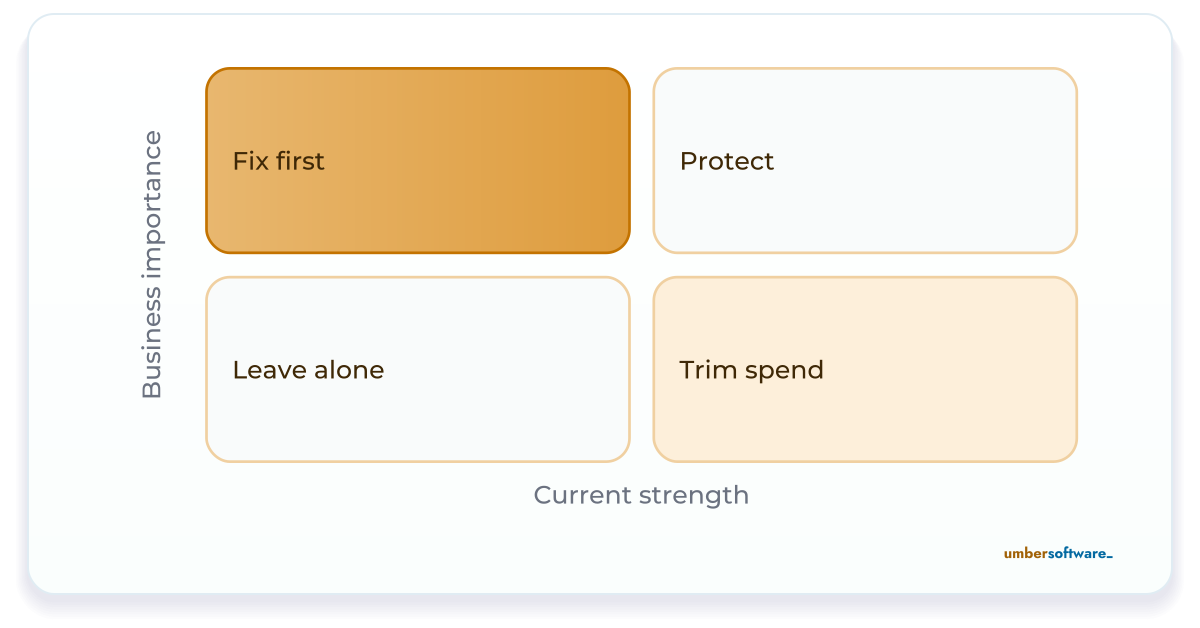
Finally, mark each gap with a type: people, process, data or software. Only the software gaps belong in this strategy, and the other three go to the owners who can fix them. I have seen strategies grow by a third simply because nobody sorted out which gaps software could close.
Layer 3: The Priority Formula
Every initiative gets one score. The formula is simple on purpose:
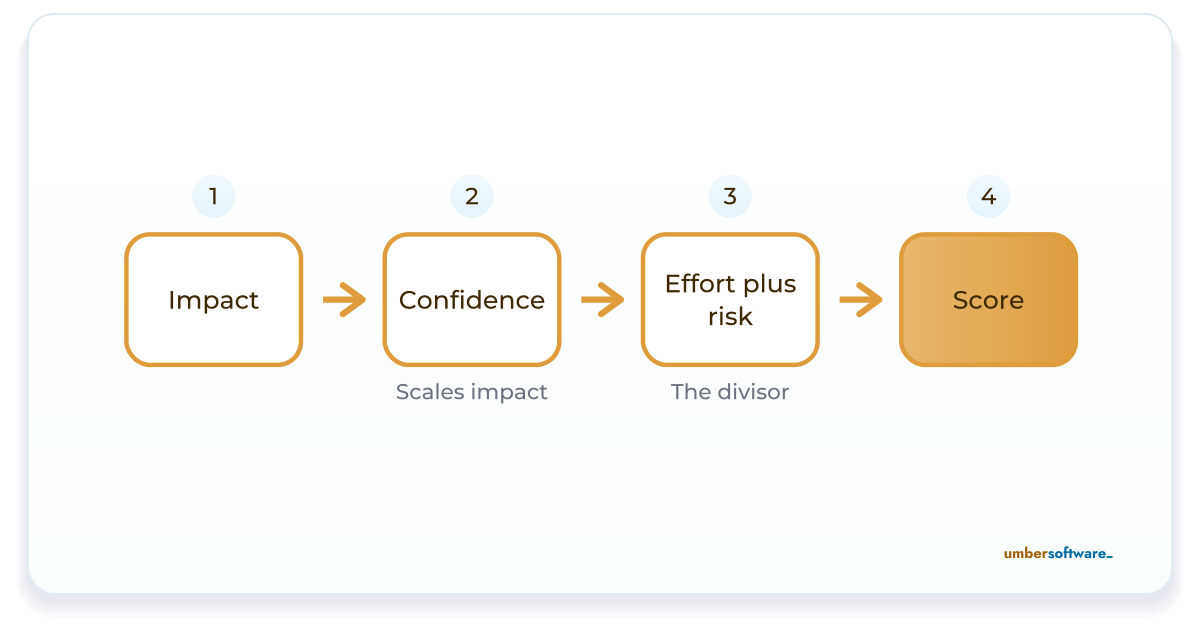
Priority score = (Outcome impact × Confidence) ÷ (Effort + Risk)
Score outcome impact from 1 to 5 by how much the initiative moves one of your outcomes. Confidence is a percentage between 50 and 100 that expresses how sure you are of that impact, based on evidence such as a pilot or a comparable project. Effort is a 1 to 5 scale for cost and time. Risk is a 1 to 5 scale for technical, security and change risk. Divide impact weighted by confidence by the sum of effort and risk.
The confidence factor matters most. It punishes ideas that sound great and have no evidence, and it rewards the boring initiative with a proven result.
| Initiative | Impact | Confidence | Effort | Risk | Score |
|---|---|---|---|---|---|
| Integration layer for orders and stock | 5 | 80% | 3 | 2 | 0.80 |
| Consolidate three project tools | 3 | 90% | 2 | 1 | 0.90 |
| Rebuild the customer portal | 4 | 50% | 5 | 4 | 0.22 |
| Pipeline security scanning | 3 | 90% | 1 | 1 | 1.35 |
| Demand forecasting module | 4 | 60% | 4 | 3 | 0.34 |
Check the arithmetic on the first row: 5 × 0.8 = 4.0, divided by (3 + 2) = 0.80. On the last row, 4 × 0.6 = 2.4, divided by 7 = 0.34. The example numbers are illustrative, chosen to show how the formula behaves.
Reading the Scores Without Fooling Yourself
The ranked list reads: security scanning, tool consolidation, integration layer, demand forecasting, portfolio rebuild. The rebuild ranks last because confidence is low and effort and risk are high, not because it is a bad idea. Its confidence can rise if you run a cheap prototype, and the score will rise with it. That is the formula doing its job: it tells you what evidence to go and get.
Watch for two traps. Teams game the scores to protect favorite projects, so ask for the evidence behind every confidence value. And teams treat a score of 0.80 against 0.90 as a real difference. It is not. Treat items within about 20 percent of each other as tied and decide on dependencies, because sometimes the lower-scored initiative unlocks the higher one.
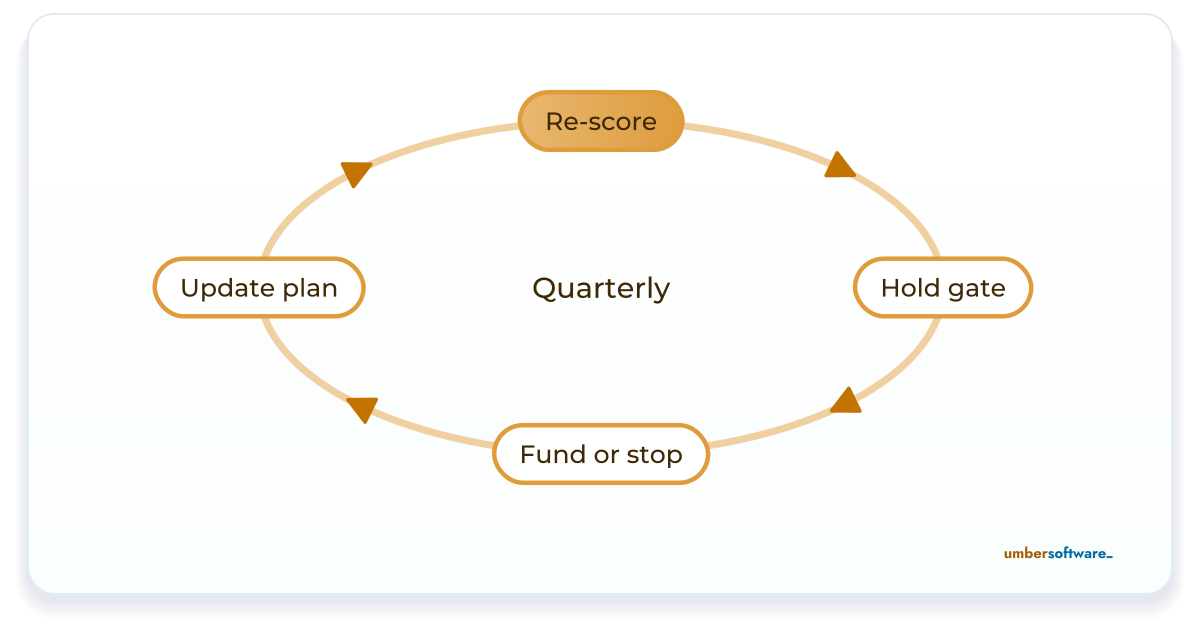
One more habit makes the formula useful: re-score at every quarterly review. Confidence is the number that should move most. A pilot that works lifts it from 60 to 85 percent, and a pilot that stalls drops it to 40. Impact and effort change slowly, while confidence follows the evidence, so the ranked list shifts for good reasons. When a sponsor asks why an initiative moved down, you can answer with the evidence that changed, and the conversation stays calm.
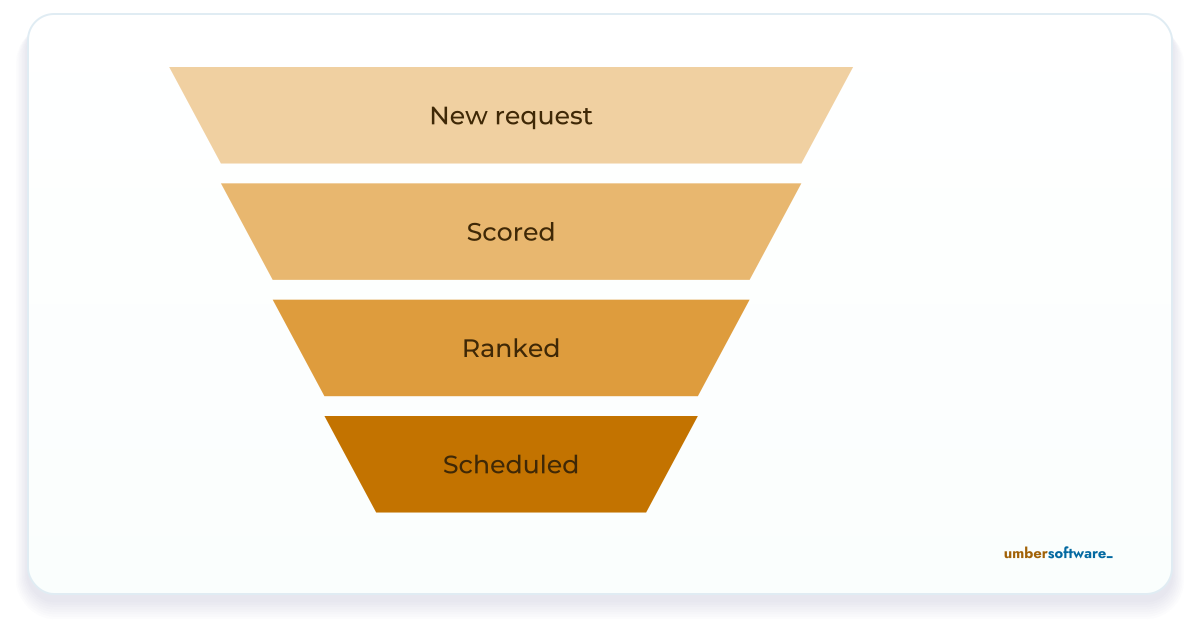
Use the same formula for requests that arrive between reviews. A new idea from the sales team gets the five scores, goes onto the list and finds its place. If it ranks in the top three, it replaces an item of similar size, and the swap is written down. This keeps urgency honest: anything can jump the queue, but it has to displace something visible.
Layer 4: Architecture Rules That Fit on One Page
Architecture rules keep the estate coherent when many teams make local decisions. Write five to ten, each as a sentence with a reason. Examples: every system exposes a documented API; each data domain has one owning system; new systems use the approved identity service; buy before you build unless the capability is a differentiator.
Each rule needs an exception path, or people will ignore the rule. An exception is a short written request with an expiry date and an owner. In my reviews, the exception log is a better indicator of strategy health than the rules themselves, since it shows where the rules do not fit reality.
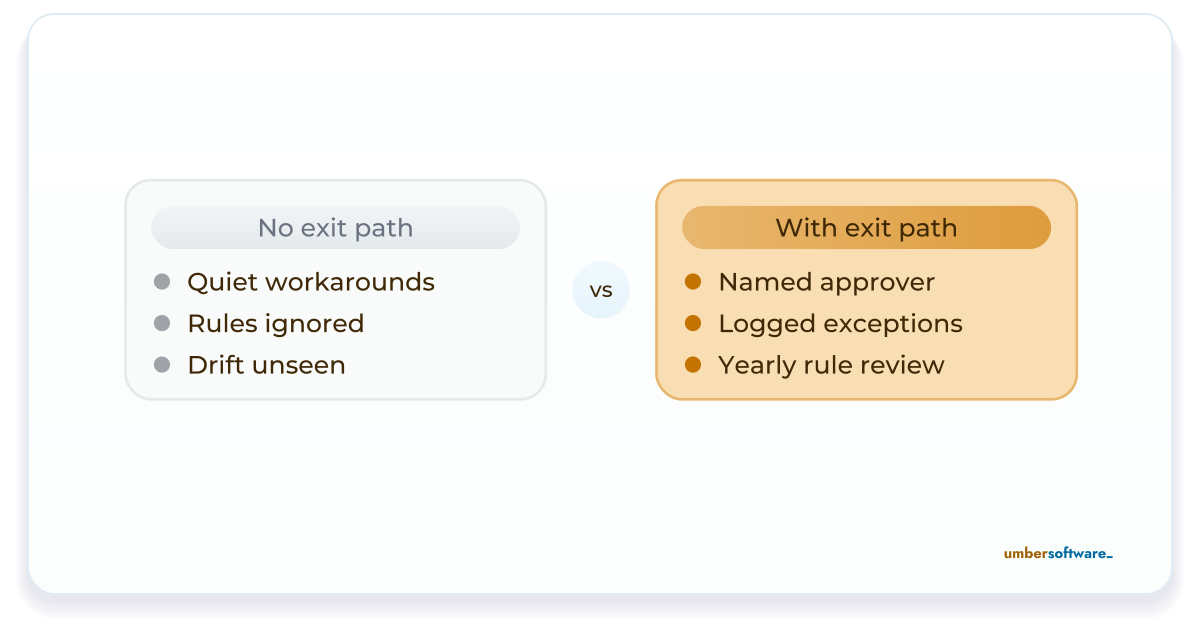
Treat the rules as a living list. Once a year, read through the exception log and promote any exception that keeps recurring into a rule or a retired rule, so the list matches how your teams actually work.
Layer 5: Governance Without Bureaucracy
Governance means a rhythm, not a committee. Review the portfolio quarterly for one hour with the scored list on screen. Fund in stages: a small discovery budget, a bigger pilot budget and full funding only after the pilot meets agreed targets. Write the kill criteria before the stage starts, for example a minimum adoption rate by a date.
Once the decisions exist, put them on a calendar. My software strategy roadmap turns the ranked list into a 12-month plan with quarterly gates. Keep the framework itself stable, because changing the rules every quarter destroys trust in them.
How to Choose a Starting Point for Your Company
You do not have to run all five layers in detail the first time. Match the depth to your size and the decisions waiting on you:
- Under 50 people: run layers 1 and 3 in one workshop and keep the rest informal.
- 50 to 500 people: add the capability map and five architecture rules.
- Over 500 people or several business units: run all five layers and review quarterly with a steering group.
- Facing a merger or major platform change: do layers 1 to 3 first, because they show where the estates overlap.
Whatever the size, finish with a two-page document that the whole company can read in ten minutes. If you want an outside view on your layers or a facilitator for the scoring sessions, a short call usually settles the scope.
Questions About Software Strategy Frameworks
What Is a Software Strategy Framework?
It is a structure that turns business goals into software decisions. It names the layers you must decide on, such as outcomes, capabilities, portfolio, architecture and governance, and gives a repeatable way to rank initiatives. A framework keeps your strategy consistent when people and priorities change.
How Many Layers Should a Framework Have?
Five is enough for most companies. Fewer layers leave gaps, usually in governance, and more layers produce documents nobody reads. Each layer should produce one page or one table, which you can update in a day.
Is the Priority Formula Meant to Be Exact?
No. It gives you a ranked list to argue about, which is far better than an unranked list. Scores are estimates, so look at the order and the gaps between items, not at decimals. If two initiatives are close, decide on risk and dependencies.
How Do I Get Honest Scores for Value and Effort?
Score in a group of three to five people from engineering, the business and finance, and ask each person to score alone before the discussion. Large differences show where you lack information. Write down the assumption behind every score so that you can check it later.
How Is a Strategy Framework Different from a Roadmap?
The framework holds the rules for deciding what matters and why. The roadmap is the dated plan that results from applying those rules. You revisit the framework yearly and the roadmap quarterly.
Can a Small Team Use This Framework?
Yes. A team of ten can run all five layers in a half-day workshop and keep the output on two pages. Keep the formula and the guardrails, and skip the formal governance meetings until the estate grows.
What Should I Do When the Framework Conflicts with a Leader's Pet Project?
Score the project like any other and show the result. If it ranks low, ask what assumption would need to be true for it to rank high, and test that assumption cheaply. This turns an opinion fight into a small experiment.
Please note: this guide is general information and not legal, financial or tax advice. Numbers and examples are typical-project estimates; confirm current details with your providers and advisers.
Did this article help you?
Thanks, noted.
Whitney Sorensen
Whitney leads the Umber editorial team and works with the consultants to turn real client projects into practical guides on software selection, custom development, integration and legacy modernization. Before joining Umber, she spent years writing and editing for engineering and IT teams. She has since reviewed architecture audits, system selections and modernization plans from client projects across industries from manufacturing to healthcare. She works remotely from the USA.