Main Points
- Plan four quarters, with detail for the next two and an outline for the rest.
- Load the plan to 80 percent of capacity so that urgent work does not break it.
- Review every quarter against outcome metrics and drop what no longer ranks high.
- Use the first 30 days to fix ownership and baselines before you start building.
A strategy without a calendar is an opinion piece. The roadmap is where decisions meet capacity, and where most companies discover they planned three years of work for one year of people. I build these plans as part of software strategy consulting, and the structure below is the one I reuse most.
It assumes you already have a ranked list of initiatives. If you do not, the scoring method in my software strategy framework produces one in a workshop or two. The plan below shows how to place that list across four quarters.
The 12 Months on One Page
Copy this table into your own document and replace the example work with your top initiatives. The themes matter more than the specific items: lay the groundwork, deliver the quick wins, take on the hard change, then lock in the gains.
| Quarter | Theme | Typical work | Quarter-end gate |
|---|---|---|---|
| Q1 | Ground and clear | Baselines, owners, tool inventory, first consolidation, security scanning in pipelines | Baselines recorded, owners named, first tool retired |
| Q2 | Quick wins and pilots | Top-ranked initiative pilot, integration of the worst manual flow, architecture rules published | Pilot meets its criteria, rules adopted by all teams |
| Q3 | Hard change | Scale the pilot, start the platform or modernization work, move to product-team funding | First platform module live, outcome metric moving |
| Q4 | Lock in and reset | Retire replaced systems, document, review scores, draft next year | Retirement dates met, next year plan agreed |
Set the Capacity Rule Before You Plan Anything
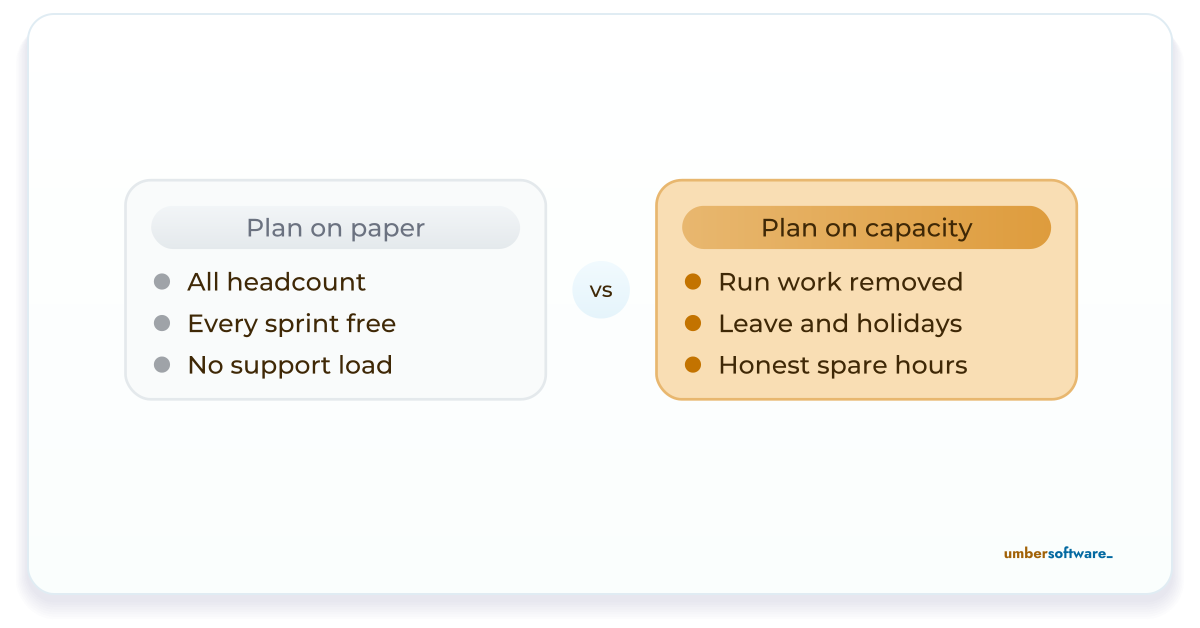
Most roadmaps fail on arithmetic. Add up the engineer-weeks you really have, subtract holidays, support work and the usual stream of urgent requests, and you will likely be left with half of what the plan assumes. I use a simple split: 60 percent for committed work such as run and maintenance, 20 percent for strategic initiatives and 20 percent for the unexpected.
That second number is the one the roadmap competes for. If you have 20 engineers and about 45 working weeks each, you start with 900 engineer-weeks. A 20 percent strategic share is 180 engineer-weeks for the year, perhaps 45 per quarter. Three initiatives that each need 60 weeks do not fit, and it is better to find that out in January than in September.
Q1: Ground and Clear
The first quarter is deliberately unglamorous. In the first 30 days, name an owner for every system in your top ten, record baselines for lead time, incidents and run cost, and list every tool with its renewal date. In the next 60 days, retire the clearest duplicate, turn on dependency and secret scanning in your pipelines and write the first version of your architecture rules.
Teams are tempted to skip this and start the big project. I have seen that fail the same way every time: nobody can prove the project helped, because nobody measured the starting point. The Q1 baseline pays off at every later gate. Several of the moves here, such as consolidating tools or writing down data ownership, appear in my software strategy examples, so you can borrow the steps.
A Sample 12-Week Sequence
- Weeks 1 to 2: confirm outcomes and owners with the business sponsor.
- Weeks 3 to 4: record baselines and build the tool and renewal register.
- Weeks 5 to 8: run the scoring workshop and publish the ranked list.
- Weeks 9 to 10: switch on pipeline scanning and write the first rules.
- Weeks 11 to 12: retire the first duplicate tool and hold the Q1 review.
Q2: Quick Wins and Pilots
In the second quarter, pick the one or two top-ranked initiatives and run them as pilots with written exit criteria. Choose work with a visible result inside eight to ten weeks, such as automating the manual flow that causes the most errors. A quick win here is your political capital for the harder work in Q3.
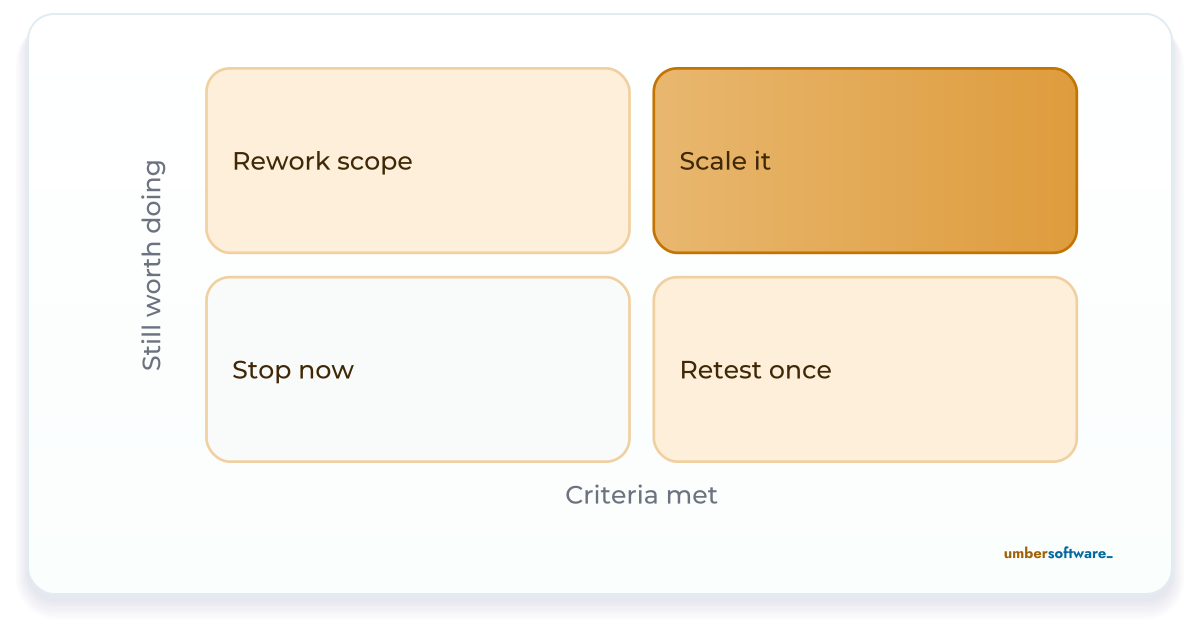
Publish your architecture rules and make the exception process real. Hold one open session where teams can challenge the rules, because rules that were never debated get quietly ignored. At the end of the quarter, compare the pilot's numbers to the Q1 baseline, and decide whether to scale, change or stop it. This is the first real use of the kill criteria.
Sequence by Dependency, Not by Excitement
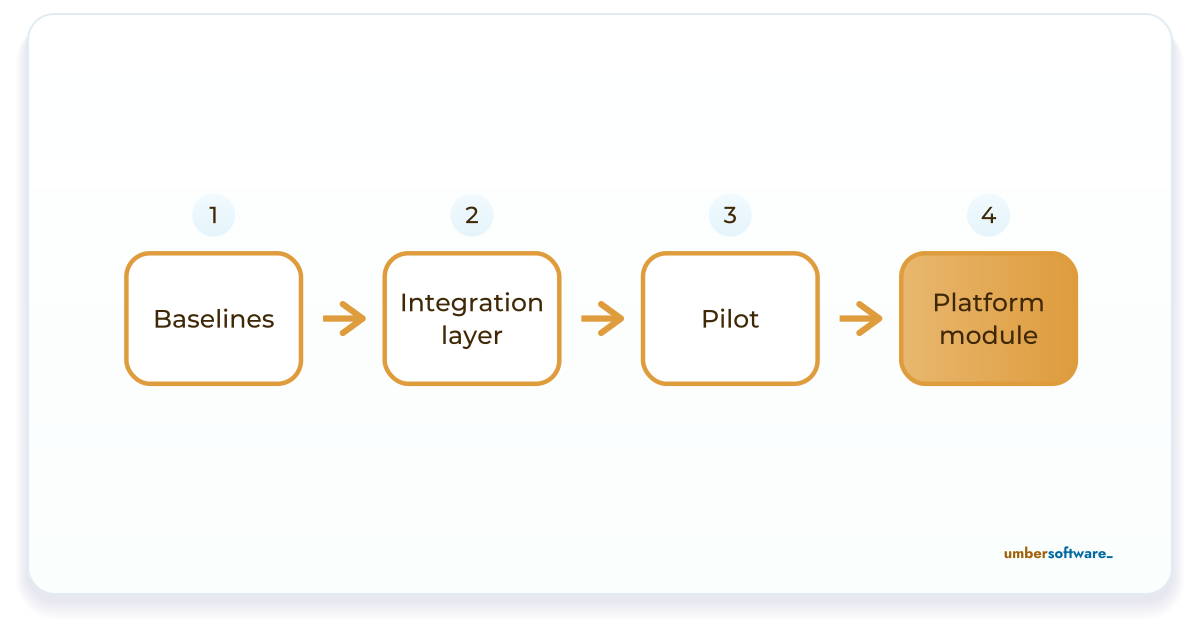
Once the quarters have themes, put the work inside them in dependency order. Some initiatives only make sense after another has landed. Data ownership comes before integrations, because integrating two systems that both claim to own customer records just automates the disagreement. Integrations come before automation, because an automated process on top of manual data transfers keeps the manual steps. Security scanning comes early, since it protects everything built afterwards.
Draw the chain on one page before you assign dates. Each arrow means "must finish before". Anything with no arrows in or out can move freely and is a good filler for gaps in capacity. Anything with many arrows out is a bottleneck: give it your best people and your earliest slot. When a bottleneck slips, tell the sponsor immediately which downstream work moves with it, because the plan's credibility rests on those small honest updates.
Q3: Take On the Hard Change
The third quarter is for the initiatives that need real capacity: a platform migration, an architecture split or a switch to product-team funding. By now you have a baseline, proven pilots and political support. Start the long work in slices, and keep each slice shippable within two months so that the quarter-end gate has something to inspect.
If the hard change is modernizing a legacy system, the phase plan in my software modernization roadmap fits inside this quarter and the next. Expect friction in this quarter. Teams will push back on new funding rules, and at least one initiative will run late. Handle it by reviewing at the quarter gate and not by extending every deadline silently.
Q4: Lock In and Reset
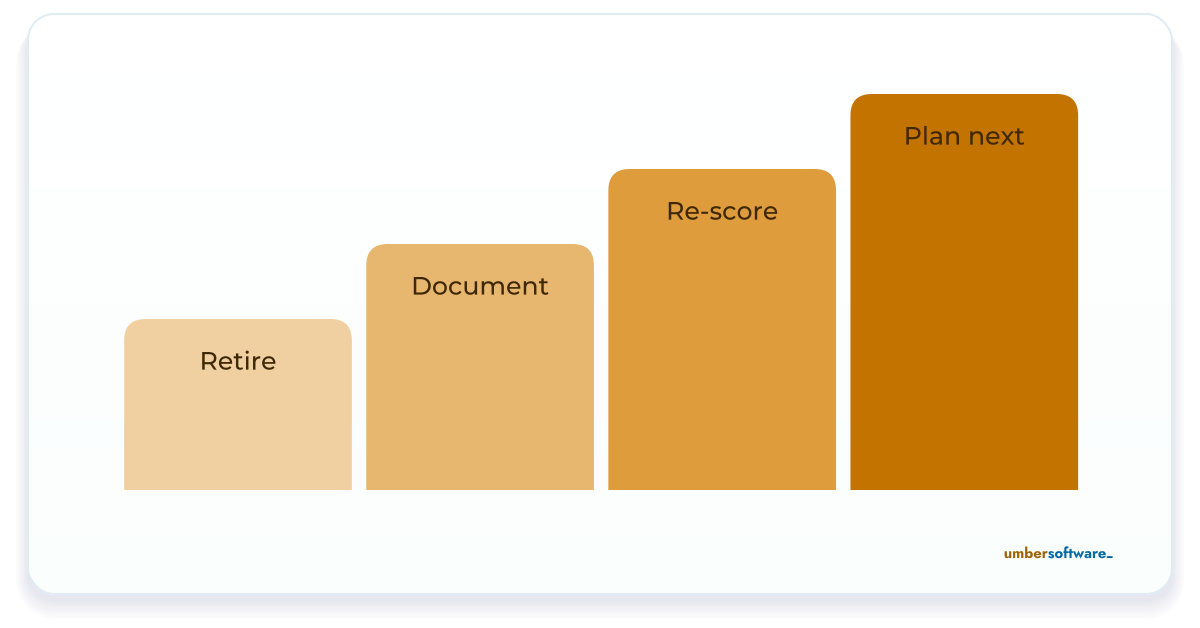
The final quarter is about finishing. Retire the systems you replaced, because otherwise you pay for both for another year. Write the documentation, hand the runbooks to the owning teams and record the final numbers against your Q1 baseline. Show the sponsor a one-page before-and-after: lead time, incident count, run cost and the outcome metric for each initiative.
Then reset. Re-score the whole list with what you learned, since some ideas gained evidence and others lost it. Draft next year's roadmap while the details are fresh, keeping a detailed plan for two quarters and an outline for the rest. Plan the reset meeting in October, not December, or it slips to the following February.
A final point on the plan itself: write the "not this year" list on the same page as the roadmap. Naming the good ideas you are deferring, with the reason, saves you from re-arguing them every month. It also shows the business that the plan is a set of choices and not a pile of promises. In my experience, sponsors trust a roadmap more when it says no to something, because it proves that the capacity math was real.
Keep the document short enough to read in ten minutes: one table for the four quarters, one page per quarter for the detail, the capacity rule and the not-this-year list. Anything longer will be skimmed, and a skimmed roadmap is soon ignored by the teams who most need to follow it.
How to Run the Quarterly Review
Keep the review to 90 minutes with the same agenda every time. Start with the numbers: outcome metrics, lead time, deployment frequency and incidents. Then go through each initiative with three questions. What shipped? What slipped and why? Does it still rank high on today's scores? Anything that fails the last question gets dropped or paused, and the decision is written in the plan with the date.
Invite the sponsor, the heads of the affected teams and finance. Send the one-page summary a week before the meeting so that the time is used for decisions. The healthiest roadmaps I see change by about a quarter of their content each review, and they are still recognizable as the same plan.
How to Choose What Goes Into Your Own Plan
Take your ranked list and apply four filters before anything goes on the calendar. Does it fit inside the strategic capacity share? Does it have a named business owner? Does it have a measurable outcome and a kill criterion? Is there a dependency that must land first? Work that fails a filter goes back to the list, with a note on what is missing.
- Fill Q1 and Q2 in detail and Q3 and Q4 as themes with two or three candidates.
- Put dependencies in front: data ownership before integrations, integrations before automation.
- Leave one open slot per quarter for the best idea that appears mid-year.
- Agree the quarter gates with the sponsor before the plan starts.
If you want a second pair of eyes on the capacity math or the sequencing, a short call with an architect usually finds the overloaded quarter within minutes.
Questions About Software Strategy Roadmaps
What Is a Software Strategy Roadmap?
It is a dated plan that turns your software strategy into quarterly work: what you start, what you stop, who owns it and how you will know it worked. It sits between the strategy, which holds your rules and priorities, and the project plans for individual teams.
Why Plan for 12 Months and Not 3 Years?
Twelve months is far enough to deliver real change and near enough to plan with confidence. I add a loose outline for years two and three, and I keep only the first two quarters detailed. Anything further out will change as you learn.
How Much of the Plan Should Be New Projects?
Keep about 60 percent of capacity for committed work, 20 percent for the strategic initiatives from the plan and 20 percent for the unexpected. If you load the plan to 100 percent, the first outage or urgent request breaks it.
Who Should Sign Off on the Roadmap?
A business sponsor and the head of engineering should both sign. Finance should confirm the budget for the first two quarters. Sign-off by engineering alone produces a plan the business ignores, and sign-off by the business alone produces one that engineering cannot deliver.
How Do I Handle Requests That Arrive Mid-Year?
Score them with the same formula you used for the plan, then swap them in at the quarterly review in place of something of equal size. Urgent items can jump the queue, but write down what they displaced.
What If a Quarter Goes Badly?
Hold a short review: what was planned, what shipped, why the gap. Move unfinished items into the next quarter only if they still rank high on the current scores. Cut the rest. A roadmap that never drops anything is a wish list.
Which Metrics Belong on the Roadmap?
Use one outcome metric per initiative plus three delivery health numbers: lead time for a change, deployment frequency and incidents per release. Report them every quarter next to the plan so that the business sees progress in its own terms.
Please note: this guide is general information and not legal, financial or tax advice. Numbers and examples are typical-project estimates; confirm current details with your providers and advisers.
Did this article help you?
Thanks, noted.
Whitney Sorensen
Whitney leads the Umber editorial team and works with the consultants to turn real client projects into practical guides on software selection, custom development, integration and legacy modernization. Before joining Umber, she spent years writing and editing for engineering and IT teams. She has since reviewed architecture audits, system selections and modernization plans from client projects across industries from manufacturing to healthcare. She works remotely from the USA.