Main Points
- Implementation services usually cost more than the software in year one.
- Use one five-year total cost formula so every vendor quote compares.
- Hidden items such as data work, integrations and staff time add 15 to 30 percent.
- Ask for renewal caps and a written five-year price table before you sign.
The price on an enterprise software proposal is rarely the price you pay. License or subscription fees make up only a slice of the first year, and the rest arrives as partner hours, data work, integrations, training and the staff time your own people spend in workshops. When you work with an enterprise software consulting team, the cost model is usually the first thing we rebuild, because a vendor quote covers perhaps a quarter of the real number.
Below you get a cost formula, typical ranges by company size, a worked example with a five-year total and the hidden items to price before you sign.
The Formula for Total Cost of Ownership
Use one formula for every vendor so the numbers compare. Total cost of ownership over five years equals subscription or license fees, plus implementation services, plus integration and data work, plus training and change, plus internal staff time, plus annual support and upgrades, plus a contingency.
ERP Research's 2026 cost breakdown reports that implementation typically costs 1x to 3x the first-year software fee, with a median around 1.5x to 2x, and that five-year ownership runs 3x to 5x the license fee. Those ratios are a handy sanity check. If your proposal shows implementation at 0.3x the license, ask what was left out.
| Cost line | Typical share of first year | What it includes |
|---|---|---|
| Implementation services | 50 to 70% | Partner hours for design, configuration, testing and go-live support |
| Software subscription or license | 20 to 30% | Per-user or per-module fees, environments, add-ons |
| Everything else | Remainder | Hardware or cloud hosting, training materials, backfill staff, travel |
What Companies Pay by Size
Ranges differ widely by scope, but published benchmarks give you a frame. The implementation budgets below come from ERP Research and exclude ongoing subscription and support fees.
| Company size | Implementation budget | Typical timeline |
|---|---|---|
| Small (1 to 50 users) | $25,000 to $150,000 | 2 to 6 months |
| Mid-market (51 to 250 users) | $150,000 to $750,000 | 4 to 12 months |
| Upper mid-market (251 to 1,000 users) | $500,000 to $2,000,000 | 8 to 18 months |
| Enterprise (1,001+ users) | $1,500,000 to $5,000,000+ | 12 to 36 months |
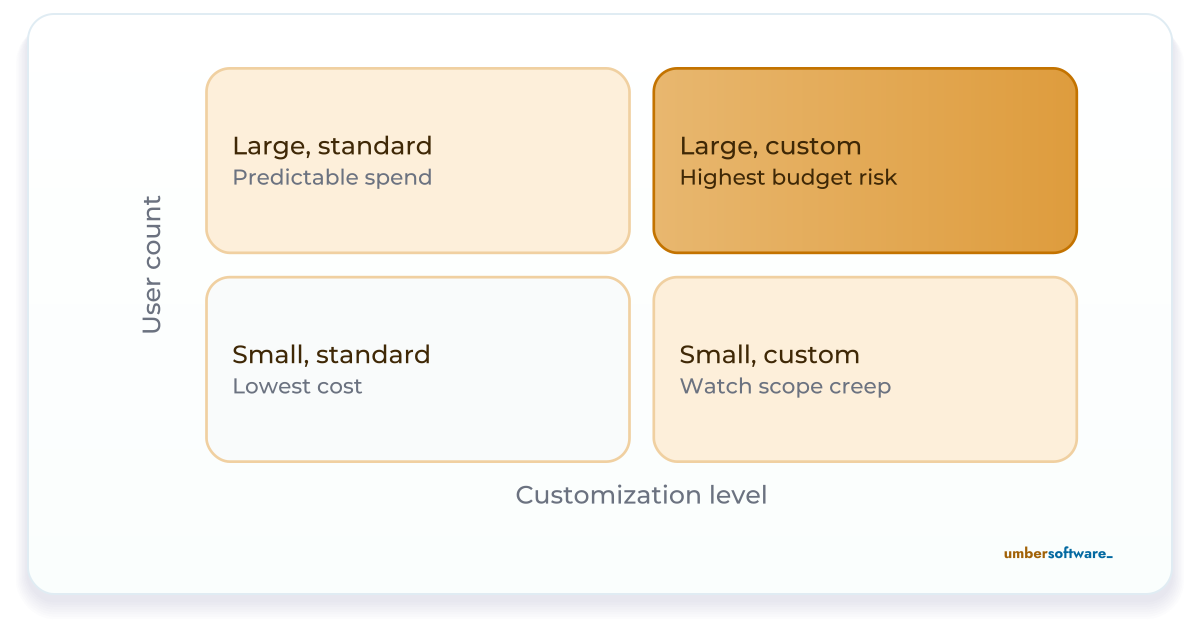
The same source cites roughly $7,200 per user over five years as a benchmark, and notes that per-user cost falls as headcount rises because fixed project costs spread across more seats. Use per-user figures to check a quote, not to build a budget. A 40-user company with three plants will cost more than a 40-user company with one office.
How Vendors Charge You
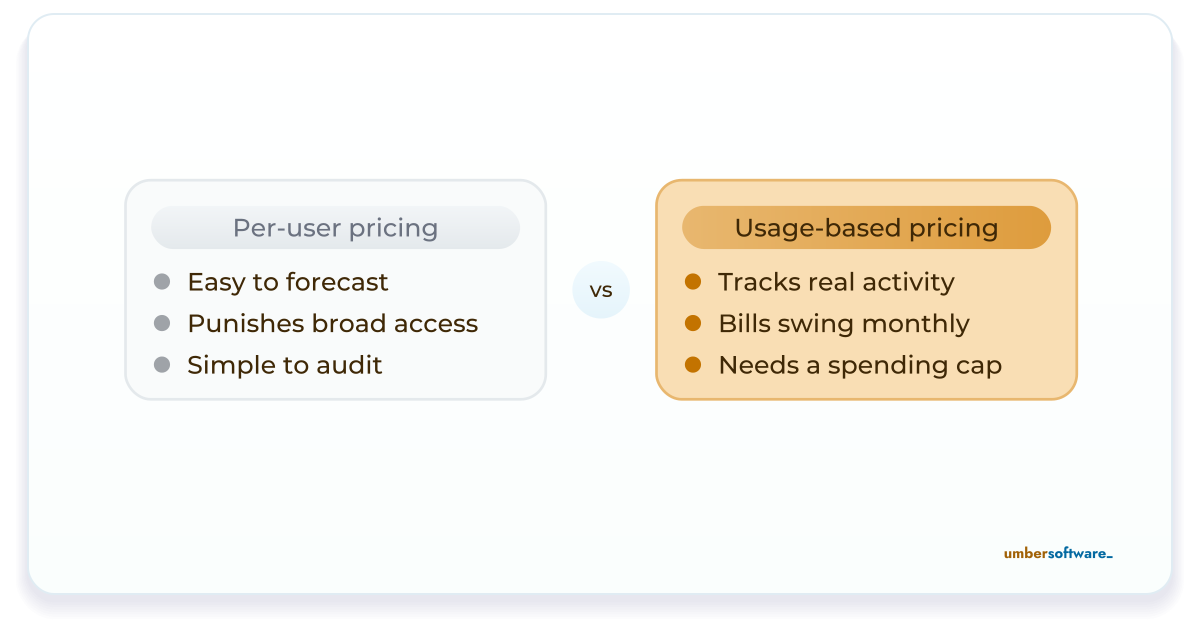
Pricing models differ more than the headline numbers suggest, so compare the model before you compare the price. Public price pages show how wide the range is. Microsoft's Dynamics 365 Business Central lists a Team Members plan from $8 per user per month on Capterra, while Odoo shows a Standard plan at $24.90 per user per month on G2. At the other end, Capterra lists Oracle Fusion Cloud ERP from US$50,000 and tells buyers to contact Oracle for detailed pricing. Many other vendors, such as NetSuite and SAP, publish no list price at all.
Read the model carefully. Per-user pricing is simple but punishes broad access, so ask which roles count as full users and which are cheap light users. Per-module pricing grows each time you switch on a feature. Revenue-based or transaction-based pricing can jump with your growth. Ask each vendor for a three-year price protection clause and the renewal uplift cap. Without a cap, a 7 to 10 percent yearly increase is easy to miss in a contract.
If you are choosing between platforms, my ranking of the best ERP software shows how a dozen systems charge, and the ERP software cost guide goes deeper on that single category.
A Worked Example: 150 Users Over Five Years
Take a manufacturer with 150 users on a mid-market cloud platform. The numbers below are my own illustration, built from the ratios above, so replace them with your quotes. The point is the shape: the subscription is the smallest of the big lines.
| Line | Year 1 | Years 2 to 5 (total) | Five-year total |
|---|---|---|---|
| Subscription ($1,200 per user per year) | $180,000 | $756,000 | $936,000 |
| Implementation partner | $360,000 | $0 | $360,000 |
| Integrations and data migration | $90,000 | $60,000 | $150,000 |
| Training and change | $60,000 | $40,000 | $100,000 |
| Internal staff and backfill | $120,000 | $80,000 | $200,000 |
| Support, upgrades and enhancements | $0 | $240,000 | $240,000 |
| Contingency (15%) | $117,000 | $0 | $117,000 |
| Total | $927,000 | $1,176,000 | $2,103,000 |
Subscription is 44 percent of the five-year total here, and the total is 2.2 times the subscription. That sits below the 3x to 5x benchmark because this example leaves out extra modules, customizations and hosting. A real plan with those lines would climb toward the benchmark, so check yours against it.
The Hidden Costs to Price Before You Sign
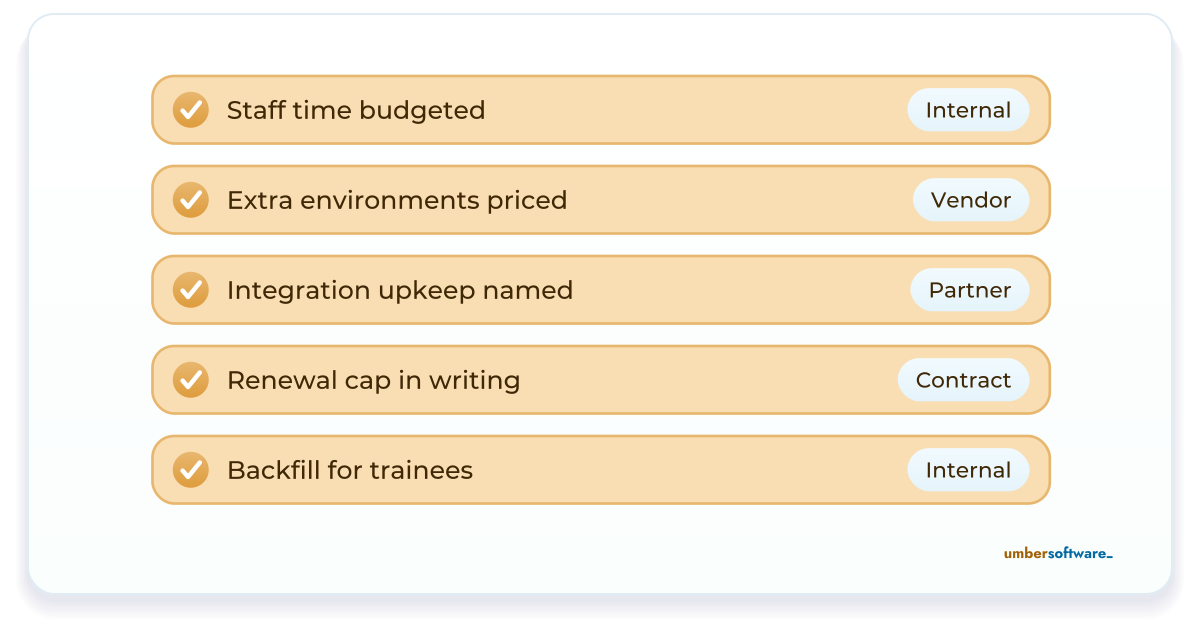
ERP Research estimates hidden costs add 15 to 30 percent to the real total on top of quoted figures. From my own project reviews, five items account for most of the surprise.
- Data cleanup and migration, especially duplicate customers and part numbers.
- Integrations to the systems you keep, such as shop floor, banking, tax or e-commerce.
- Extra environments for testing and training, which some vendors bill separately.
- Your own staff time. Ten key users at 30 percent for a year is three full-time salaries.
- Annual renewal uplifts and the price of add-on modules you switch on later.
Staff time deserves special attention because it never appears on a vendor invoice. If you count it, your project is more expensive than the quote and still a good investment. If you do not count it, you will run short on people in month six. The software asset management consulting team I work with tracks license usage after go-live, which stops you from paying for seats nobody uses.
Where You Can Safely Cut Cost
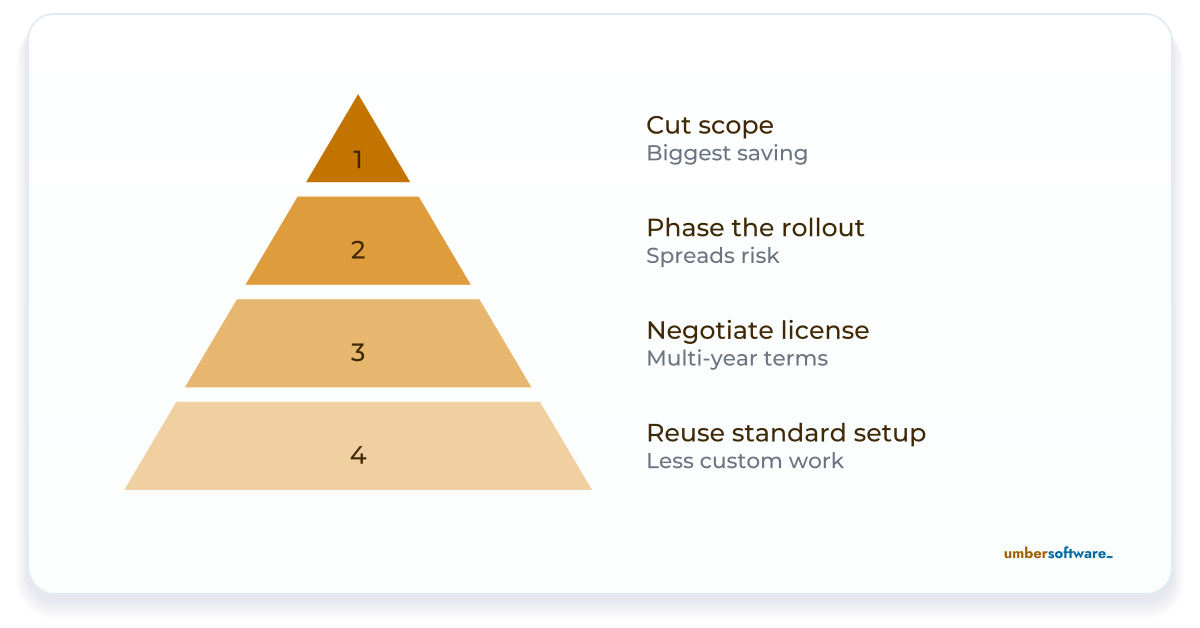
Some savings are real and some only move cost to a later year. Real savings come from fewer customizations, a smaller first release and cleaner data before the partner starts. Cutting training or testing never saves money, because the cost reappears as lost productivity and defect fixing after go-live.
Negotiate the license as hard as the services. Multi-year terms, volume tiers and a fair ramp-up for user counts are all standard asks. Partner rates have more room than most buyers expect, especially for a project of six figures or more. Ask for a blended rate and a cap on senior hours. My notes on software contract negotiation consulting list the clauses worth asking for.
Before you start, a rollout plan like the one in my guide to enterprise software implementation helps you see where costs arise by phase. And if you want to know where the market is heading before you sign a long contract, read the overview of enterprise software trends. Gartner forecast in April 2026 that worldwide software spending will reach $1.44 trillion this year, growing 15.1 percent, which tells you vendors have little reason to cut prices on their own.
When the Money Leaves Your Account
Cash timing matters as much as the total. Subscriptions are billed yearly in advance, often with the first invoice due at signing, while the project is still months from go-live. Partner invoices follow milestones or monthly time sheets. Training and extra environments tend to land in the last quarter before go-live, when the budget feels spent.
Ask your finance lead to map the cost by quarter, not just by year, and to check it against your cash plan. If the first-year outflow is tight, negotiate a delayed subscription start, a ramp in user counts or a milestone schedule that ties a share of the partner fee to a successful go-live. Vendors accept these terms more often than buyers expect, particularly when you sign before their quarter ends.
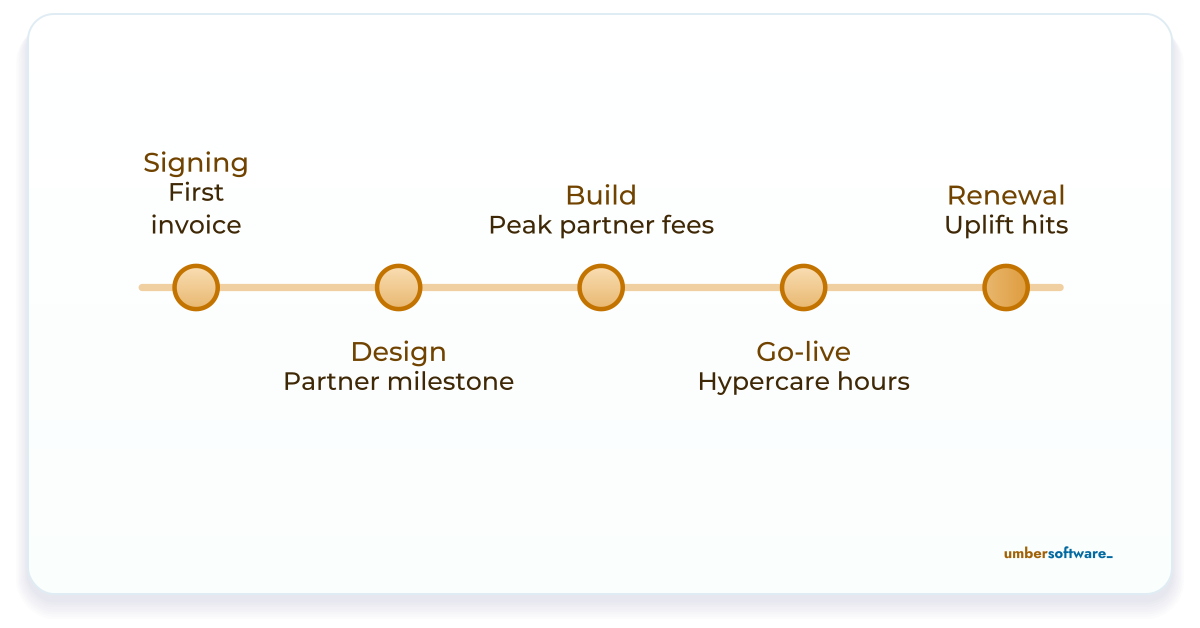
Finally, decide who holds the budget. A project budget held by IT and a license budget held by finance invites arguments over overruns. One owner, one number and a monthly report keep the conversation honest.
One more habit helps: keep a running cost log from the day you sign. Record every invoice, change order and internal hour against the model, and review the gap monthly. A gap of five percent in month three is a conversation. A gap of thirty percent in month nine is a crisis.
How to Build Your Own Cost Model
Start with a one-page sheet and fill it in this order, so nothing hides inside a lump sum.
- List users by type, and ask each vendor which types count as full users.
- Request a five-year price table that shows subscription, support and renewal uplift.
- Ask two partners for an estimate by phase, with assumptions and a change-order rate.
- Add your internal staff time at a loaded hourly cost.
- Add 15 percent contingency, and 30 percent if integrations are unclear.
- Compare total five-year cost per user across vendors, and check the ratios against the benchmarks above.
If a vendor refuses to give a five-year table, treat that as information about the renewal. An independent review of quotes, like the work done in software selection consulting, usually pays for itself on the first contract.
Sources
- ERP Research: ERP Implementation Cost Breakdown 2026
- Capterra: Dynamics 365 Business Central pricing
- G2: Odoo reviews and pricing
- Capterra: Oracle Fusion Cloud ERP
- SaaStr on Gartner: 2026 software spending forecast
Questions About Enterprise Software Cost
How Much Does Enterprise Software Cost?
It depends on users, scope and platform. Published implementation budgets run from about $25,000 to $150,000 for small companies and from $1.5 million to $5 million or more for large enterprises, before subscription fees. Your own number comes from a five-year model that includes subscription, services, integrations, training and internal time.
Is the License the Biggest Cost?
Usually not. In the first year, implementation services make up about 50 to 70 percent of the spend and the subscription about 20 to 30 percent, according to ERP Research. Over five years the subscription grows in weight, but services, integration and staff time still add up to more than many buyers expect.
What Hidden Costs Should I Plan For?
Data cleanup, integrations to the systems you keep, extra test environments, your own staff time and renewal uplifts. Estimates put hidden items at 15 to 30 percent on top of quoted figures. I add a 15 percent contingency to every model, and 30 percent when integrations are unclear.
Why Do Vendors Not Publish Prices?
Many price by user type, module and company size, and negotiate each deal. NetSuite and SAP publish no list price, while Business Central and Odoo show per-user figures on public pages. Ask each vendor for a written five-year quote with the same user counts so you can compare.
How Can I Reduce Implementation Cost?
Adopt standard processes instead of customizing, release in smaller steps and clean your data before the partner starts. Negotiate partner rates and cap senior hours. Cutting testing or training does not save money, because the cost returns as defects and lost productivity after go-live.
Should I Choose Per-User or Per-Module Pricing?
Per-user pricing is easy to forecast but gets expensive when many people need access, so ask about cheaper light-user roles. Per-module pricing grows each time you add a feature. Choose the model that matches how your headcount and scope will change over the next three years.
How Do I Check Whether a Quote Is Realistic?
Compare it against ratios: implementation of about 1x to 3x the first-year subscription, and five-year ownership of roughly 3x to 5x the license. A quote far below those ratios often leaves out integration or data work. A second opinion from an independent advisor is a cheap check.
Disclaimer: Prices, ratings and benchmarks change often and were checked when this article was last updated, so confirm them with each vendor. The worked example is my own illustration. Nothing here is legal, tax or financial advice.
Did this article help you?
Thanks, noted.
Whitney Sorensen
Whitney leads the Umber editorial team and works with the consultants to turn real client projects into practical guides on software selection, custom development, integration and legacy modernization. Before joining Umber, she spent years writing and editing for engineering and IT teams. She has since reviewed architecture audits, system selections and modernization plans from client projects across industries from manufacturing to healthcare. She works remotely from the USA.