Main Points
- An assessment checks structure, data, deployment, operations and team fit, not just code quality.
- Evidence beats opinion: use deployment history, incident logs and dependency maps.
- Score each area for readiness against the change you plan, such as growth or a migration.
- Finish with a ranked list of decisions that each have an owner and a date.
Teams usually ask for an assessment after something has already gone wrong: releases slow to a crawl, one outage too many, or a buyer who wants to know what they are acquiring. If you want outside help with the work, software architecture consulting covers the same ground I describe here.
I have run these reviews on systems from ten-year-old monoliths to fresh microservice estates. The method below is the short version I use. It tells you whether your architecture is ready for the next change, and what to fix first if it is not.
What a Software Architecture Assessment Actually Covers
An assessment answers one question: can this system carry the change you plan to make? The change might be double the traffic, a new product line, a cloud move or a larger team. Without that target, you collect opinions. With it, you can say that a finding matters, or that it does not.
The review looks at six areas. Each one has its own evidence, and each one fails in its own way.
| Area | What you check | Typical evidence |
|---|---|---|
| Structure | How modules or services depend on each other, and where the boundaries sit | Dependency graph, import maps, list of files that change together |
| Data | Who owns each table, how data is shared and how schema changes ship | Schema, migration history, list of services touching one database |
| Deployment | How code reaches production and how fast you can roll back | Pipeline config, lead time from commit to release, rollback log |
| Runtime | Performance under load, failure behavior and capacity limits | Load test results, incident reports, monitoring dashboards |
| Security | Access control, secrets handling, patch state and exposed surfaces | Dependency scan, access review, network diagram |
| Team fit | Whether the structure matches how people are organized and who knows what | Ownership list, onboarding time, key-person dependencies |
Do not try to score all six at full depth. Pick the two or three that bear on your planned change and cover the rest at a glance. A team preparing for growth cares most about runtime and data. A team about to split a monolith cares most about structure and deployment.
Set the Scope Before You Read a Line of Code
Write down three things on one page: the system boundary, the planned change and the decision the assessment will feed. If the decision is "should we rewrite or modernize in place", the review needs to compare costs of both, not just list flaws.
I also ask for a time box. Two to four weeks is plenty for one system. Anything longer and the system changes under your feet while you describe it. People also lose patience, and the findings arrive after the decision was made anyway.
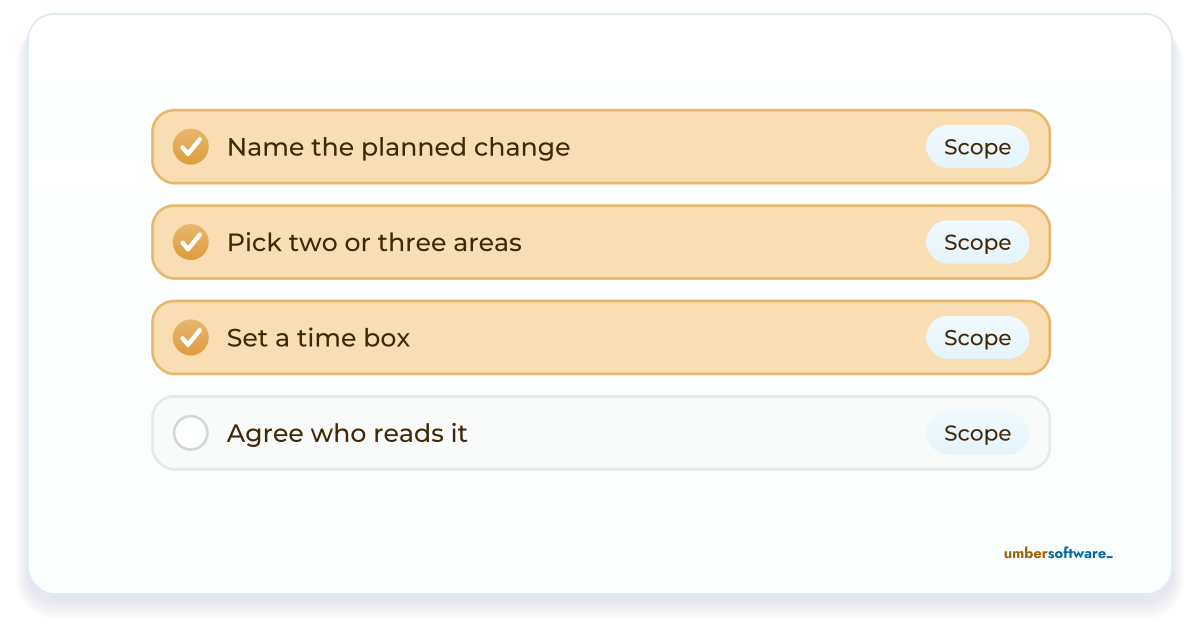
Agree who reads the result before you start. A report written for an engineering lead looks different from one written for a board. The first can say "the order service shares a database with billing". The second needs the cost of that sentence in time and money.
Collect Evidence From Four Places
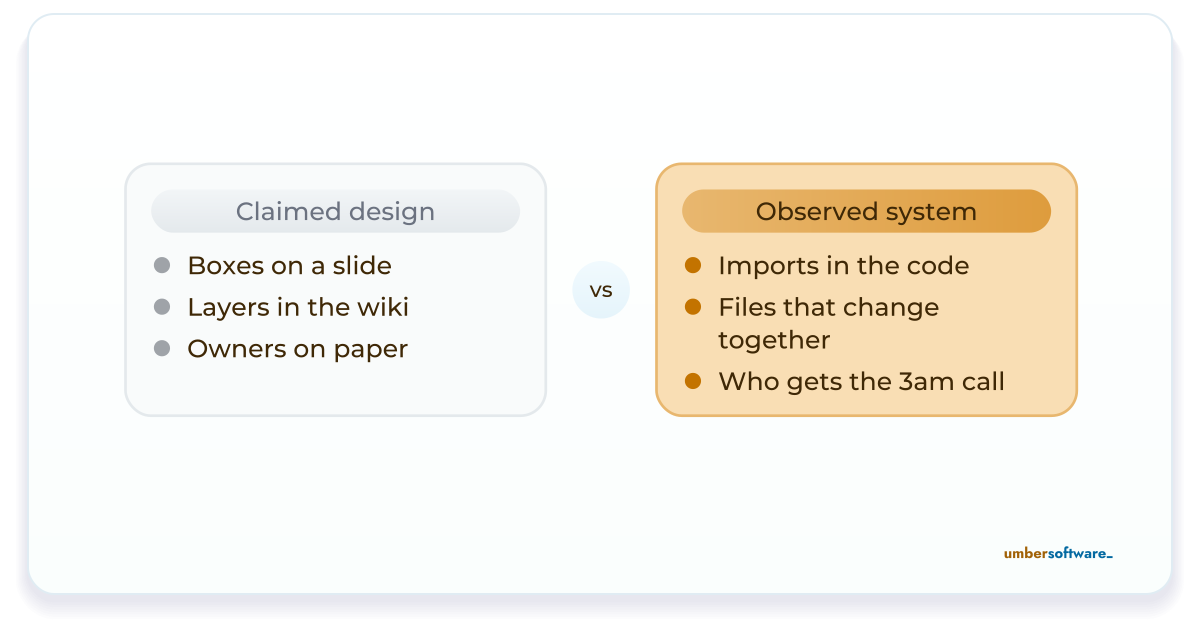
Opinions about architecture are cheap, and most teams hold strong ones. I ask for evidence from four sources and treat interviews as the place to explain the numbers, not replace them.
The Repository and Its History
Version history shows which files change together, which ones cause most bug fixes and which modules nobody has touched in two years. Files that change together but live in different services are a sign that the boundary is in the wrong place. A simple count of commits per module tells you more than most diagrams.
The Pipeline and the Release Record
Look at the time from commit to production, the failure rate of releases and how long a rollback takes. If a release needs a weekend and a checklist, your deployment architecture is the bottleneck, whatever the code looks like.
Incidents and Support Tickets
Read the last twenty incidents. Patterns appear fast: the same database, the same third-party call, the same batch job. Incident reviews tell you where the architecture hurts in practice rather than in theory.
Interviews With the People Who Change the System
Ask each person where they are afraid to make changes. The answers cluster around the same two or three places, and those are usually your highest-risk areas. I also ask what they would never ship on a Friday, which tends to reveal missing tests and manual steps.
If the system has no documentation, build a current-state diagram from this evidence and ask the team to correct it. The corrected diagram is the first real result of the assessment, and it often surprises the people who built the system. My software architecture framework article gives you a model for drawing that diagram in layers.
Score Readiness Against the Change You Plan
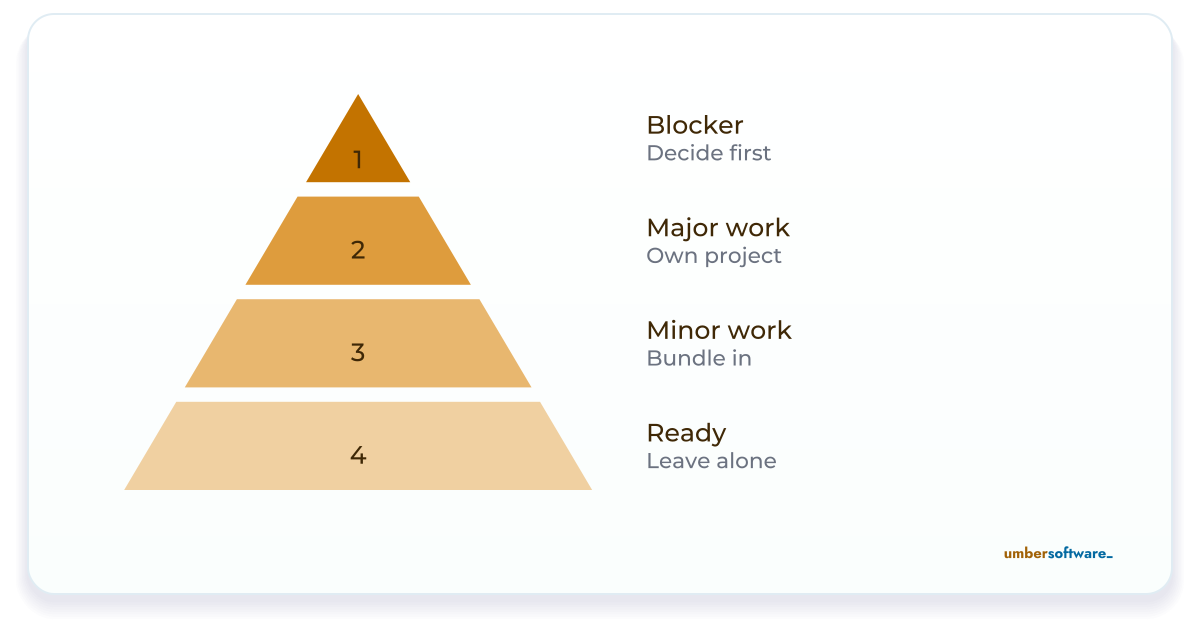
Scoring turns a pile of findings into a picture you can compare across areas. I use a simple four-level scale and always score against the target change.
| Level | Meaning | What you do next |
|---|---|---|
| Ready | The area handles the planned change with no extra work | Leave it alone |
| Minor work | Small fixes needed, each under a few days | Bundle with the feature work |
| Major work | A change of weeks, with a clear solution | Plan as its own project before the change |
| Blocker | The change cannot succeed without redesign | Decide first: redesign, reduce scope or accept the risk |
Resist averaging the scores. One blocker in the data area outweighs five areas that are ready. A system is only as ready as its weakest part for the change at hand.
Here is a realistic case. A logistics client wanted to triple order volume within a year. Structure and security scored as minor work. The runtime was a blocker: one nightly batch job locked the order tables for ninety minutes, and volume would have pushed it past dawn. The fix was a two-week change to process orders in slices. The assessment found it in the first week, long before the first peak season did.
Findings That Come Up Again and Again
Certain problems show up in most assessments I run. Knowing them helps you ask better questions in the first week.
- A shared database that several services write to, so no service can change its tables alone.
- A "core" module that every other module imports and that nobody owns.
- Configuration that differs between test and production in ways nobody has listed.
- Integrations that fail silently, with no alert and no retry.
- Key-person risk, where one developer is the only one who understands a critical part.
- A deployment path that works only from one laptop or one old build server.
Not every one of these needs fixing. A shared database is fine in a small system with one team. It becomes a problem when a second team arrives. That is why scoring against a planned change beats a universal checklist. If you do want a universal list to confirm nothing was skipped, the software architecture checklist covers the basics in eleven points.
Turn Findings Into Decisions
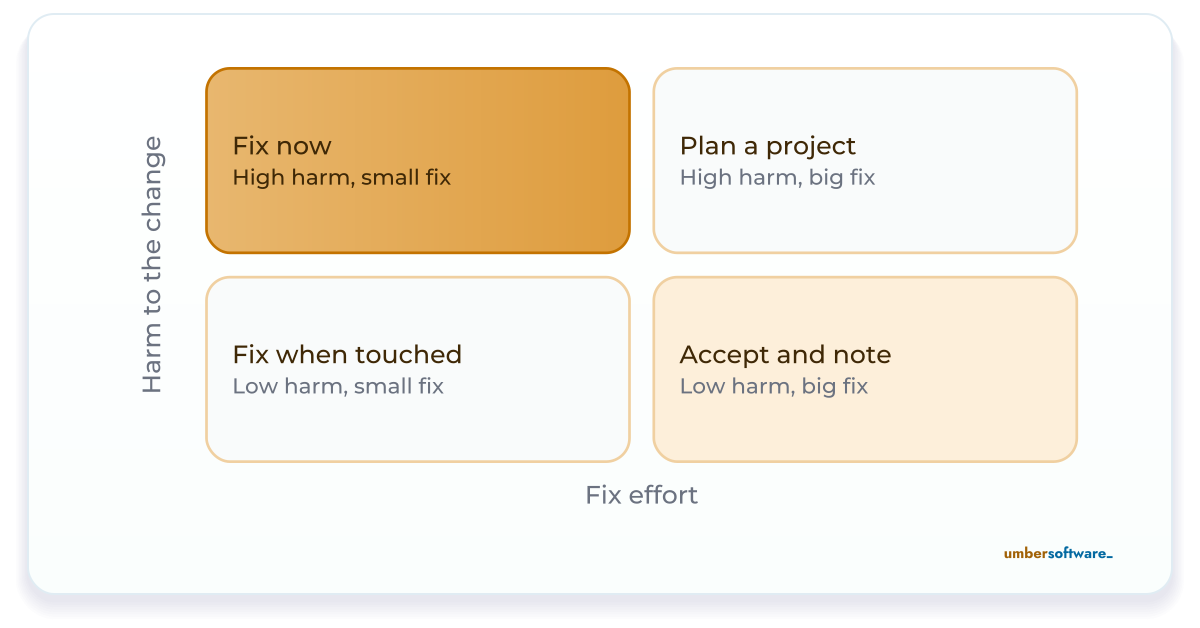
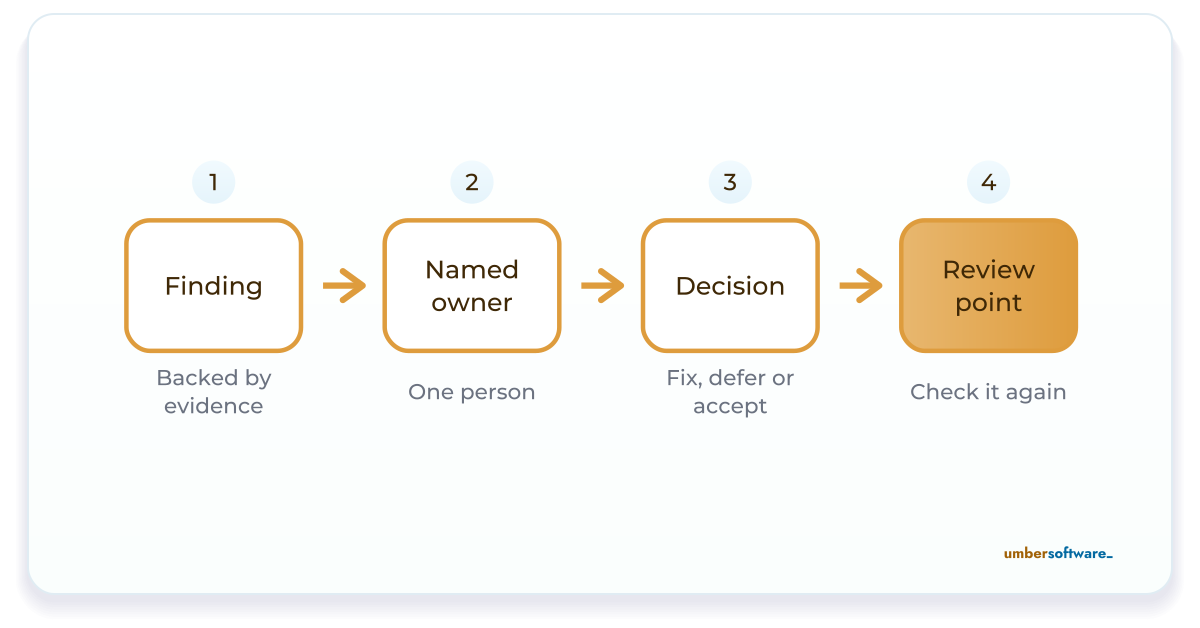
The report is not the product. The decisions are. For each finding I write one line with four parts: what is wrong, what it costs, the options, and the recommendation. Then I sort by cost of leaving it alone, not by technical interest.
Four outcomes cover nearly everything: fix now, fix when you next touch that area, accept the risk with a named owner, or drop it. The third one matters more than people expect. Accepting a risk on purpose, in writing, is a legitimate result, and it protects you when someone asks later why nothing was done.
Keep the list short. Ten findings with owners will move. Sixty will not. When I hand over a report, the first page holds the top five decisions, and the rest sits in an appendix. If you want to compare your findings against accepted design habits before deciding, my list of software architecture best practices gives you a reference point.
Tooling can speed up the evidence step. Dependency analyzers, change-history reports and load testing tools do much of the counting for you, and the software architecture tools comparison shows which ones I use. Pick them after you know your questions, not before.
How to Choose Between a Self-Assessment and Outside Help
You can run the first pass yourself. Gather the evidence from the four sources, score the areas and see what stands out. That costs a few days of senior staff time and teaches the team a lot about its own system.
Bring in someone from outside when one of these applies:
- Two groups disagree about why delivery is slow and neither will accept the other's explanation.
- A buyer, investor or auditor needs an independent opinion.
- The people who built the system are also the people who would be criticized by the findings.
- You plan a large and costly change, such as a migration, and want a second look before you commit.
An outside reviewer also brings comparison. After a few dozen systems you can tell quickly whether a problem is ordinary or truly unusual, and that saves you from chasing the wrong fix.
Questions About Software Architecture Assessments
How Long Does a Software Architecture Assessment Take?
A focused assessment of one system usually takes two to four weeks. Most of that time goes into interviews and reading code and deployment history, not into writing the report. Larger estates with many services take longer because every integration needs its own look. Agree on a time box up front, since an assessment without a deadline tends to turn into a rewrite plan.
Who Should Take Part in the Assessment?
You need the people who change the system every week: two or three senior developers, whoever owns operations, and one person who speaks for the business. Managers alone give you the official story. Engineers alone miss the cost of the problems. Keep the group small enough that people speak openly, and promise that findings describe the system, not individuals.
What Is the Difference Between an Architecture Assessment and a Code Review?
A code review checks how well individual changes are written. An architecture assessment looks at structure: how parts depend on each other, where data lives, how the system is deployed and how it copes with load and failure. Clean code can sit inside a poor architecture, and the reverse is also common, which is why you need both views.
Do We Need an Outside Assessor?
Not always. An internal team can assess its own system if the findings will be taken seriously. An outside view helps when the team has stopped seeing its own workarounds, when two groups disagree about the cause of slow delivery, or when a board, investor or buyer wants an independent opinion. Many teams run a self-assessment first and bring in outside help for the findings that are disputed.
What Does an Assessment Cost?
The main cost is staff time. Expect a few days of interviews and walkthroughs from your engineers, plus the assessor's fee if you hire one. Prices vary widely by system size and depth, so ask for a fixed quote with a clear scope. A short, well-scoped assessment is cheap compared with a modernization project started on the wrong assumptions.
Can We Assess an Architecture That Has No Documentation?
Yes, and it is common. You reconstruct the picture from the running system: deployment configuration, dependency graphs, database schemas, logs and a few long conversations. The first deliverable then becomes a current-state diagram that the team agrees is accurate. That diagram is useful even if you never act on another finding.
What Should We Do with the Results?
Turn every finding into a decision: fix now, fix with the next feature in that area, accept the risk, or ignore. Put an owner and a date on each one. Reports that end as a long list of observations get filed and forgotten, while a short ranked list with owners gets worked through.
Please note: this guide is general information and not legal, financial or tax advice. Numbers and examples are typical-project estimates; confirm current details with your providers and advisers.
Did this article help you?
Thanks, noted.
Whitney Sorensen
Whitney leads the Umber editorial team and works with the consultants to turn real client projects into practical guides on software selection, custom development, integration and legacy modernization. Before joining Umber, she spent years writing and editing for engineering and IT teams. She has since reviewed architecture audits, system selections and modernization plans from client projects across industries from manufacturing to healthcare. She works remotely from the USA.