Main Points
- Good architecture keeps change cheap, so judge every practice by that test.
- Start with a modular monolith and split a service out only for a clear reason.
- Give every data set one owner, and make every integration fail loudly.
- Write short decision notes and review the design twice a year.
Architecture advice is often vague, so I wrote these practices as pairs: do this, avoid that. They come from reviews I have run on client systems, and they match what software architecture consulting engagements recommend most often. Each practice matters because it keeps the next change cheap.
If you want to see where your own system stands first, an architecture assessment will tell you which of these eleven you need most.
The Eleven Practices at a Glance
| Practice | Main payoff |
|---|---|
| 1. Design for expected change | Effort goes to costly-to-reverse decisions |
| 2. Modular monolith first | Low operating cost, clean future split |
| 3. One-way dependencies | Parts can be tested and replaced alone |
| 4. One owner per data set | Schemas can change safely |
| 5. Loud integration failures | Shorter outages |
| 6. Automated releases | Small, reversible changes |
| 7. Built-in observability | Faster diagnosis |
| 8. Security at the boundaries | Lower retrofit cost |
| 9. Short decision notes | Fewer repeated debates |
| 10. Test the architecture | Resilience you can prove |
| 11. Scheduled reviews | Drift stays small |
Design for the Change You Expect
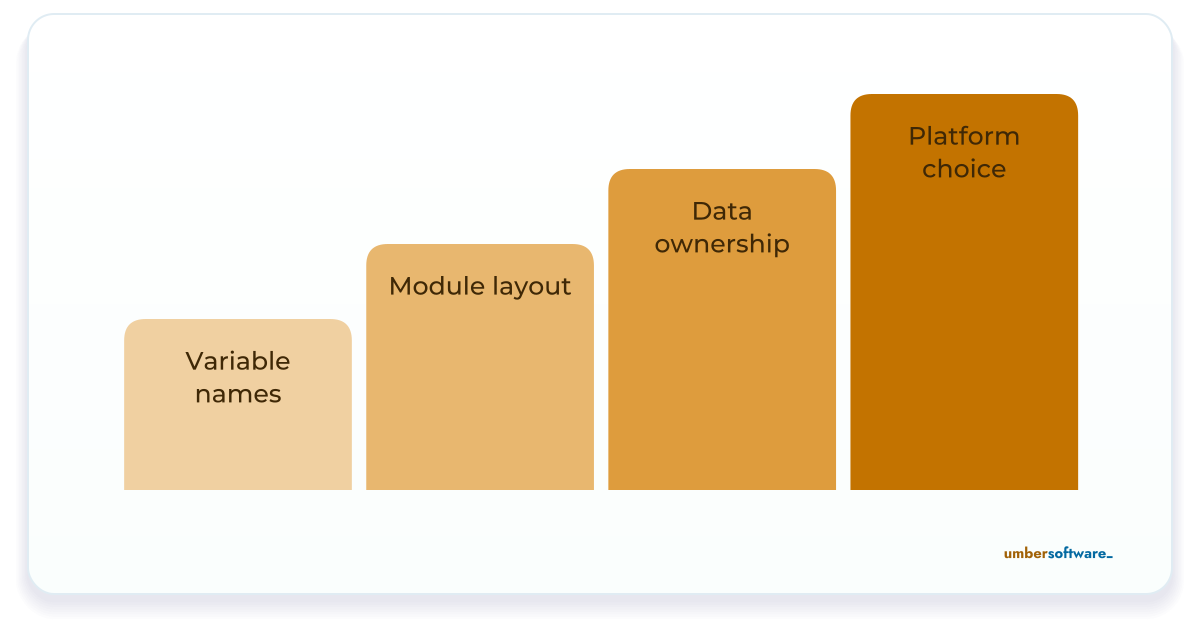
Architecture is the set of decisions that are expensive to reverse. Spend your design time there, and leave cheap decisions to the teams. In a retail project I reviewed, the team had debated a logging library for weeks and picked the database in an afternoon. The database was the choice they regretted.
Do This
Write down the two or three changes you expect in the next 18 months, such as more tenants, a second region or a new payment provider, and test each design choice against them.
Avoid This
Designing for every imaginable future. Each extra extension point is code someone has to maintain.
Start With a Modular Monolith
A single deployable with strict internal boundaries gives you most of the benefit of services at a fraction of the operating cost. You can split a clean module out later. Splitting a tangled one is a painful project, and I have seen teams run it for a year.
Do This
Enforce module boundaries in code with explicit interfaces, and fail the build when one module reaches into another's internals.
Avoid This
Adopting microservices because a conference talk did. A team of eight running twenty services spends its week on plumbing.
Keep Dependencies Pointing One Way
Circular dependencies are the quiet killer of change speed. When module A needs B and B needs A, you cannot test, replace or deploy either alone. Business rules should depend on nothing, and technical details such as databases and frameworks should depend on the rules.
Do This
Draw the dependency graph once a quarter and remove every cycle you find. Automated checks catch new ones the day they appear.
Avoid This
A shared utility module that grows until every part of the system imports it.
Give Each Data Set One Owner
When three services write the same table, nobody can change its shape. Ownership turns data into a contract. Others read it through an interface, an event or a replica, and the owner stays free to change what is behind it.
Do This
Name an owning module for every table and expose reads through a defined interface.
Avoid This
Reporting queries that join across every owner's tables directly. Use a read replica or a separate reporting store instead.
Make Integrations Fail Loudly
Most outages I investigate begin at an integration: a slow partner API, a changed field, an expired certificate. The painful ones are silent, where data stops flowing and nobody knows for two days.
Do This
Set timeouts, retries with backoff and an alert on every external call. Keep a dead-letter queue so failed messages can be replayed.
Avoid This
Calling a third-party service in the middle of a user request with no timeout.
Automate the Path to Production
A deployment that depends on a person's memory will eventually go wrong. Fast, boring releases are also the best risk control you have, because each change is small and easy to reverse.
Do This
Build once, deploy the same artifact everywhere and keep a rollback you have actually tested this quarter.
Avoid This
Manual steps that live in one person's head, or a staging environment that differs from production in ways nobody has listed.
Build Observability In From the Start
You cannot fix what you cannot see. Logs, metrics and traces are architecture, not extras, because they decide how fast you find the cause of a problem at three in the morning.
Do This
Give every request an ID that travels through all components, and define a few service-level targets such as response time and error rate.
Avoid This
Dashboards with sixty graphs and no alerts. Pick the handful of signals that tell you users are hurting.
Decide Security at the Boundaries
Retrofitting security is far more costly than designing it in. Identity, access rules and secrets handling cut across every part of the system, so they belong in the architecture, not in each team's judgment.
Do This
Use central identity, least-privilege access, secrets stored in a vault and a dependency scan in the pipeline.
Avoid This
Credentials in configuration files, or a flat internal network where every service can talk to every other.
Record Decisions in Short Notes
Six months after a design choice, nobody remembers why it was made. A half-page decision record, with the options considered and the reason for the choice, saves long arguments and keeps new developers from undoing good decisions.
Do This
Keep one note per significant decision in the repository, with date, context, options and consequences.
Avoid This
Long design documents that go stale after the first release. Short, dated notes stay true because they describe a moment.
Test the Architecture, Not Just the Code
Unit tests tell you a function works. They say nothing about whether the system survives a database failover or a traffic spike. Architectural properties need their own tests.
Do This
Add fitness checks to the pipeline for dependency rules and response times, and rehearse failure with a game day once or twice a year.
Avoid This
Assuming resilience because the diagram has two of everything. Pull the plug and find out.
Review the Architecture on a Schedule
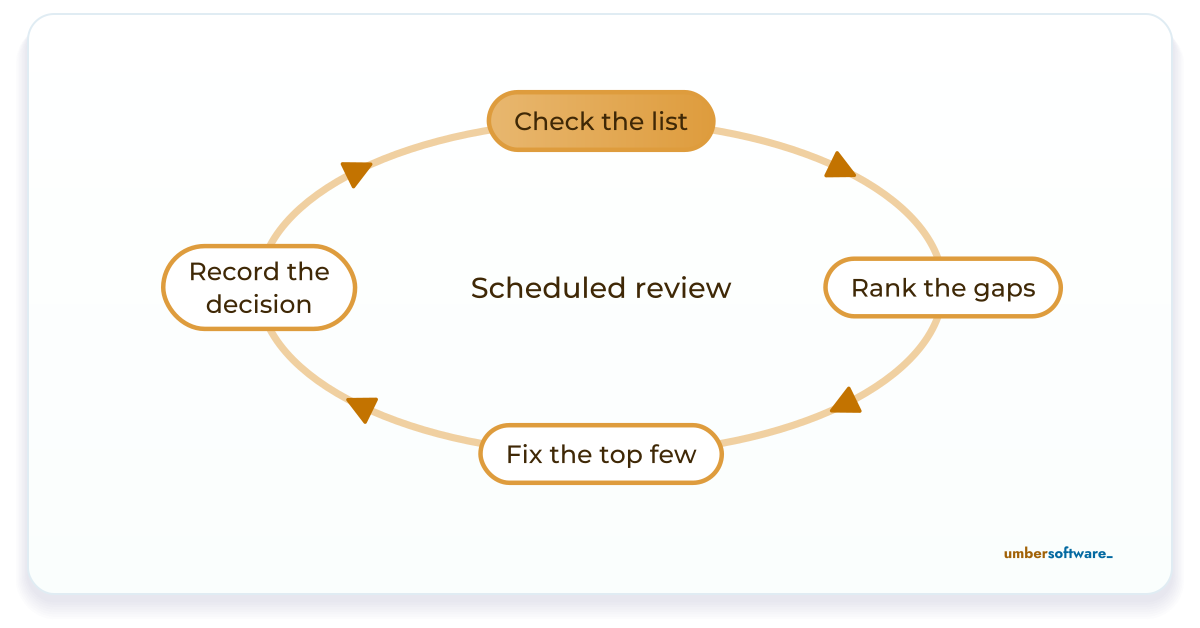
Systems drift. The design you approved two years ago has met new features, new people and shortcuts taken under deadline. A regular review keeps drift small enough to correct with ordinary work.
Do This
Run a light review twice a year using a fixed list, and a deeper one before any large change.
Avoid This
Waiting for an outage or a failed audit to look at the structure.
Several of these practices tie into things you can check item by item. The software architecture checklist turns them into eleven yes-or-no questions. The software architecture framework explains the layers that give the practices a place to live.
Why Teams Skip Good Practice, and What Changes Their Mind
Nobody argues against these practices in a meeting. They get skipped because of deadlines. A feature is due, the shortcut works today, and the cost lands on someone else next quarter. I have watched the same pattern in dozens of teams: the shortcut is taken once, copied twice and then treated as the way things are done.
What changes minds is a number. Show that a release takes nine days because three modules must change together, and the argument for clean boundaries makes itself. Show that the last four incidents began at the same partner API, and a timeout policy gets approved the same afternoon. Keep your evidence small and specific, and avoid presenting a grand redesign.
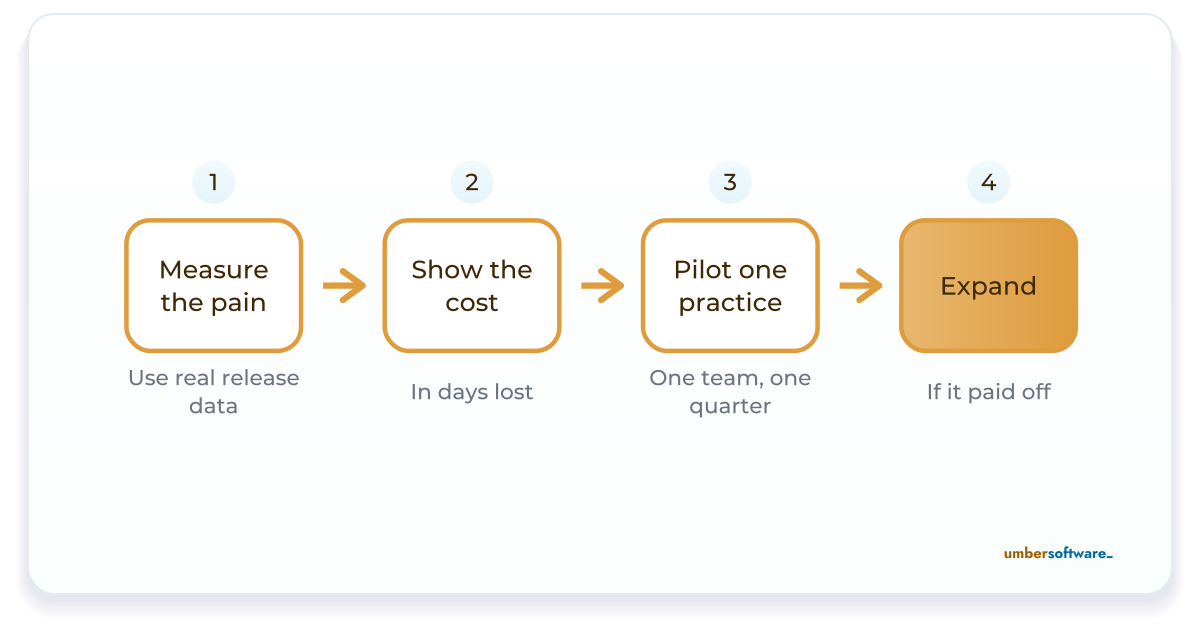
Budget matters too. Reserve a fixed share of every sprint, often around fifteen to twenty percent, for structural work, and protect it the way you protect time for bug fixes. Teams that wait for a quiet period never find one. If you want help sizing that share against your roadmap, the software architecture tools ranking also lists products that measure drift for you, so the case for the work can rest on data rather than opinion.
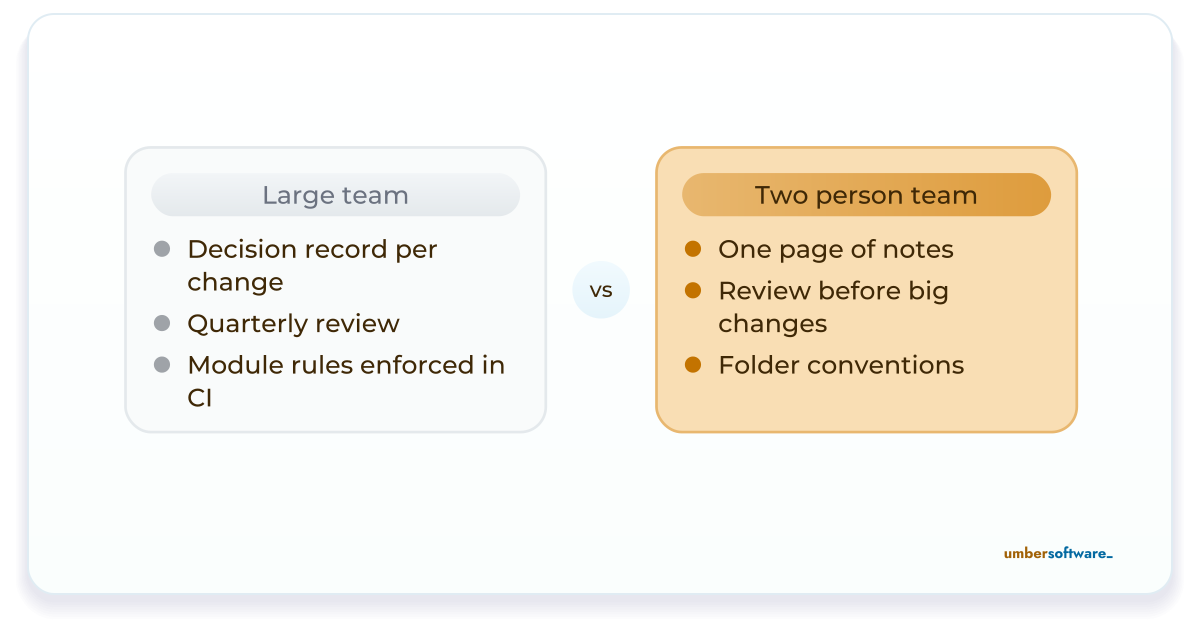
Finally, accept that some practices will not fit. A two-person product team does not need a game day or a formal review schedule. Adapt the rhythm to the size of the team and the cost of failure. The point is to keep change cheap, and a practice that adds more cost than it removes has missed that point.
Picking Your First Step
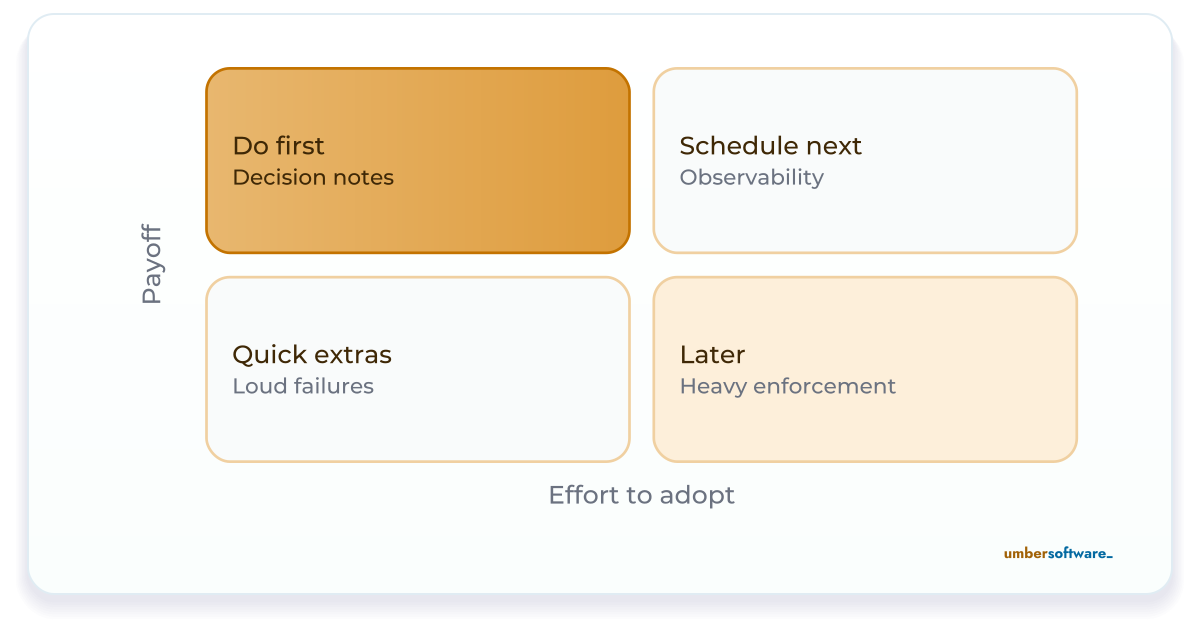
You will not adopt eleven practices in a quarter. Pick by pain. Slow, risky releases point to practice six. Frequent outages from partner systems point to five and seven. A team that cannot change the database points to four.
- Choose the practice that removes your most expensive recurring problem.
- Apply it to the module that changes most often, not to the whole system.
- Measure one number, such as lead time or incident count, before and after.
- Keep the practice only if the number moves.
Some of the practices call for tools, for example dependency checks or tracing. Pick tools after you pick the practice, and prefer ones your team can run without a specialist.
Questions About Software Architecture Best Practices
What Are the Most Important Software Architecture Best Practices?
If you can only do three, pick clear module boundaries, one owner per data set and an automated path to production. Those three keep change cheap, which is the main reason architecture matters at all. The rest of the list builds on them.
Should We Use Microservices?
Only when you have a reason that a modular monolith cannot meet, such as teams that must deploy independently or parts that need very different scaling. Microservices add network failures, versioning and operational work. Teams under roughly fifteen engineers rarely get a net benefit.
How Much Architecture Documentation Is Enough?
Enough that a new developer can draw the main parts and their dependencies after a week. In practice that means one current-state diagram, short decision records and a page on how to deploy and roll back. More than that tends to go stale.
Who Should Own the Architecture?
Give it to a small group of senior engineers who also write code in the system. A separate architect who never touches the code drifts away from reality. The group should have the authority to say no to changes that break the agreed boundaries.
How Do We Introduce These Practices into an Existing System?
Pick one practice and one area. For example, remove dependency cycles in the module that changes most often. Show the gain in release speed or fewer bugs, then move to the next. A big-bang cleanup rarely survives the next deadline.
How Often Should We Review Our Architecture?
Twice a year for a light review is a good rhythm, with a deeper one before any major change such as a migration or a new product line. After a serious incident, review the part involved while the details are fresh.
Do Best Practices Differ for Small Teams?
The principles stay the same, but the tooling changes. A small team gets the same benefit from a modular monolith, a simple pipeline and decision notes without a platform group. Skip anything that needs a dedicated person to maintain it.
Please note: this guide is general information and not legal, financial or tax advice. Numbers and examples are typical-project estimates; confirm current details with your providers and advisers.
Did this article help you?
Thanks, noted.
Whitney Sorensen
Whitney leads the Umber editorial team and works with the consultants to turn real client projects into practical guides on software selection, custom development, integration and legacy modernization. Before joining Umber, she spent years writing and editing for engineering and IT teams. She has since reviewed architecture audits, system selections and modernization plans from client projects across industries from manufacturing to healthcare. She works remotely from the USA.