Main Points
- Run every software project through six steps: charter, delivery model, plan, governance, execution and review.
- Write down the stop rules in the charter, before the budget is spent.
- Keep five short artifacts and update them weekly, because stale documents are worse than none.
- Treat the team method, whether Scrum or Kanban, as a choice inside the framework.
Most software projects do not fail in the code. They fail in the gaps around it: nobody agreed what done means, the sponsor changed their mind in month three, and the status report said green until the week it turned red. A framework closes those gaps with a few fixed decisions made in a fixed order. It is the structure behind my team’s software project management consulting, reduced to what one person can run.
The model has six steps. Each one has a question, an owner and an artifact. I describe them briefly, show how they fit together in a table and then cover the places where projects usually slip.
The Six Steps at a Glance
Work in order the first time. Once you know the steps, you can revisit any of them when something changes.
| Step | What it answers | Artifact | Owner |
|---|---|---|---|
| 1. Charter | Why does this project exist and when does it stop? | One-page charter with stop rules | Sponsor |
| 2. Delivery model | How will the work be organized? | Model choice with reasons | Project lead |
| 3. Plan | What is in scope, in what order, at what cost? | Delivery plan with estimates | Project lead |
| 4. Governance | Who decides, and how often do they look? | Decision and risk log | Steering group |
| 5. Execution | Is the work on track today? | Weekly status note | Team |
| 6. Release and review | Is it safe to ship, and what did the team learn? | Release checklist and review | Project lead |
Step 1: A Charter With Stop Rules
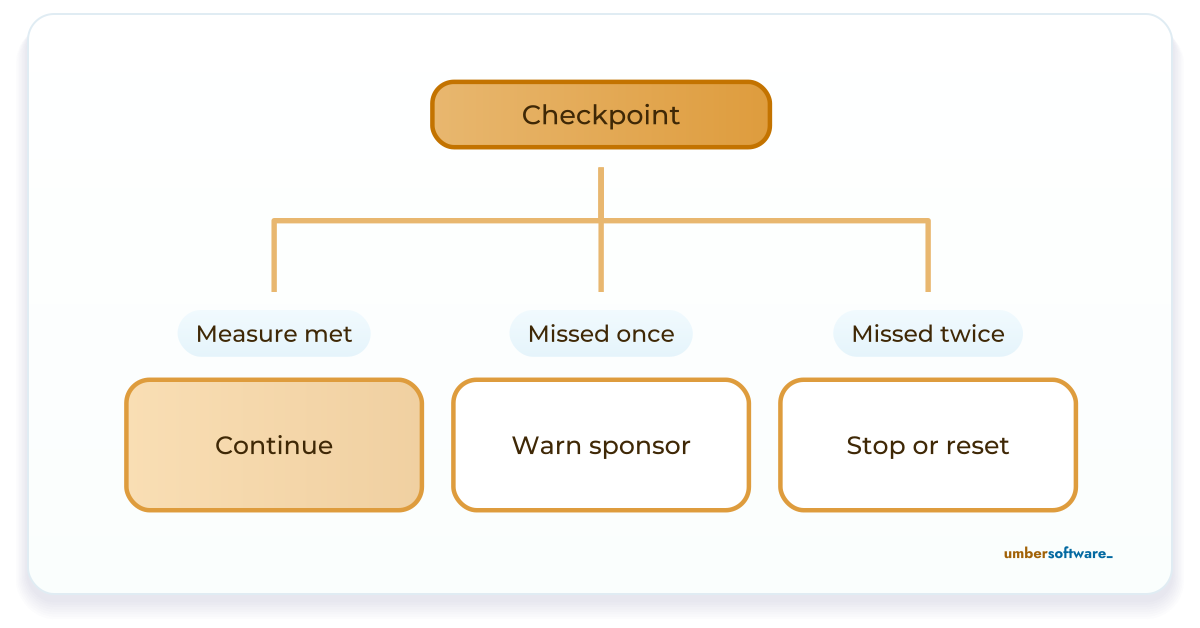
The charter is one page. It names the business outcome, the sponsor, the budget ceiling, the date that matters and the people who must say yes before launch. Add two or three stop rules, for example: stop if the forecast cost passes the ceiling by 20 percent, or if the pilot group does not use the first release within two weeks.
Stop rules feel pessimistic and they save more money than any other line on the page. In my client work, the projects that ran far over budget almost always had a point where everyone privately doubted the plan and nobody had permission to say so. A written rule gives that moment a name.
Step 2: Choose the Delivery Model on Purpose
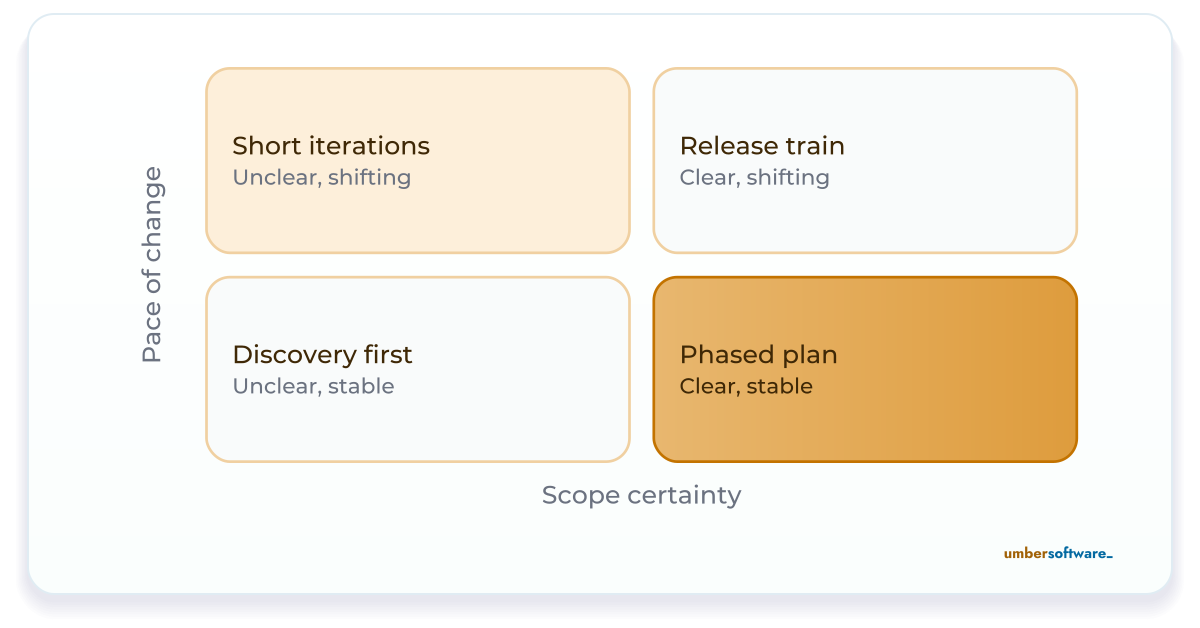
Pick the way the team will work and write down why. A fixed-scope contract or a regulatory deadline points toward a phased plan. Unclear requirements and a user group you can reach every week point toward iterative delivery. Many projects use a short fixed discovery phase, then iterative build, then a fixed hardening phase before release.
The point of this step is to stop the model from being picked by habit. A team that always runs Scrum will run Scrum on a data migration with a fixed cutover date, and the sprints will fight the calendar. If you want a deeper look at what each method does best, the software project management best practices cover it in detail.
Step 3: Plan Scope, Order and Cost Together
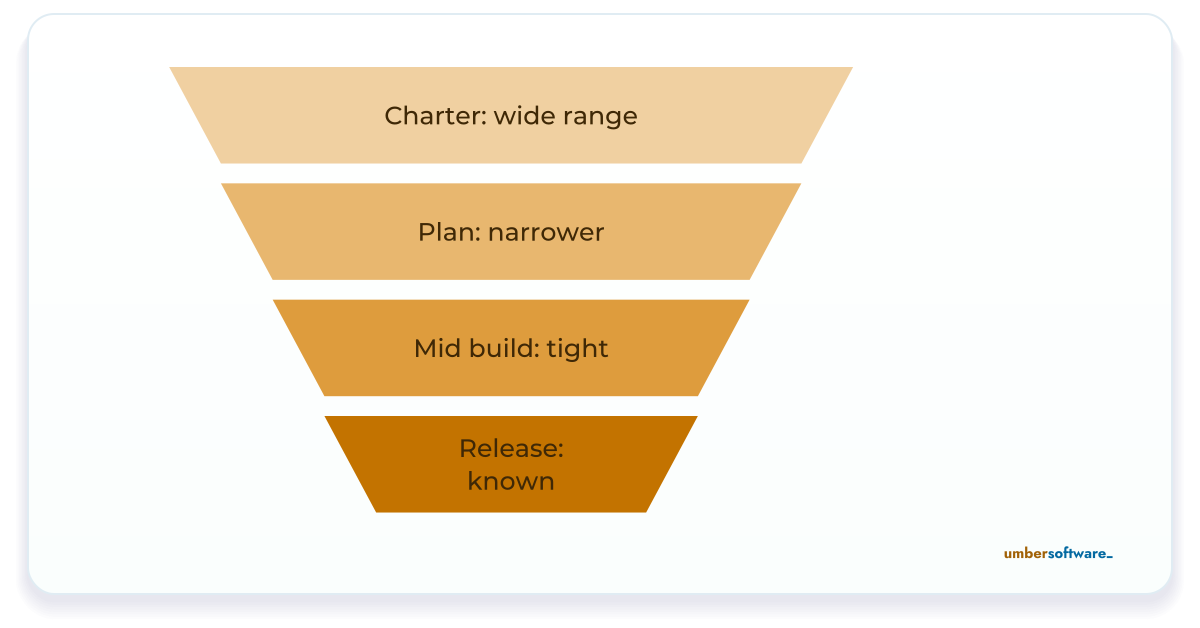
A plan has three parts that must agree: what is in scope, the order of delivery and the estimate. Start with the smallest release that gives the sponsor a real result. List everything else as later releases, each with a rough size. People will ask for the later items on day one, and a visible list lets you say "yes, in release three" without a fight.
For estimates, use ranges, not single numbers. A task that takes three to eight days is honest. A task that takes "five days" is a guess wearing a costume. Add the range up, and report the total as a range as well. As the project learns, the range narrows, and the sponsor sees it narrowing.
| Plan element | What to write | Common mistake |
|---|---|---|
| First release | Smallest slice with a real user result | A "foundation" release no one can use |
| Later releases | Named items with rough size | An unsized wish list |
| Estimates | Low and high value per item | One number with no range |
| Dependencies | Teams, vendors and data you wait on | Assuming others are ready |
| Buffer | A visible reserve, owned by the project lead | Hidden padding in every task |
Step 4: Governance That Fits on a Calendar
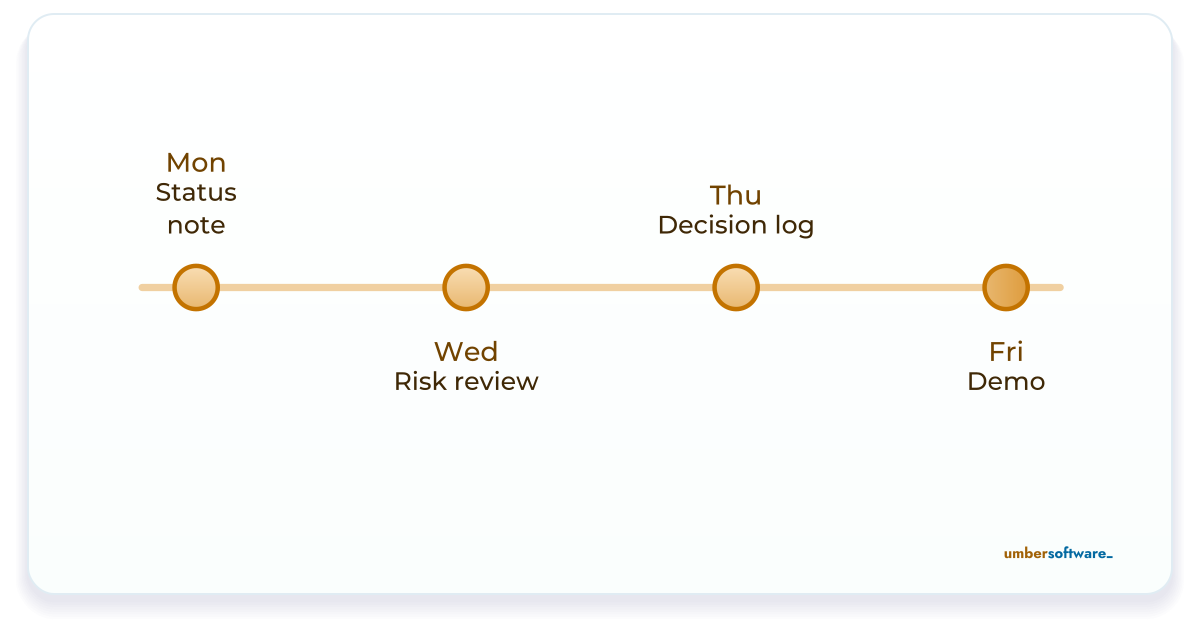
Governance is who decides and how often. For most projects that means a steering group of three or four people that meets every two weeks for thirty minutes, with a decision and risk log on screen. Every risk has an owner and a date. Every decision has a name next to it, so that nobody has to reconstruct who agreed to what in month five.
Keep the group small. A steering meeting with twelve people produces opinions, and a meeting with three produces decisions. If extra stakeholders need information, send them the weekly note instead of an invitation. Many of the problems I describe in software project management challenges, such as scope creep and unclear ownership, shrink once the log exists.
Step 5: Execution and the Weekly Status Note
During execution, the framework asks for one thing: an honest weekly note of about 150 words. It has four lines: what finished, what is next, what is blocked and what changed in the forecast. The forecast line is the one people skip, and it is the one the sponsor needs.
Track work in whatever tool the team likes. Tool choice matters less than whether the board matches reality every morning. If you are still shopping, my list of software project management tools looks at the main choices. Judge progress by working software that a user can try, because tasks marked complete tell you only that someone clicked a button.
Step 6: Release Checks and a Short Review
Before release, run a checklist and keep it the same for every project: tests passed, data migrated and verified, rollback plan written, support briefed, users informed and the sponsor's sign-off recorded. A fixed list prevents the Friday afternoon release that someone regrets on Monday. The software project management checklist expands each item into questions you can answer yes or no.
Two weeks after release, hold a review of one hour. Compare the result with the charter: did the outcome happen, what did the project cost against the range and which estimate was furthest off? Write three changes for the next project and put them into the templates. This is where the framework gets better, because every project teaches it something.
Who Does What Inside the Framework
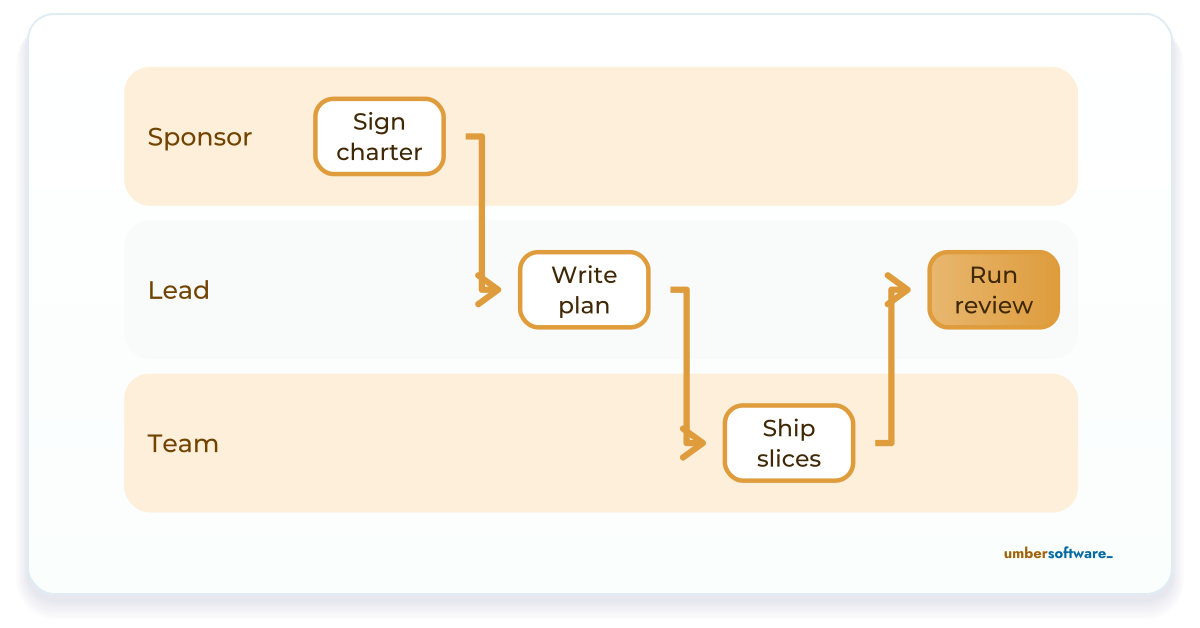
Four roles cover almost every project. The sponsor owns the outcome and the budget, and answers questions about priorities within a day or two. The project lead owns the plan, the status note and the release checklist. The team lead owns the quality of the work and the estimates. Users or their representatives test early versions and say what is wrong with them while it is still cheap to fix.
In small projects one person holds two roles, and that is fine as long as the sponsor and the project lead are different people. When one person is both, nobody can say no to a request, and the stop rules from step 1 lose their force. Write the names into the charter so that everyone knows who decides.
Fitting the Framework to Your Size
The six steps scale down and up. A team of five can run them in one shared document and a fifteen-minute weekly call. A company with a dozen concurrent projects needs the same artifacts in the same format, plus a monthly portfolio review that looks at every charter side by side.
- One team, one project: combine steps 1 to 3 into a single kickoff and skip the formal steering group.
- Several teams, one product: add the decision log and a fortnightly steering meeting.
- Many projects: add a portfolio view and run the same status note across all of them.
- External vendor involved: put the stop rules and the acceptance criteria into the contract.
Adopt the framework one project at a time. Run it on the next project that starts, collect the feedback at the review and adjust the templates before the second project. Forcing it onto every running project at once wastes goodwill and gives you noisy results.
Choosing Where to Begin
Pick the step that hurts most today. If projects start without a clear reason, begin with the charter. If estimates always miss, start with step 3. If surprises arrive late, start with the weekly note and the risk log. You do not need all six on day one, but the charter and the weekly note are the cheapest two and cover most of the damage.
If you want someone to run the first cycle with you, set up the templates and coach the project lead, a short call will tell you how much outside help the first project needs.
Questions About Software Project Management Frameworks
What Is a Software Project Management Framework?
It is a repeatable structure for running software projects: how work is scoped, who decides, how progress is tracked and when a project is allowed to continue. It sits above the delivery method. Scrum, Kanban or a plain phase plan can all run inside the same framework.
Is a Framework the Same as Scrum or Waterfall?
No. Scrum and Waterfall describe how a team does its work. A framework also covers what happens around the team, such as funding, risk reviews, release approval and reporting to sponsors. Most companies I work with use a team method inside a lightweight framework like the six steps below.
How Long Does It Take to Put the Framework in Place?
A small company can apply all six steps to one project in a two-hour kickoff plus a few short working sessions. Rolling it out across a portfolio of projects takes a quarter, because people need one full cycle to see the rhythm and fix the templates.
Which Delivery Method Should I Pick Inside the Framework?
Use iterative delivery when requirements will change and you can release often. Use a phased plan when scope is fixed by a contract or regulation. Many projects mix both, with a fixed discovery phase followed by iterative build. The framework works for either, as long as the step 2 decision is written down.
How Much Documentation Does the Framework Need?
Five short artifacts are enough: a one-page charter, a delivery plan, a risk and decision log, a weekly status note and a release checklist. If a document is never read or updated, drop it. Short artifacts that people keep current beat long ones that go stale in a month.
Can the Framework Handle Several Projects at Once?
Yes. Give every project the same charter and the same weekly status format, then review them side by side every two weeks. Shared formats let you compare projects and move people between them without a retraining week.
When Should I Stop a Project Instead of Fixing It?
Set the stop rules in step 1, before emotion is involved. Typical triggers are a forecast cost above the approved ceiling, a key assumption proven wrong or a sponsor who no longer has a use for the result. A project that meets a stop rule gets a decision meeting within a week.
Please note: this guide is general information and not legal, financial or tax advice. Numbers and examples are typical-project estimates; confirm current details with your providers and advisers.
Did this article help you?
Thanks, noted.
Whitney Sorensen
Whitney leads the Umber editorial team and works with the consultants to turn real client projects into practical guides on software selection, custom development, integration and legacy modernization. Before joining Umber, she spent years writing and editing for engineering and IT teams. She has since reviewed architecture audits, system selections and modernization plans from client projects across industries from manufacturing to healthcare. She works remotely from the USA.