Main Points
- ROI needs the full five-year cost, not just the license price.
- Count only benefits with a named owner and a baseline number.
- Ramp benefits after go-live and run a downside case before you commit.
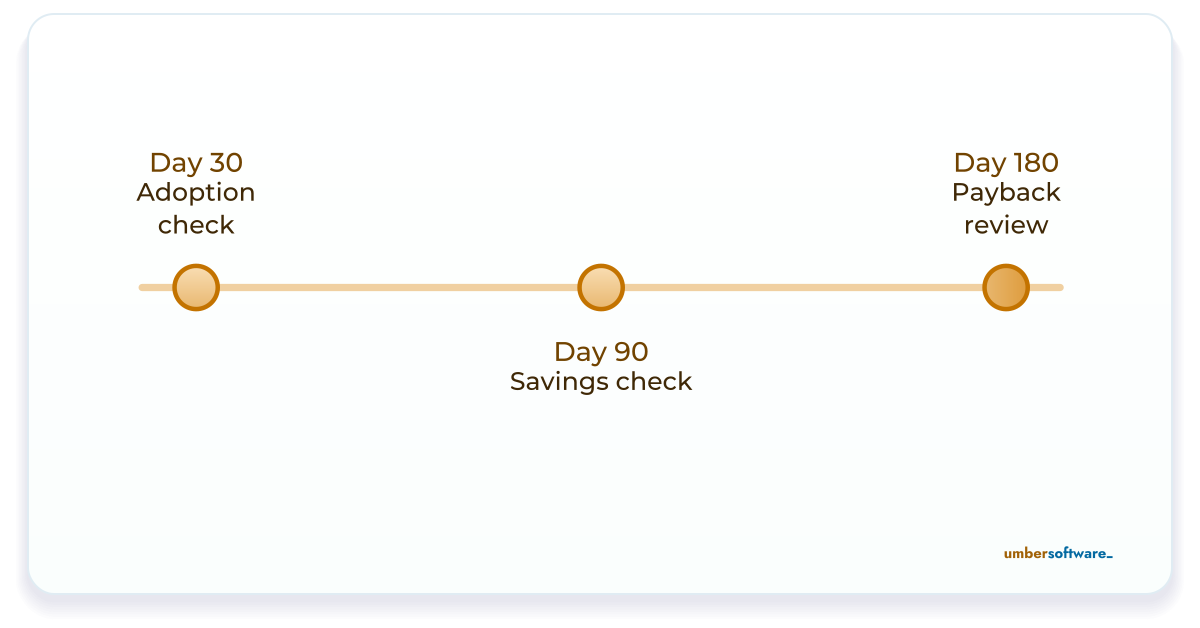
- Review results at 30, 90 and 180 days against the business case.
Ask five ERP vendors about return on investment and you will hear five confident numbers, none of which you can check. The honest answer is that ERP returns are real, uneven and easy to overstate. In my ERP software consulting reviews, the projects that proved their return had one thing in common: the business case was written down before the contract was signed and measured afterward.
This guide gives you the formula, the sources of return worth counting, a worked example with payback and a calculator for a first estimate. I explain where to be skeptical, too.
The ERP ROI Formula
Keep the formula plain. Annual net benefit equals the yearly value of the benefits minus the yearly running cost. Payback in months equals the one-time project cost divided by the monthly net benefit. Five-year ROI equals total benefits minus total costs over five years, divided by total costs.
The costs side must be the full five-year total: subscription, implementation, integrations, training, internal time and support. My guide to ERP software cost shows how to build it. A return calculation that uses only the license price is the most common mistake I see, and it flatters the project by half or more.
Where ERP Returns Actually Come From
Benefits fall into five groups. The table shows how to measure each one and how much confidence to place in it.
| Benefit | How to measure it | Confidence |
|---|---|---|
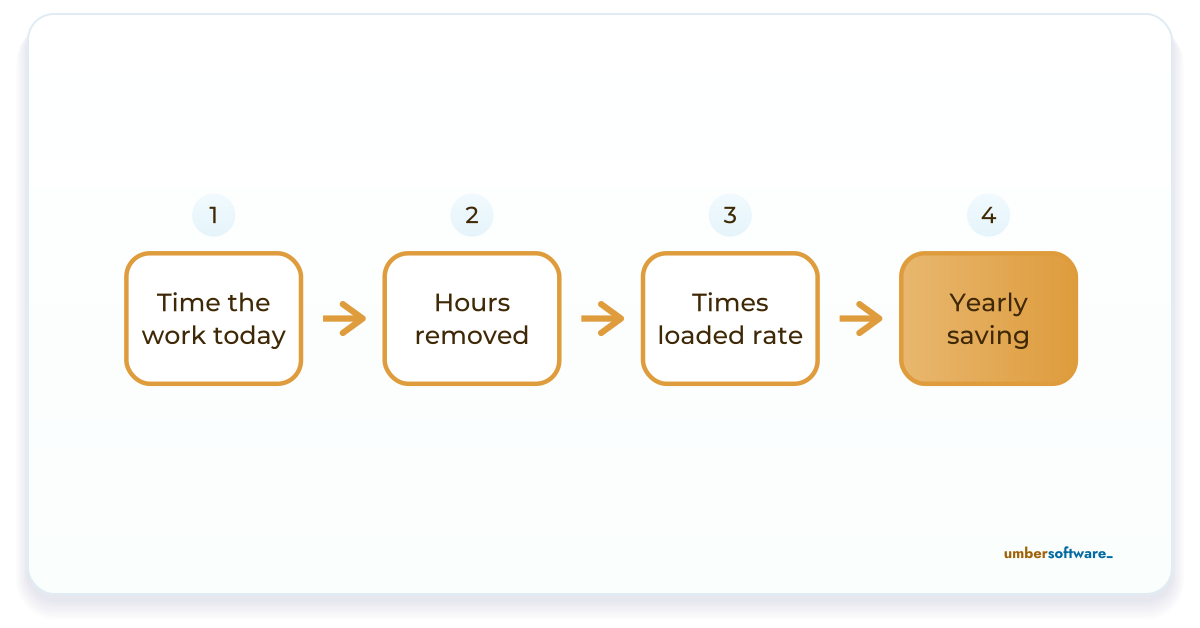
| Less manual re-entry and reconciliation | Hours per week removed times loaded hourly cost | High, if you time the work today |
| Faster close and reporting | Days saved in the close and hours of finance time | High |
| Lower inventory and fewer stockouts | Average stock value reduced times carrying cost; lost sales avoided | Medium, depends on planning discipline |
| Retired systems and licenses | Yearly fees of tools the ERP replaces | High, if you actually switch them off |
| Growth without added admin headcount | Roles you did not hire as volume rose | Low to medium; hard to prove |
Gartner predicts that finance teams using cloud ERP with embedded AI assistants will close their books 30 percent faster by 2028, and notes that most CFOs are still early in adoption, with data quality and skills gaps as obstacles. Treat that as a direction, not a number to put in your own case.
A Worked Example: A 120-User Distributor
This example is my own illustration, based on a typical mid-sized distributor. Replace each input with your numbers. Costs follow the ranges in my budget guide, and benefits are deliberately conservative.
| Item | Basis | Amount |
|---|---|---|
| One-time project cost | Implementation, integrations, training, internal time and 15% contingency | $640,000 |
| Yearly running cost | Subscription and support | $190,000 |
| Benefit: re-entry and reconciliation | 900 hours saved per month at $38 | $410,400 per year |
| Benefit: inventory reduction | $900,000 less stock at 20% carrying cost | $180,000 per year |
| Benefit: retired tools | Three legacy systems switched off | $72,000 per year |
| Total yearly benefit | Sum of the three | $662,400 |
| Yearly net benefit | Benefit minus running cost | $472,400 |
At full speed, payback is $640,000 divided by $472,400, or about 1.35 years. Benefits do not start at full speed, though. I ramp them: 25 percent in the first year after go-live, 75 percent in the second and 100 percent from the third. With that ramp, cumulative benefits pass cumulative costs around month 33 after go-live. Over five years, costs are $640,000 plus five years of $190,000 running cost, or $1,590,000. Ramped benefits are $165,600, $496,800 and then $662,400 for three years, or about $2,650,000. That is a five-year ROI of about 67 percent. Slightly different assumptions swing it by tens of points, so show your board the range, not one number.
Estimate Your Own Time Savings
Start with the largest and most reliable benefit: manual work. Enter the hours your team spends each week on re-keying, reconciliations and chasing data, the share an ERP could remove, the loaded hourly cost and the monthly subscription you expect. The result ignores implementation cost, so compare it with your project budget afterward.
Does the Tool Make Sense for You?
Drag the sliders to reflect your tasks and the plan you want to compare.
Metrics Your Finance Chief Will Ask For
A board rarely asks for a formula. It asks four questions. What is the total cost over five years, and how sure are you? When does the project pay back, and what happens if it slips? Which benefits are measured today and which are hopes? What do we stop paying for? Prepare one slide for each, with the downside case on the same page as the base case.
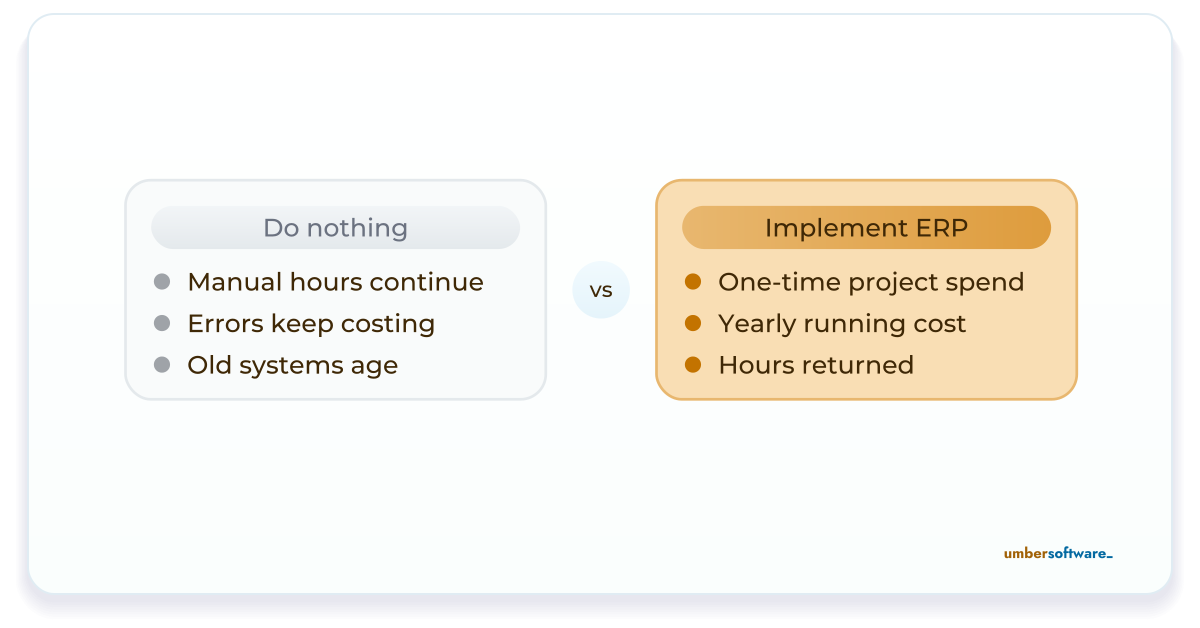
Add a view of the options. Doing nothing has a cost too: the manual hours keep growing with volume, and old systems get more expensive to maintain. A case that compares the ERP with a cheaper alternative, such as better integrations between existing tools, is more convincing than one that compares the ERP with nothing. If the cheaper path captures most of the benefit, take it and say so. Boards trust consultants and project leads who sometimes recommend less.
When the Return Is Negative
Some projects should not go ahead. If the manual work is small, the processes are stable and the old system still works, the return will be thin. I have advised clients to wait, fix a process, or buy a narrower tool. That advice costs a consulting fee and saves a project budget, which is a fair trade for the client.
Timing: Why Payback Looks Longer Than the Slide Says
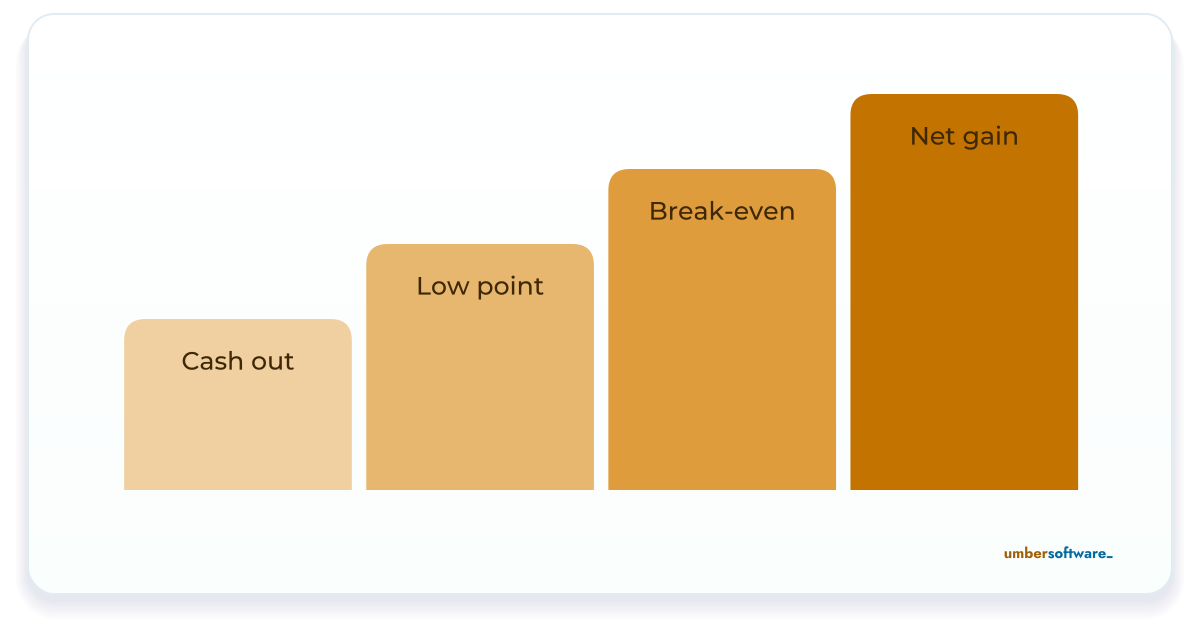
Vendor slides often show payback from go-live at full benefit. Your cash flow starts at signing, runs through months of services spend and sees benefits only after people change habits. Plot cumulative cost and cumulative benefit by quarter, and you will see a dip before the curve climbs. The dip is deeper if the project overruns, and the climb is slower if training is thin.
Use the chart to answer one question: how much cash do you need to carry before the curve turns? A company with a strong balance sheet can accept a deep dip. A company with tight cash should shrink the first release so benefits start sooner.
Which Assumption Moves the Result Most
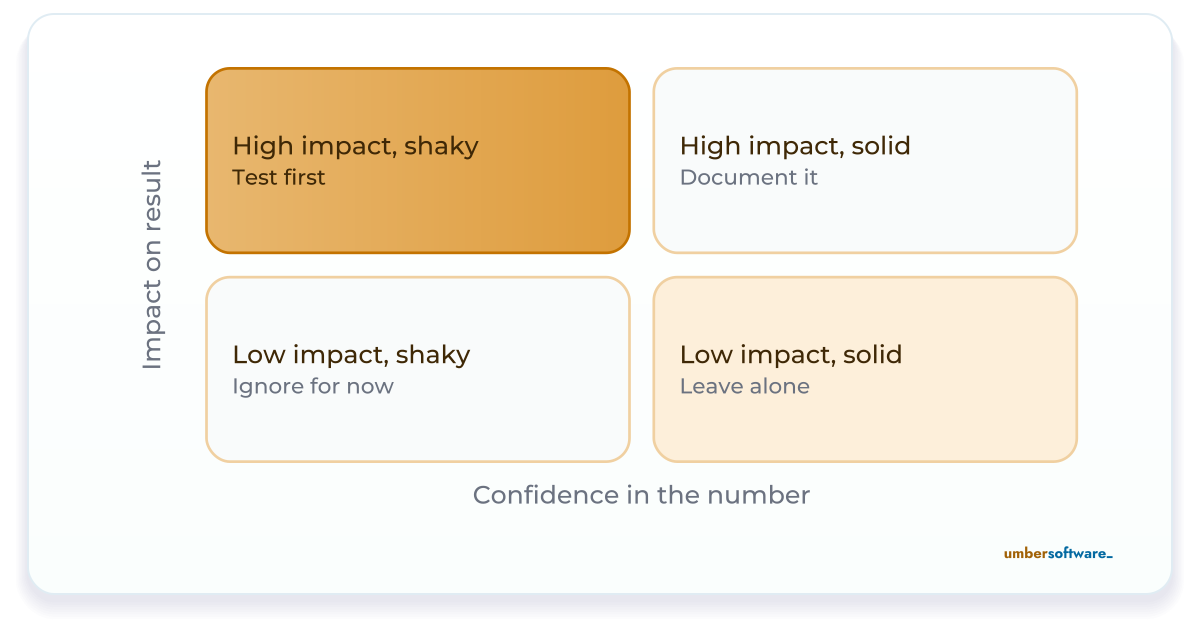
Run the worked example again with each input changed by 20 percent, one at a time. In the distributor case, the hours saved per month swing the result far more than the subscription price or the inventory reduction. A 20 percent drop in hours cuts yearly net benefit by about $82,000, while a 20 percent rise in running cost cuts it by $38,000. That tells you where to spend your validation effort: time the manual work before you sign, with a stopwatch and a sample of real weeks, instead of trusting an estimate from a workshop.
A sensitivity table of five rows takes an hour to build and answers the first question any skeptical director will ask. It also shows the vendor where you will challenge claims. Share the table with the partner, and ask them to commit to the benefit that moves the result most, for example by tying part of their fee to a measured reduction in manual hours after go-live.
Where to Be Skeptical
Vendor case studies show real results, but they are chosen. Treat them as proof of what is possible, not what is typical. Three claims deserve a harder look.
- Headline percentages for inventory reduction. They often compare a badly run warehouse with a well run one, so ask for the starting point.
- Headcount savings. Fewer people in finance is rarely the real outcome. The more common result is the same team handling more volume.
- Payback periods measured from go-live, not from signing. The first can be a year shorter than the second.
Panorama Consulting's 2026 ERP Report found that more than a quarter of organizations exceeded their project budgets. A project that overruns by a quarter moves payback by months. Run a downside case with costs 25 percent higher and benefits delayed by six months, and keep the project only if it still holds up.
How to Improve Your Return
Return is mostly decided in design and adoption. Three moves help the most. First, adopt standard processes where you can, because every customization adds cost at build, test and each upgrade. Second, clean your data early, since bad master data slows every benefit. Third, track adoption by behavior: are orders entered in the system, and is the close inside the target?
Review your results at 30, 90 and 180 days and compare them with the business case. Where a benefit is lagging, the cause is usually a process that was never switched over, not a missing feature. For trends that may add new benefits, see ERP software trends, and for platform choices that shape your cost side, my ranking of the best ERP software helps.
How to Build Your Business Case
- List the benefits above and name an owner and a baseline number for each.
- Build the five-year cost model with a 15 percent contingency.
- Ramp the benefits: low in the first year after go-live, full from year three.
- Run a downside case with higher cost and later benefits.
- Choose the smallest first release that captures the biggest benefits.
- Verify the vendor and contract details with the ERP software checklist.
If you run a small company, the same steps apply with fewer lines, and my guide to ERP software for small business shows what a lean case looks like.
Sources
Questions About ERP Software ROI
What Is a Good ROI for ERP Software?
There is no universal number, and published figures vary. In my reviews, well-run mid-market projects often reach payback between two and three years after signing, once benefits ramp up. Treat any vendor promise of a much shorter payback with caution, and test it against a downside case.
How Long Does It Take to See a Return from ERP?
Costs start at signing, but benefits start after go-live and ramp over one to two years as people change habits. Payback measured from go-live looks better than payback measured from signing. Ask which one anyone quotes to you.
How Do I Measure ERP ROI After Go-Live?
Record baselines before the project, such as hours on reconciliations, days to close and stock value. Measure the same numbers at 30, 90 and 180 days, and compare them with the business case. Behavior metrics, such as orders entered in the system, show adoption early.
Which ERP Benefits Are Easiest to Prove?
Time saved on manual re-entry and reconciliation, days saved in the close and fees from retired systems. All three can be timed or read from invoices. Inventory and growth benefits matter but depend on planning discipline and are harder to attribute.
Should I Include Intangible Benefits in the ROI?
I list them separately and do not put them in the number. Better visibility, easier audits and less dependence on key people are real, but a board will trust a case that stands on measurable benefits alone.
What Costs Do People Forget in ERP ROI?
Internal staff time, backfill, data cleanup, integrations, extra environments and renewal uplifts. Estimates put hidden costs at 15 to 30 percent of the real total. A return model without them looks better than the project will turn out.
Can a Small Business Get a Positive ROI from ERP?
Yes, if the scope is narrow and the manual work is real. Small firms have fewer seats to spread fixed costs over, so keep the first release lean and target the largest time sinks. A conservative case with a downside check is the best test.
Disclaimer: Figures and examples are my own illustrations based on typical projects, so check them against your own numbers and current vendor quotes. Nothing here is legal, tax or financial advice.
Did this article help you?
Thanks, noted.
Whitney Sorensen
Whitney leads the Umber editorial team and works with the consultants to turn real client projects into practical guides on software selection, custom development, integration and legacy modernization. Before joining Umber, she spent years writing and editing for engineering and IT teams. She has since reviewed architecture audits, system selections and modernization plans from client projects across industries from manufacturing to healthcare. She works remotely from the USA.