Main Points
- A framework defines who owns security, which controls apply at each stage and how you verify them.
- Six phases take a small team about four months, starting with ownership and scope.
- Put controls into settings and pipelines, since people forget policies but tools remember.
- Measure outcomes such as days to fix critical findings, not the number of scans run.
A software security framework is a repeatable model for deciding what to protect, how, and who checks. Without one, security work happens in bursts after incidents. With one, it becomes part of how the team ships. The model below comes from the engagements our software security consulting team runs, and it is designed for teams of 10 to 200 people who do not have a security department.
It borrows ideas from public references such as NIST SP 800-218 and the OWASP Software Assurance Maturity Model, and strips them down to six phases you can start this month. If you only need a fast list of basics, begin with the software security checklist and return here when you want structure.
The Six Phases in Short
| Phase | Timing | Finish line |
|---|---|---|
| Set Ownership and Scope | Weeks 1 to 2 | Owner named, scope list approved, one-page policy signed off. |
| Model Threats Early | Weeks 3 to 4 | One threat model per high-risk feature, with tickets for each finding. |
| Build Security Into Daily Work | Weeks 5 to 8 | Required review, pipeline scans, a coding guide of two pages or less. |
| Verify Before You Release | Weeks 9 to 12 | Security tests in the suite, release gate documented, first outside test booked. |
| Operate and Respond | Weeks 13 to 16 | Alerts wired to people, incident drill held, patch deadlines in force. |
| Measure and Refine | Ongoing, quarterly | Quarterly metrics review, six-month re-score, annual audit scheduled. |
The order matters. Ownership comes first because nothing else survives without it. Verification comes after building because there must be something to test. Measurement comes last and repeats, which turns the six phases into a loop.
Phase 1: Set Ownership and Scope
Timing: Weeks 1 to 2
Every framework collapses without an owner. Name one person accountable for software security, even if it is 20 percent of their time, and give them authority to block a release. Then list the systems in scope, ranked by the data they hold.
Write a one-page policy covering who owns decisions, which standard you follow and how exceptions get approved. Keep it short enough that developers will read it. The software security assessment gives you the starting score for this phase.
Finish line: Owner named, scope list approved, one-page policy signed off.
Phase 2: Model Threats Early
Timing: Weeks 3 to 4
Threat modelling sounds heavy, but a useful session takes 45 minutes. Draw the data flow of one feature, mark where data crosses a trust boundary and ask what could go wrong at each crossing. Write the answers as tickets.
Start with your riskiest feature, usually login, payments or file upload. You will find design flaws that no scanner can see, and fixing them in a diagram costs a fraction of fixing them in production.
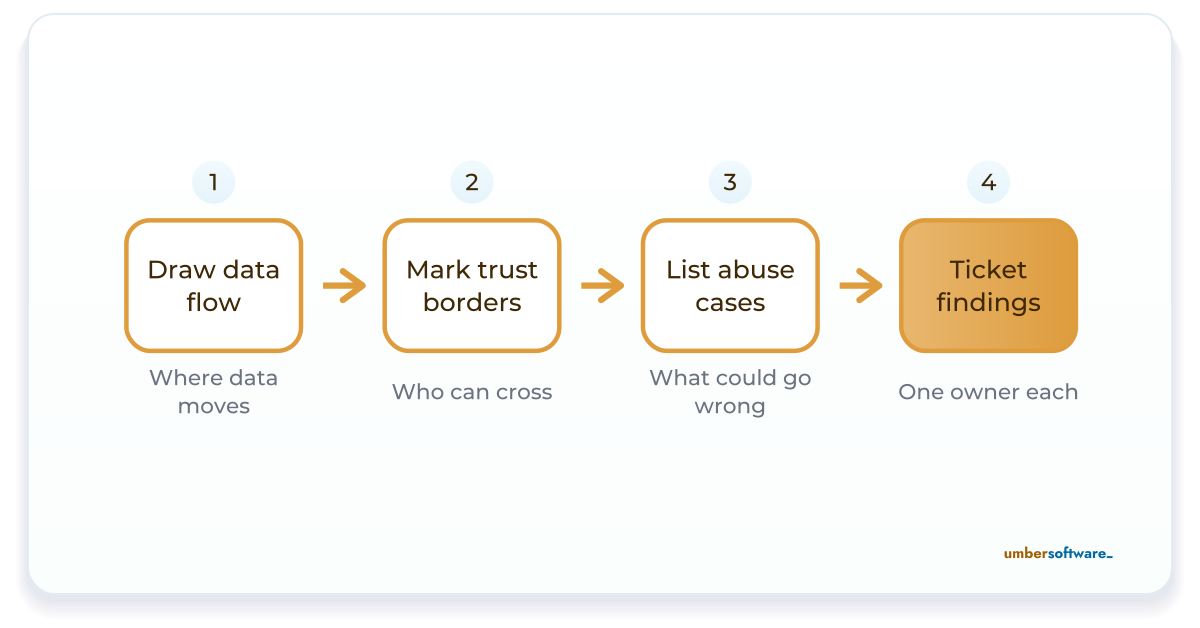
Finish line: One threat model per high-risk feature, with tickets for each finding.
Phase 3: Build Security Into Daily Work
Timing: Weeks 5 to 8
This is where the framework meets the developer's day. Require peer review, add automated dependency and secret scans to the pipeline, and publish a short secure coding guide for your stack. Keep the first rule set small.
Developers accept controls that give fast, clear feedback in the tools they already use. They resist ones that arrive as a PDF three weeks after the code shipped. The application security tools comparison helps you choose scanners that fit your pipeline.
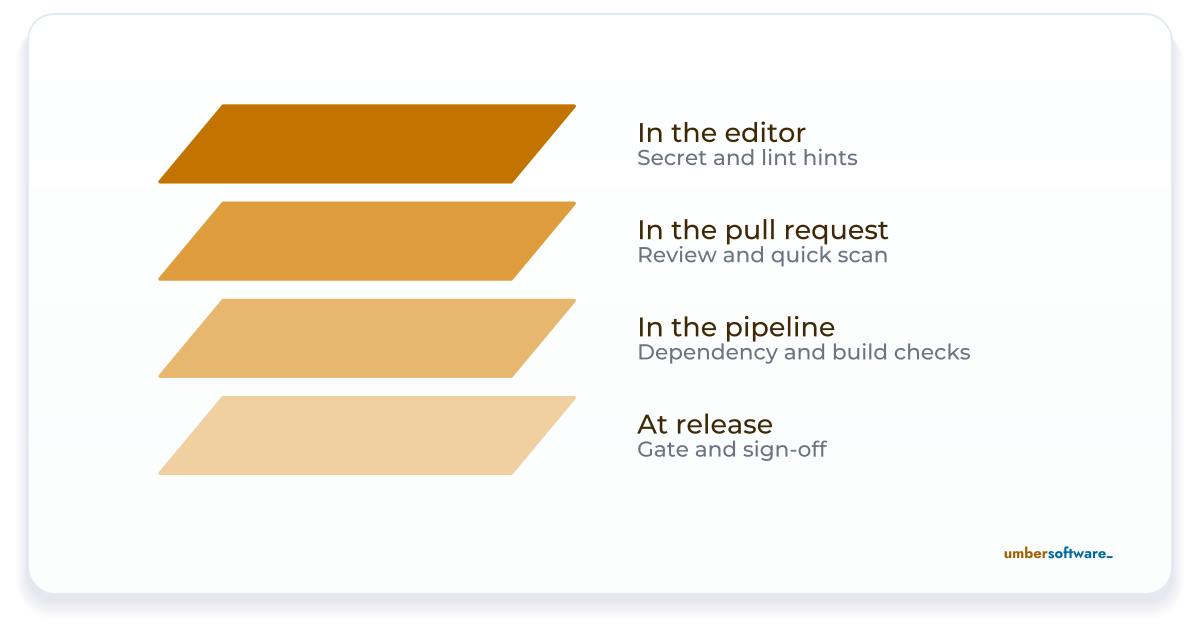
Finish line: Required review, pipeline scans, a coding guide of two pages or less.
Phase 4: Verify Before You Release
Timing: Weeks 9 to 12
Verification proves the controls work. Add security test cases to your automated suite, such as attempts to reach another user's data, and schedule an independent test for high-risk releases. Define a release gate: no open critical findings.
The gate is the part teams resist most, and it is the part that gives the framework teeth. Agree on it in advance, so nobody negotiates it at 5 p.m. on release day.
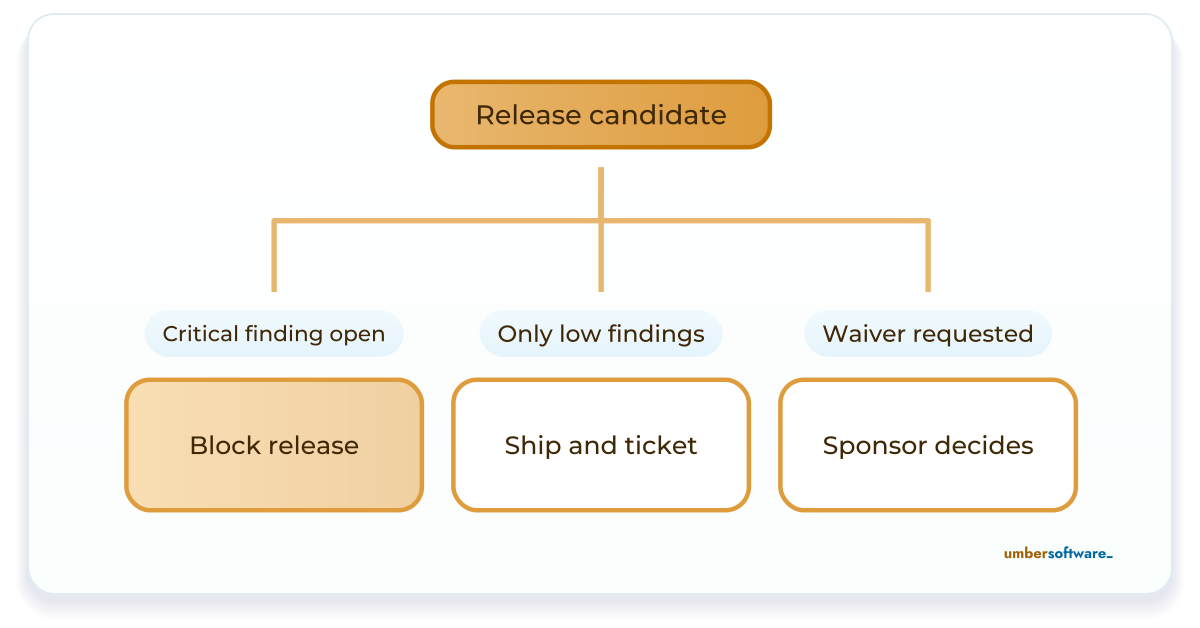
Finish line: Security tests in the suite, release gate documented, first outside test booked.
Phase 5: Operate and Respond
Timing: Weeks 13 to 16
Running software is where most incidents unfold. Log security events, alert on suspicious patterns and keep a short incident plan with named roles. Practice it once, so the first real use is not the first time anyone reads it.
Add a patch routine with deadlines by severity and track how long fixes take. Slow patching is a quiet risk that grows every month, as the software security risks article explains with real patterns.
Finish line: Alerts wired to people, incident drill held, patch deadlines in force.
Phase 6: Measure and Refine
Timing: Ongoing, quarterly
A framework earns its keep when it changes how you work over time. Pick three to five numbers: open critical findings, days to fix, percent of repositories with scans, and percent of releases that passed the gate. Review them quarterly.
Re-score yourself every six months and adjust the plan. Retire controls that nobody uses and add ones that incidents or audits show you need. A short security audit each year provides the outside check.
Finish line: Quarterly metrics review, six-month re-score, annual audit scheduled.
Who Does What Inside the Framework
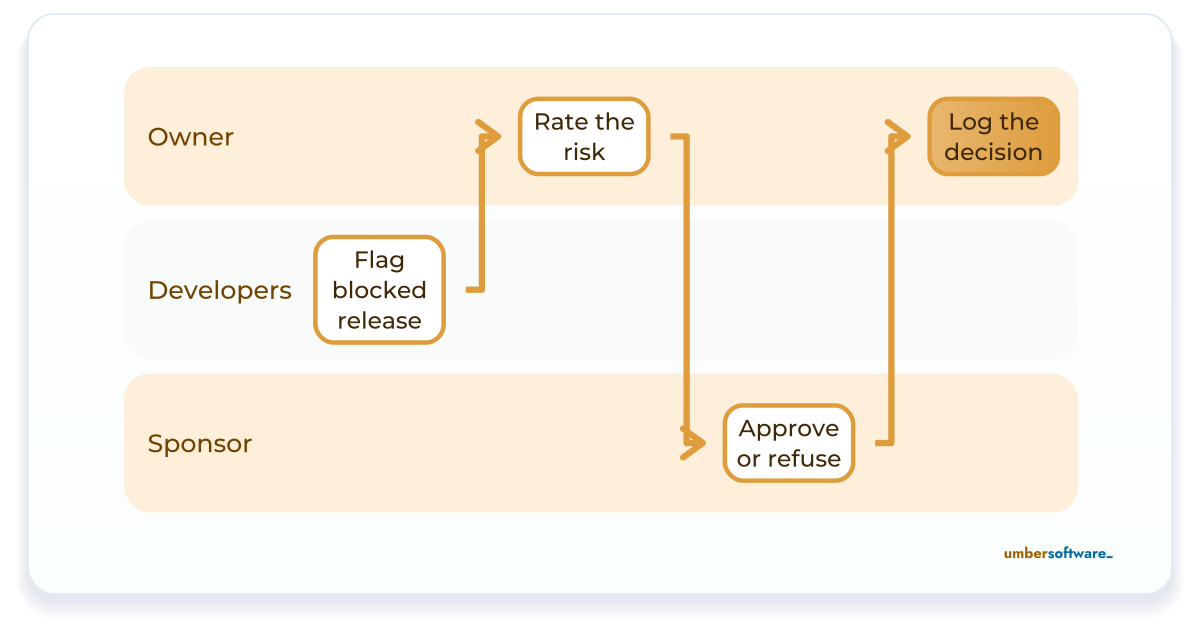
A framework needs clear roles, and four cover almost every case. The owner sets priorities and runs the quarterly review. Developers apply controls in their daily work. A reviewer, who can be a senior developer from another team, checks high-risk changes. A business sponsor, often the head of product or the CEO in a small company, backs the release gate when someone wants to bypass it.
The sponsor role is the one companies forget. The first time a deadline collides with a blocked release, someone with authority must say the gate stands. If that person was never part of the conversation, the gate disappears under pressure and the framework loses its credibility the same week.
| Role | Main duty | Time needed |
|---|---|---|
| Owner | Priorities, quarterly review, metrics | Two to four hours a week |
| Developers | Apply controls, fix findings | Built into normal work |
| Reviewer | Check high-risk changes and threat models | A few hours per release |
| Sponsor | Back the release gate, approve exceptions | One short meeting per quarter |
A 40-Person Company Rolling It Out
A healthcare scheduling vendor with 40 staff and three engineering squads used the six phases over one half-year. The head of engineering became the owner, and each squad named one champion. Week two produced a one-page policy. By week four they had threat-modelled the patient login and the calendar sharing feature, which surfaced two design flaws, both fixed in a single sprint.
The build phase took longer than planned. Their first pipeline scan produced about 600 alerts, and the team nearly abandoned it. They fixed that by turning on only the rules for critical issues and secrets, which cut the noise to under 30 items. Rules were added gradually over the following months.
The release gate went live in week eleven. Within two weeks it blocked a release that included a library with a known remote code execution flaw. The squad grumbled, upgraded the library in an afternoon and shipped the next morning. That single event did more to convince the team than any presentation had. At the six-month re-score, their maturity total moved from 6 to 11 out of 18.
Adapting the Model to Your Team Size
The same phases work at different scales. The difference lies in how much formality you add. A team of ten can run all six phases with one lead developer and a shared checklist. A team of two hundred needs named champions inside each squad and a small central group that maintains standards.
| Team size | Who owns it | Cadence | Where to keep it light |
|---|---|---|---|
| Up to 15 people | Lead developer, part time | Monthly review | Policy: one page; threat models: one per quarter |
| 16 to 60 people | Security champion in each team | Monthly team review, quarterly summary | Policy: two pages; templates for models |
| 61 to 200 people | Small central group plus champions | Monthly metrics, quarterly review | Automate every gate that can be automated |
Whatever the size, resist adding documents before you add habits. I have seen companies with a 40-page security policy and no required code review. The policy impressed an auditor for about a day.
The Only Documents You Need to Start
Teams often delay the framework while they write paperwork. Three short documents are enough for the first half year, and each should fit on a single page.
- A policy page naming the owner, the standard you follow and how exceptions are approved.
- A release gate page stating which findings block a release and who can grant an exception.
- An incident page with roles, contact numbers and the first three actions in order.
Everything else can wait until an audit, a customer or an incident shows you need it. Writing less also means you will keep the documents current, and an accurate one-pager beats a detailed document that describes last year's setup.
Pitfalls That Quietly Break a Framework
The biggest one is a framework that lives in a document and not in tooling. Every control that can be a setting or a pipeline step should be. People forget policies, and settings remember for them.
The second is a gate that is too strict too early. If your first rule blocks every release, people will find ways around it. Begin by blocking only critical issues, then tighten over several releases.
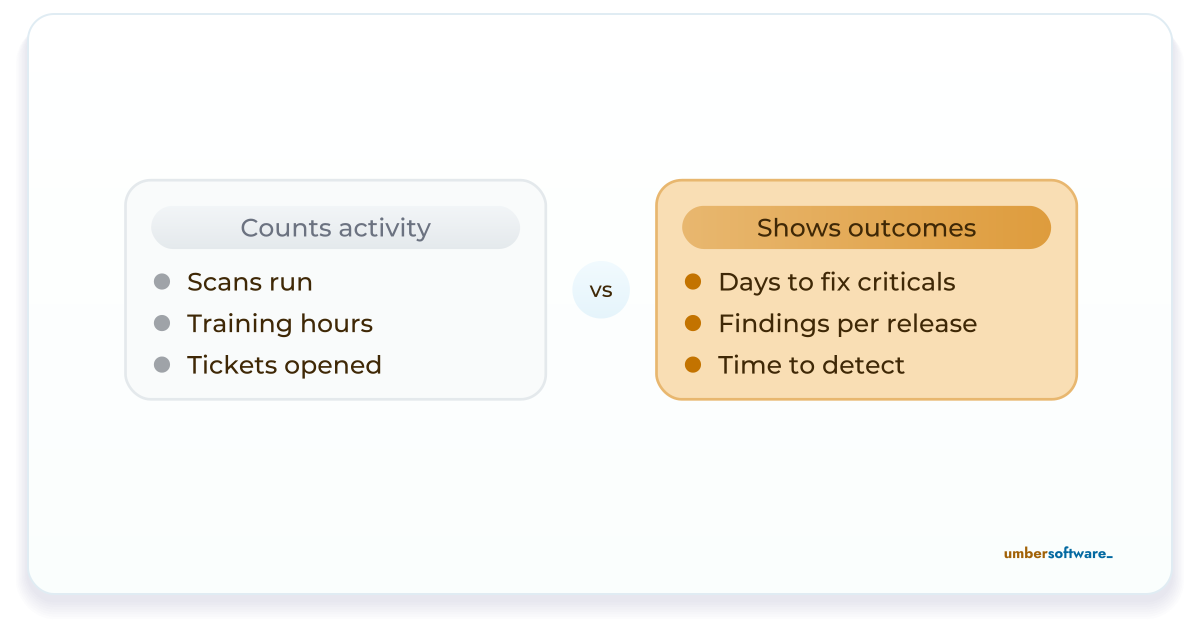
The third is measuring activity instead of outcomes. Counting scans run tells you little. Counting days to close critical findings tells you whether the work is landing.
How to Choose Between Frameworks and Starting Points
NIST SP 800-218 suits teams that want process-level guidance and need to answer government or large-enterprise customers. OWASP SAMM works well for self-assessment and showing progress. The CISA Secure by Design principles are a good orientation for product leaders who set priorities. You do not need to pick one forever, and the six phases above map to all of them.
- It names an owner and a review rhythm.
- Every control has a way to verify it.
- It produces a few numbers you can track.
- It fits on your team's calendar without a new meeting culture.
Questions About Software Security Frameworks
What Is a Software Security Framework?
It is a repeatable model that defines who owns security decisions, which controls you apply at each stage of development and how you check they work. It turns scattered security tasks into a routine.
How Long Does It Take to Set Up a Framework?
A working version of the six phases takes about four months for a small team, with ownership and policy in the first two weeks. Measurement and improvement then continue quarterly.
Which Framework Should I Choose?
Choose the one your customers name, or the one closest to how you build. NIST SP 800-218 gives process guidance, OWASP SAMM supports self-assessment, and the six-phase model here maps to both.
Do I Need a Full-Time Security Person?
Not at the start. A lead developer who spends a fraction of their time on ownership can run the first phases. Add dedicated staff when the team and the number of systems grow.
How Do I Get Developers to Follow It?
Put controls in the tools they use, keep rules few and clear, and give fast feedback. Developers resist late, vague and manual requirements more than strict ones.
What Should I Measure?
Track open critical findings, days to fix them, the share of repositories with automated scans and the share of releases that passed the gate. Review the numbers every quarter.
How Is a Framework Different from a Checklist?
A checklist lists controls to apply once. A framework defines ownership, a process and a review cycle, so the controls keep working over time and improve as your product changes.
Sources
- NIST SP 800-218, Secure Software Development Framework
- OWASP Software Assurance Maturity Model
- CISA Secure by Design
Please note: this guide is general information and not legal, financial or tax advice. Numbers and examples are typical-project estimates; confirm current details with your providers and advisers.
Did this article help you?
Thanks, noted.
Whitney Sorensen
Whitney leads the Umber editorial team and works with the consultants to turn real client projects into practical guides on software selection, custom development, integration and legacy modernization. Before joining Umber, she spent years writing and editing for engineering and IT teams. She has since reviewed architecture audits, system selections and modernization plans from client projects across industries from manufacturing to healthcare. She works remotely from the USA.